
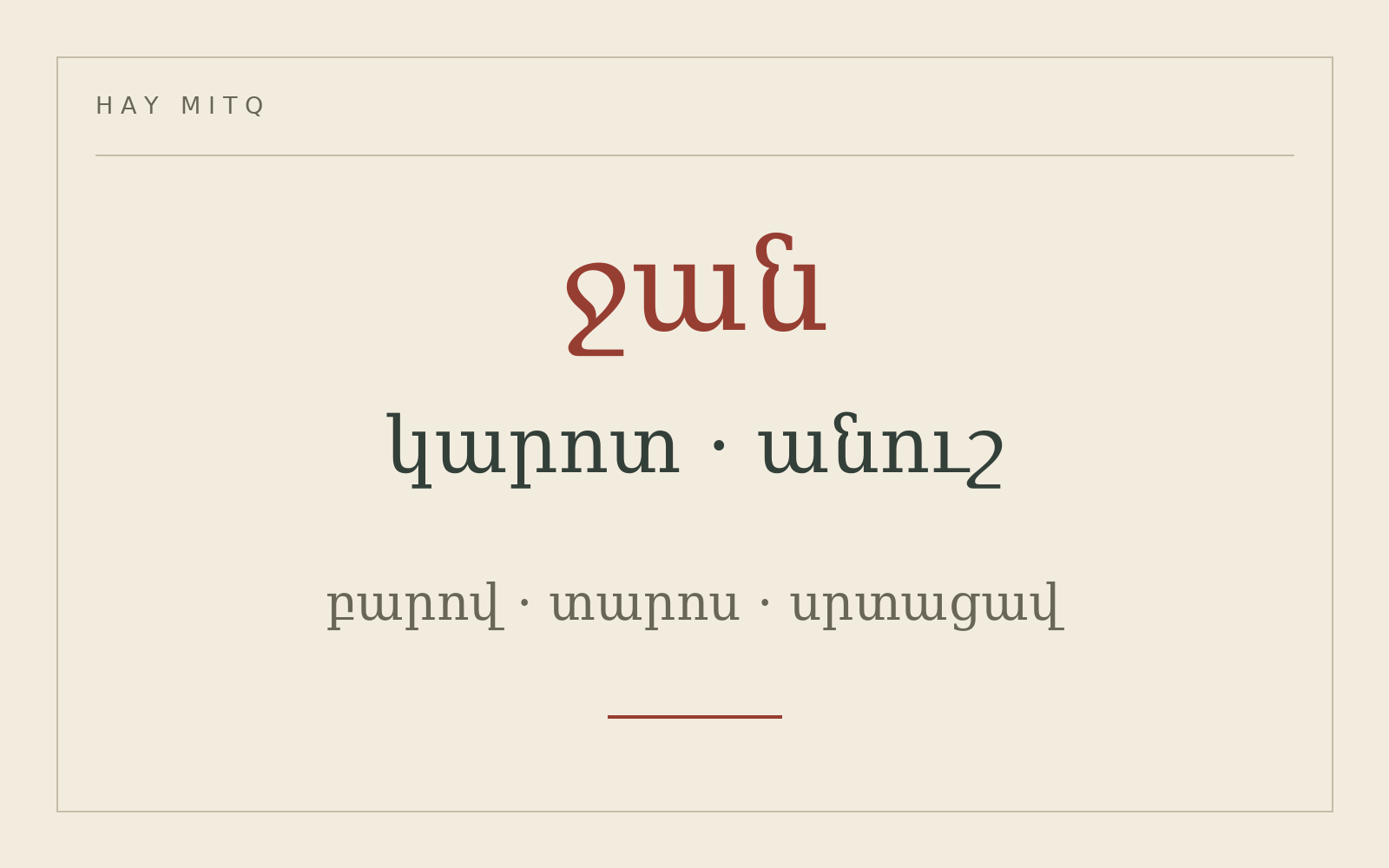
A child calls for their mother and hears “Ջան” in reply. A guest thanks their hosts for a meal, and the hosts respond, “Անուշ լինի.” Someone speaks about how long they have been away from home and says, “Կարոտել եմ.”
These expressions can be translated. But sometimes doing so means changing an entire sentence rather than replacing a single word: finding the right tone, choosing between “dear,” “enjoy,” “I miss you,” and “how I’ve missed you.”
This is not because Armenian feelings are inaccessible to other people. Languages simply bring meanings together in different ways. Where one language uses a short word, another may need a phrase. A dictionary also cannot always convey the familiar setting: who is speaking, to whom, and with what expression.
Let us look at several Armenian words in this spirit: not as mysterious “untranslatable treasures,” but as part of everyday speech. The comparisons below focus primarily on Russian equivalents, with English explanations to show what those translations convey.
Ջան: a small word that changes the distance between people
“Narek” and “Narek jan” address the same person. But they do not sound quite the same.
The second form can express tenderness, warmth, or a wish to soften a request. Depending on the situation, Russian equivalents include «дорогой», «милый» and «родной»: “dear,” “sweetheart,” or an affectionate “my dear.” Sometimes the most natural translation adds no separate word at all, conveying the warmth through tone instead.
A reply to someone calling is especially revealing:
— Մա՛մ։ — Ջա՛ն։
“Mom!” “Yes, sweetheart?”
The reply might also mean “What is it, dear?” Here the word itself becomes a response: you have been heard, and answered affectionately.
Yet “jan” does not necessarily imply deep intimacy. It can also appear in a friendly conversation with someone the speaker does not know particularly well. The relationship and tone make all the difference.
This familiar Armenian term of affection has Persian origins. That does not make it any less at home in Armenian: borrowed words can become an inseparable part of everyday culture. It is important, however, not to confuse it with the separate dictionary entry ջան associated with effort.
Կարոտ: longing with someone or somewhere in mind
“Karot” is often described as a word that cannot be translated. That is an appealing claim, but not an accurate one. Russian has «тоска» and «томление», words conveying longing or yearning, while «скучать», “to miss,” often works perfectly well for the verb կարոտել.
The difficulty arises when we try to choose one equivalent for several different situations.
Քեզ կարոտել եմ։ «Я по тебе соскучился». “I’ve missed you.”
Տան կարոտ։ «Тоска по дому». “Longing for home.”
In these uses, կարոտ concerns the absence of someone or something dear, and the desire to see them again, feel their presence, or be near them. It is not simply a bad mood. The feeling is directed towards someone or something.
For someone living far from their birthplace, that might be home, loved ones, a childhood street, or familiar speech. But the word should not be reduced to migration or a nation’s historical experience: a person can miss someone they have not seen for only a few days.
Nor should կարոտ automatically be translated as “nostalgia.” Nostalgia often looks back towards the past; կարոտ may be directed towards someone you hope to see tomorrow.
Անուշ: pleasing to more than the palate
Many people know “Anush” as a woman’s name. It is also a word that cannot always be replaced by the Russian «сладкий», “sweet.”
Անուշ բույր can mean a pleasant fragrance; անուշ ձայն, a gentle, pleasing voice. In other combinations, the word conveys something welcome, tender, or restful.
The common thread is not sugar, but the pleasure something brings to the senses.
This is especially clear at the table:
Անուշ լինի։
Depending on the situation, this expression can be rendered in Russian as «приятного аппетита» or «на здоровье»: a wish to enjoy the food or a warm response to thanks for it. It is equally appropriate when the food is not sweet at all. A literal translation about sweetness would only confuse the guest.
Russian, too, has expressions such as «сладкий сон» and «сладкий голос», “sweet sleep” and “a sweet voice,” so the metaphor itself is not unique. What matters is which combinations sound natural in each language, and how an ordinary adjective becomes a good wish.
Բարով: wishing for more than a good beginning
In Armenian, someone with a new item of clothing may hear:
Բարով մաշես։
Taken literally, the expression includes a wish that the person should wear the item out. But nobody is hoping that the new clothes will quickly fall apart. The meaning is closer to “Wear it with joy” or “May it serve you well.”
In expressions of this kind, բարով is associated with well-being, good fortune, and enjoyment. Different situations therefore call for different Russian translations:
Բարով գնաս։ «Счастливого пути». “Have a good journey.”
Բարով հասնես։ «Благополучно доберись». “Arrive safely.”
Բարով մաշես։ «Носи на здоровье». “Enjoy wearing it.”
These wishes contain a simple but expressive idea: receiving something new or setting out on a journey is only the beginning. We hope that what follows will go well, too.
One Armenian word connects these situations, while Russian generally uses several different set expressions.
Տարոս: may you have this joy, too
At a wedding, you may hear:
Տարոսը քեզ։
This is usually rendered in Russian as «И тебе того же» or «Теперь твоя очередь»: “The same to you” or “Now it’s your turn.” But the second version can sound too blunt, as though the other person were expected to be next in line to fulfil a social obligation.
The Armenian expression is, above all, a wish: may you experience similar happiness. Dictionaries associate it not only with weddings, but with other welcome events as well.
It is an interesting way to respond to congratulations. Rather than simply saying thank you, the person wishes comparable good fortune upon the speaker.
Of course, even a kindly traditional expression is not always appropriate. A wish that someone will marry may delight one person and upset another. Knowing what an expression means does not automatically tell us when it is best used.
Language preserves familiar ways of speaking about happiness. Tact, however, requires us to consider what happiness means to the person we are addressing.
Աչքալույս: good news shared with others
Dictionary meanings of աչքալույս include a congratulation and good news, as well as a gift or treat given on the occasion of such news.
Alongside the word is the familiar expression:
Աչքդ լույս։
It may be said, for example, upon hearing joyful news about someone’s loved ones. In the corresponding Russian context, «Поздравляю!», “Congratulations!”, is a natural translation. Yet the Armenian expression’s imagery connects eyes with light.
There is no need to turn this image into an invented ancient doctrine. Its power is understandable without a legend: good news changes a person’s face, bringing joy to it.
It is also interesting that news, congratulations, and a celebratory treat appear together within the word’s dictionary meanings. Joy is not merely information that has been passed along. It becomes an occasion for meeting and for others to take part.
Սրտացավ: when another person’s trouble matters to you
Սրտացավ can be translated into Russian as «сочувствующий», «заботливый» or «отзывчивый»: “sympathetic,” “caring,” or “responsive to others’ needs.” It is not a word without Russian equivalents.
Its internal imagery, however, helps us hear an important shade of meaning: heart and pain.
A սրտացավ մարդ is someone who can respond to another person with genuine concern. They do not merely know that something is wrong; they feel that it matters to them.
Naturally, the word itself guarantees no action. It describes an attitude, rather than awarding a certificate of kindness. In everyday speech, it may describe a doctor, a friend, a teacher, or anyone whose care can be felt.
When Armenian itself needs more than one word
There is an expression without which this discussion would be incomplete:
Ցավդ տանեմ։
Literally: “May I take away your pain” or “Let me take your pain.”
This is not a single word, but a set phrase. Its everyday meaning is not always connected with the other person actually suffering. It can express tenderness, accompany thanks, or serve as an affectionate form of address.
For that reason, “I will take away your pain” may explain the image while doing a poor job of translating the conversation. In one situation, the Russian «родной мой», an affectionate “my dear,” may sound more natural; in another, a warm expression of thanks without any literal mention of pain.
The same care is needed with մեռնեմ քեզ. The literal image of dying in an affectionate expression should not be read as a real intention. What matters here is a convention of speech, not a literal scenario.
Such expressions show the difference between two questions: “What words make up this phrase?” and “What is the speaker doing by saying it?” The answer to the second may be: comforting, thanking, or calling someone affectionately.
What is really lost in translation?
Not necessarily meaning. Often, it is familiarity.
The word “jan” can be explained at length to a Russian-speaking reader. But in an Armenian family, nobody explains it every time it is used: it already belongs to familiar voices, requests, conversations, and memories.
The same is true of any native language. Some words we know from dictionaries; others we recognise long before we can define them.
The value of these Armenian words is therefore not that tenderness, longing, or care are inaccessible to other peoples. It lies in a particular way of naming familiar human feelings and making them part of daily speech.
Sometimes an accurate translation really does require an entire sentence. And sometimes one word, spoken in the right voice, is enough.