In 1920, Diana Apcar received a passport from the Republic of Armenia. Yet long before her official appointment, her name meant something to Armenian refugees that mattered more than a title: in faraway Japan there was someone they could turn to. This story from the Heirs of Hayk series follows a woman who used letters, personal connections, and her own signature to give people a chance to go on with their lives.
A Passport from the Country She Served from Japan
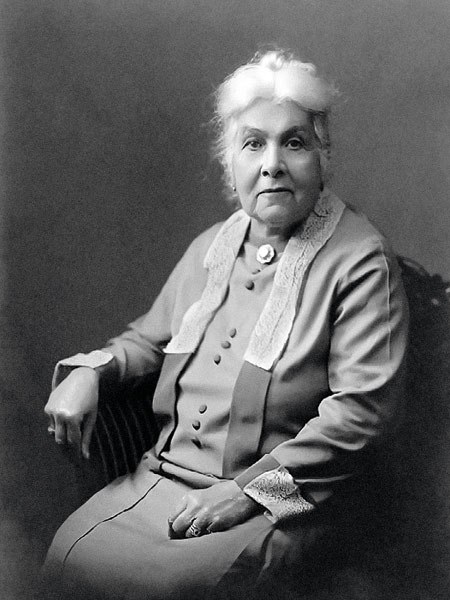
The Armenian Cultural Foundation in Arlington holds Diana Apcar’s Armenian passport, issued in 1920. An image of it appears alongside other family records: baptismal certificates and documents linking several generations and several countries. The passport stands out among them. It brings together the life of a woman born in Rangoon and the history of a young republic in the Caucasus. [1].
On an ordinary political map, Armenia and Japan are separated by an immense distance. In Apcar’s life, that distance comes down to a practical question: what can you do for your compatriots from wherever you happen to be?
Her story often begins with a distinction: she was one of the first women diplomats. It deserves our attention, but it can also obscure what matters most. The diplomatic appointment went to someone who was already helping people. First came the appeals, the negotiations, and the search for money and documents. The official paperwork came later.
The passport is worth looking at for more than its rarity. It records the moment a state recognized work that had begun without a mandate from any government.
An Armenian Woman from Rangoon
Diana was born on October 17, 1859, in Rangoon, now Yangon. Named Gayane at birth, she belonged to the Armenian Aghabek family, grew up in Calcutta, and moved to Japan with her husband in 1890. Yokohama would become the city most closely associated with her life. [2].
That geography explains a great deal. From the beginning, her Armenian identity took shape far from the historic homeland: in her family, church, language, and community. Belonging to her people did not require her to live in any one place. It did mean having a connection she could choose to keep alive.
We are used to drawing the diaspora as arrows pointing out from the homeland. Apcar’s life suggests looking in the opposite direction too. People scattered across the world could become sources of support. Knowing another country, its language and its rules, could matter a great deal to someone arriving there for the first time.
Her own life was far from easy. She had five children, two of whom died young. After her husband died in 1906, she had to care for the children and run the family business. Helping others did not grow out of a life of complete security. It became part of a life that already carried plenty of responsibilities. [2].
That matters if we want to remember her as a person rather than a figure on a pedestal. Work, home, and loss were part of her life. She found room for public service amid all of them.
First, She Tried to Make the World Listen
Before refugees needed her help on Japanese shores, Apcar addressed the international public as an author and commentator. After the Adana massacres in 1909, the Armenian question became central to her work. She wrote in English, reaching out to people who might influence public opinion or political decisions. [2].
That work moved at a very different pace from ours. You had to write an appeal, send it, and wait for a reply. Between the writer and the reader stood long distances, editorial offices, secretaries, and institutions. Even a letter that reached its destination might not be heard.
Her surviving correspondence with David Starr Jordan, the first president of Stanford University, spans 1910 to 1924. The archival record contains a series of documents rather than a single appeal. It shows how long she kept at it, returning to the subject, making new requests, and sustaining a conversation over many years. [3].
Bearing public witness presents a particular difficulty. When you tell people about someone else’s suffering, you have to overcome the comforting thought that it is happening far away and has nothing to do with them. For Apcar, the distance was real. Writing from Japan, she tried to make the fate of Armenians a question that could not simply be put aside.
We need no later tributes to show how persistent she was. The letters do that themselves.
She Kept Trying
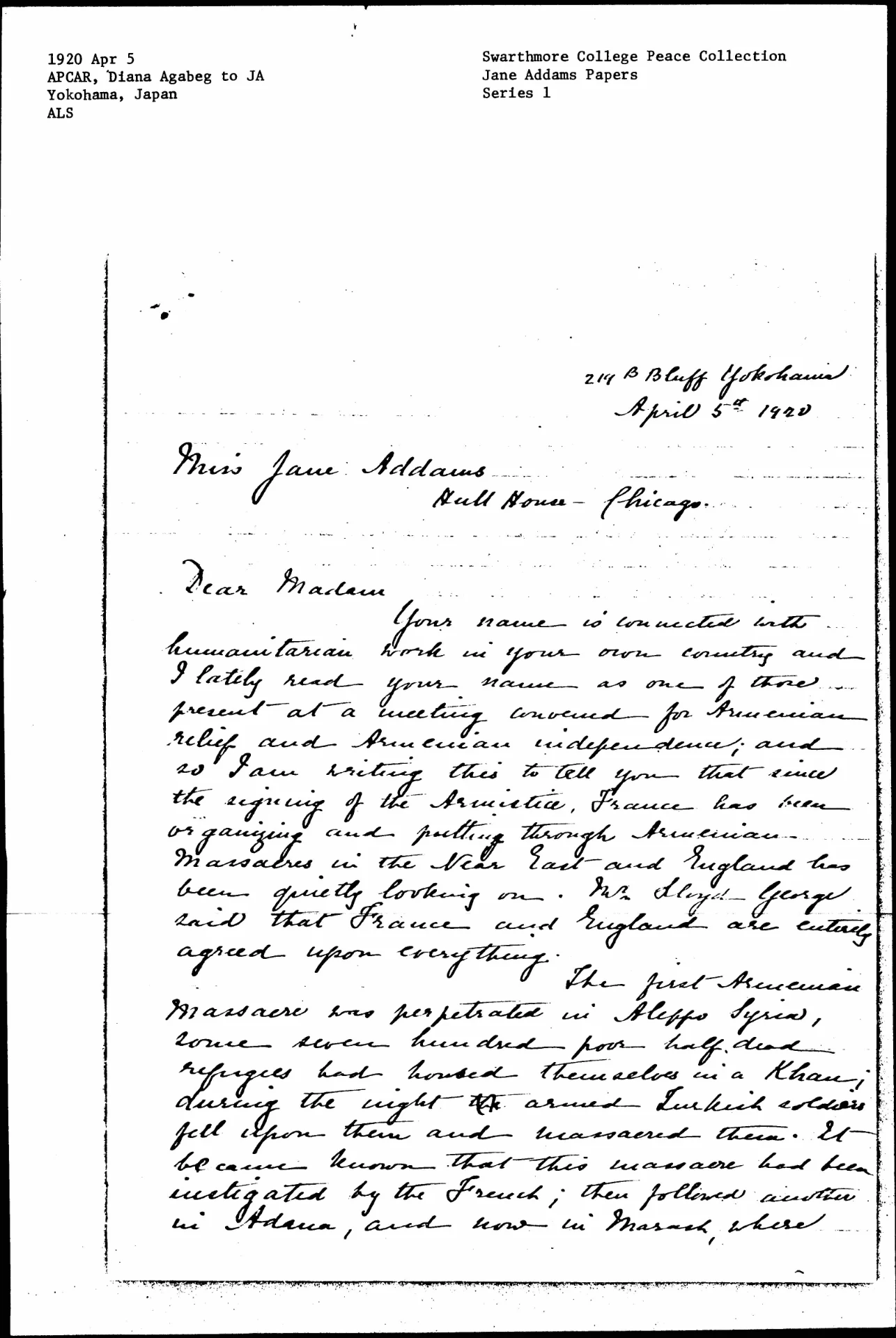
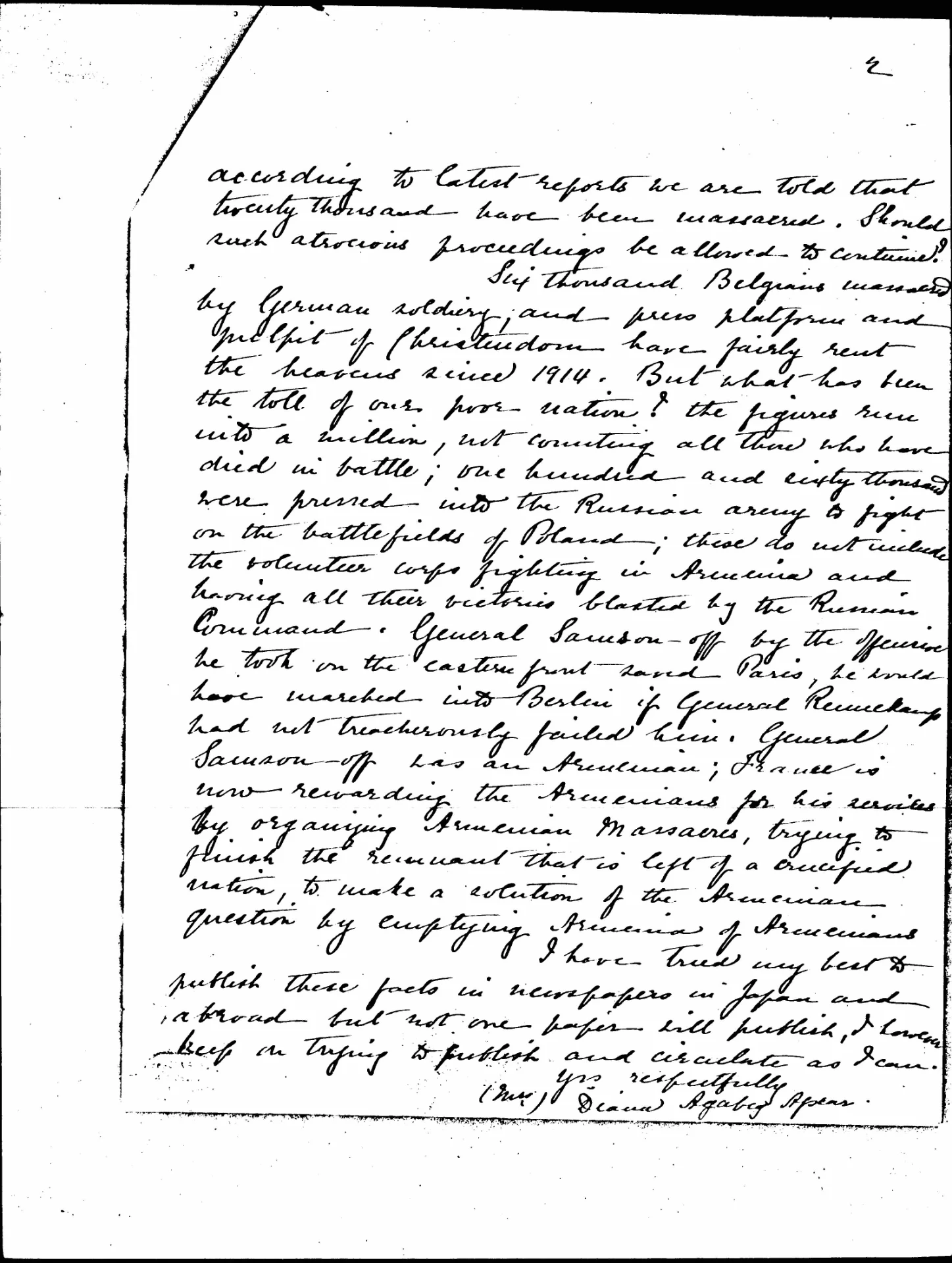
On April 5, 1920, Apcar wrote to the American social reformer Jane Addams. At the top of the page is the address 214 B Bluff, Yokohama. The destination is just as specific: Hull House, Chicago. A letter about people in danger of being killed links two distant cities. [4].
Apcar explains why she is writing to Addams in particular: she knows of her humanitarian work and her involvement in discussions about aid to Armenians. At the end, she says that she has tried without success to publish the information in Japanese and foreign newspapers. She adds that she is still seeking publication and sharing the information by whatever means she can.
That ending carries more force than any invented monologue. She has already been turned down, and she tells us what she is doing next. There is no promise of an easy victory. There is a decision to keep working.
The letter contains sharp political accusations and reports of violence that had reached Apcar. What makes it important here is what it records about her own efforts: she was looking for someone who could help the information reach people beyond her immediate circle.
Today we might call it a fight for attention. Apcar wanted attention to lead somewhere: once people knew of the suffering, she wanted them to accept some responsibility toward those who were suffering.
The Road East
For some Armenians who survived the Genocide, the route to safety ran through Russia, Siberia, and the Far East. From there, it might be possible to reach Japan and continue to North America. The route looks surprising if you search the map for the shortest way. Refugees, though, need the way that is still open, not the shortest line.
Meline Mesropyan’s study of Japanese archives shows how much depended on documents, entry permits, and money for onward travel. Apcar worked on these specific problems. She approached the Japanese authorities to find ways for people to pass through when their circumstances did not fit the usual procedures. [5].
Someone might still have the strength to keep traveling but lack the right document. There might be relatives across the ocean, but between them and the refugee stood a port, the price of a ticket, and another country’s entry requirements. Reaching a safe shore did not always mean the journey was over.
At this point, compassion alone could take you only so far. You had to know what to do first. Whom should you approach? Who could confirm a person’s identity? Who would vouch for them? How could you get those individual decisions to add up to a journey someone could actually make?
Apcar was among those who knew how to turn a general desire to help into a series of steps that could be carried out.
What One Signature Can Do
Among Apcar’s published papers is a letter of guarantee in English and Japanese, written on behalf of a married couple. The English section lists three obligations: to provide financial assistance if needed or if requested by the authorities; to cover losses caused to third parties; and to pay the cost of departure if the Japanese authorities require the couple to leave the country. At the bottom is the signature of Diana Aghabek Apcar. [6].
Vouching for someone goes beyond expressing sympathy. It puts a name to an obligation. Where an institution sees a stranger with insufficient documentation, another person steps forward and puts it in writing: I will take responsibility.
No signature could erase every border or rule. It could, however, supply what was missing in a particular case. The history of rescue turns on things that rarely find their way onto monuments: a completed form, a well-timed letter, a confirmed address, somewhere to stay for a while.
Apcar helped people look for shelter, work, relatives, and ways to travel onward. Her work intersected with that of charities, local communities, transport companies, and the refugees themselves. That does not diminish her role. It shows what she actually did: she made the different parts of a difficult journey work together. [7].
A Girl Named Berjouhi
In 1919, Diana Apcar and a young girl named Berjouhi Kailian crossed paths in Yokohama. The Armenian Museum of America told the story of their meeting in its exhibition In the Shadow of Branches.
According to the museum’s account, based on family history, Berjouhi’s mother carried her out of the Ottoman Empire on her back. They reached Yerevan, then traveled by the Trans-Siberian Railway to a refugee camp in Vladivostok. Apcar helped them reach Yokohama and arranged for them to sail on the Mexico Maru to Seattle. From there the family went to join relatives in Weymouth, Massachusetts. [8].
What happened next helps explain what we mean when we say a life was saved. Berjouhi became an artist. Her paintings and works on paper preserved the memory of what she had lived through. In 2018, her family donated a substantial part of her work to the museum.
That changes the scale of the story. What Apcar saw was a child and her mother who needed to get somewhere else. Today we can also see the life that could unfold because they did: a girl growing up, becoming an artist, keeping a memory alive, and leaving work for others to see.
No one can know in advance what will come of helping another person. Someone who needs a ticket today does not owe anyone a famous life in return for being saved. But Berjouhi’s story lets us see what is usually left out of a short biography: a life saved goes on for decades.
Another Steamship, Another Family
Another story survives in the recollections of Harutiun Tashjian, recorded by his son James and published in the Armenian Weekly. The family, from Kharpert, traveled through Vladivostok and made it to Japan. The account describes questioning, waiting, and a building that looked like naval barracks. Then Apcar appears and addresses the refugees in Armenian.
She tells them that they may be able to sail aboard the Empress of Japan to Vancouver and continue from there by train to the United States. This is a family memory, not a diplomatic record. But it shows what her arrival meant to people in transit: they had been waiting in uncertainty, and now they had a concrete next step. [9].
There is no need to invent the weather that day or imagine how every person there felt. The source gives us enough: people waiting for a decision, then hearing they might be able to leave.
The records also show how varied these routes could be. For one family, the next stop was Seattle; for another, Vancouver. To say Apcar “helped refugees travel to America” is to compress many separate cases into a single phrase. Each one had to be seen through on its own.
The Correspondence Behind One Name
The Hoover Institution Archives preserve Apcar’s correspondence with the American Red Cross. The published collection includes letters, telegrams, lists of names, sailing schedules, and appeals from refugees from the spring and summer of 1919. One of her correspondents was T. J. Edmonds. [10].
Even the list of documents changes our picture of her work. This was an ongoing effort: a letter needed an answer, the answer raised another question, and somewhere there were people still waiting for that question to be settled.
Work like this is hard to dramatize. There is no single climax. It consists of tasks done again and again, each important to the family next in line. Public memory tends to preserve a person’s name. Behind the name is the ability to stick with work that is still unfinished.
Published alongside the correspondence are records of passengers who traveled from Japan to San Francisco. The compilers retain the spellings in the ship manifests and make clear that the list is incomplete. It should not be read as a list of everyone Apcar personally helped. What it does show is who traveled the Pacific route and when: names, years of birth, dates of arrival, and the ships that carried them. [11].
Here the history of the diaspora stops being abstract. It becomes a record we can read one line at a time.
An Appointment from Yerevan
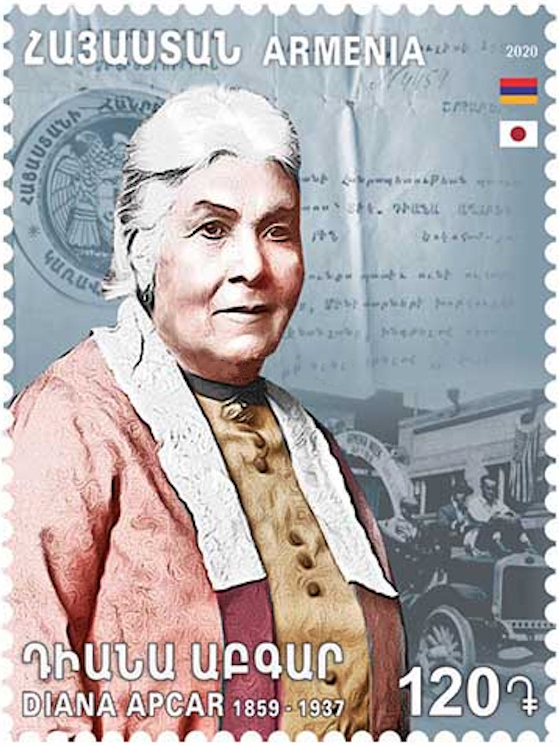
On July 22, 1920, Hamo Ohanjanyan, who led the government and the foreign ministry of the Republic of Armenia, wrote to appoint Apcar honorary consul in Japan. The letter linked the appointment to her work defending Armenia’s interests and helping her compatriots. [12] and [13].
“Honorary consul” is more accurate than “ambassador,” a title often found in popular accounts. Apcar was among the first women to receive such a diplomatic appointment in the modern era. The young Armenian republic’s choice matters in its own right: it entrusted its interests to a woman who had already shown what she could do far from Yerevan.
Appointment by the Armenian government and acceptance by the host country were separate procedures. According to Meline Mesropyan’s research in Japanese archives, the Japanese authorities never approved the appointment. Neither the Armenian passport nor the letter from Yerevan constituted Japanese accreditation. July 22 is therefore the date of the Armenian appointment, not the date of a separate Japanese act of recognition. [5] and [14].
That distinction takes nothing away from Apcar. It helps us see the difficulty of the moment: the republic was trying to build international ties while facing a grave crisis of its own. Through people like Apcar, Armenia had a presence abroad as a country able to speak for itself, rather than simply a subject of other powers’ negotiations.
The Work Outlasted the Appointment
The fall of the First Republic did not bring Apcar’s refugee work to an end. According to research by her family, she continued helping people in the years that followed. The political situation had changed, but people still needed her assistance. [7].
In 1923, the Great Kantō Earthquake destroyed her home. She died in Japan in 1937. Among the published papers is a newspaper obituary that remembers her as a mother to Armenian refugees. [2] and [15].
Today her legacy must be pieced together from material in different collections: family papers, American correspondence, Japanese government records, and the memories of survivors. That dispersal recalls the history of the people she served. Their memory has to be brought together across borders, much as she once helped bring people together.
Readers have a part in this too. We can look past the impressive title to the person who held it, keep her real achievements from being lost in a more dramatic legend, and remember the names of those whose lives her work touched.
Heirs of Hayk: What It Means to Belong
Nothing in Diana Apcar’s life supports the comforting notion that one person can undo a catastrophe. She did not stop the Genocide. She could not dictate the policies of great powers or decide her homeland’s future by herself.
But between having all the power in the world and having none, there is plenty a person can do. You can get an answer to a letter. Find someone willing to vouch for a stranger. Help a family stop waiting and get back on the road. Make sure that someone who has lost their home is not entirely alone in an unfamiliar country.
That is where Apcar did her work. Her life matters as more than the story of an exceptional woman from the past. It puts a question to us today: what do we do with our sense of belonging when someone actually needs help?
For Diana Apcar, being Armenian took the form of specific acts. Neither her birthplace nor her address could tell you all that her homeland meant to her. You could see it in the people she was prepared to answer for and in the determination with which she saw things through.
Her passport remains in an archive. Letters and photographs remain in museum collections. And in the story of Berjouhi Kailian there was a long life after rescue.
Together, these traces preserve what matters most: when the world was closing in on people, Diana Apcar helped them find a way that was still open.