A manuscript contains several histories. One is recorded in its text. Another belongs to the person who copied the lines, prepared the pigments or decorated the page. A third concerns those who read, protected and passed on the book. Yerevan’s Matenadaran brings these histories together, showing why preserving a manuscript means much more than saving its words.
From repository to research institute
The word “matenadaran” means a repository of books or manuscripts. The foundation of the Yerevan collection was the manuscript library of the catholicosate at Etchmiadzin, transferred to Yerevan in 1939. It is useful to distinguish the centuries-long lives of the books from the more recent history of the modern research institution.
On 3 March 1959, the Matenadaran received the status of a research institute. Its responsibilities included describing and cataloguing manuscripts, conservation and restoration, publication, translation and sharing the heritage with a wider public. This approach treats a book as something to be both protected from damage and made available for study.
Why the name of Mashtots matters
The institute bears the name of Mesrop Mashtots, who created the Armenian alphabet in 405. This connection helps explain the collection’s significance. These are traces of a culture in which writing became a means of passing faith, knowledge and historical memory between generations.
In 1997, the Matenadaran manuscript collection was inscribed in the international register of UNESCO’s Memory of the World programme. This recognises documentary heritage. It is a different register from the World Heritage List, which includes architectural and natural sites.
Beyond the display case
The holdings span history, philosophy, medicine, geography, grammar and other fields of knowledge. They include manuscripts in Armenian and other languages. The collection invites us to understand book culture through translation, encounters between traditions and the movement of ideas.
The institute’s manuscript depository page describes approximately 23,000 manuscripts, fragments and talismans. The last two categories matter: this is not a count of complete books alone. A fragment may preserve only part of a lost text, yet still help a scholar reconstruct its history. Work with original manuscripts requires special permission; museum visiting and scholarly research are organised differently.
The book as a work of art
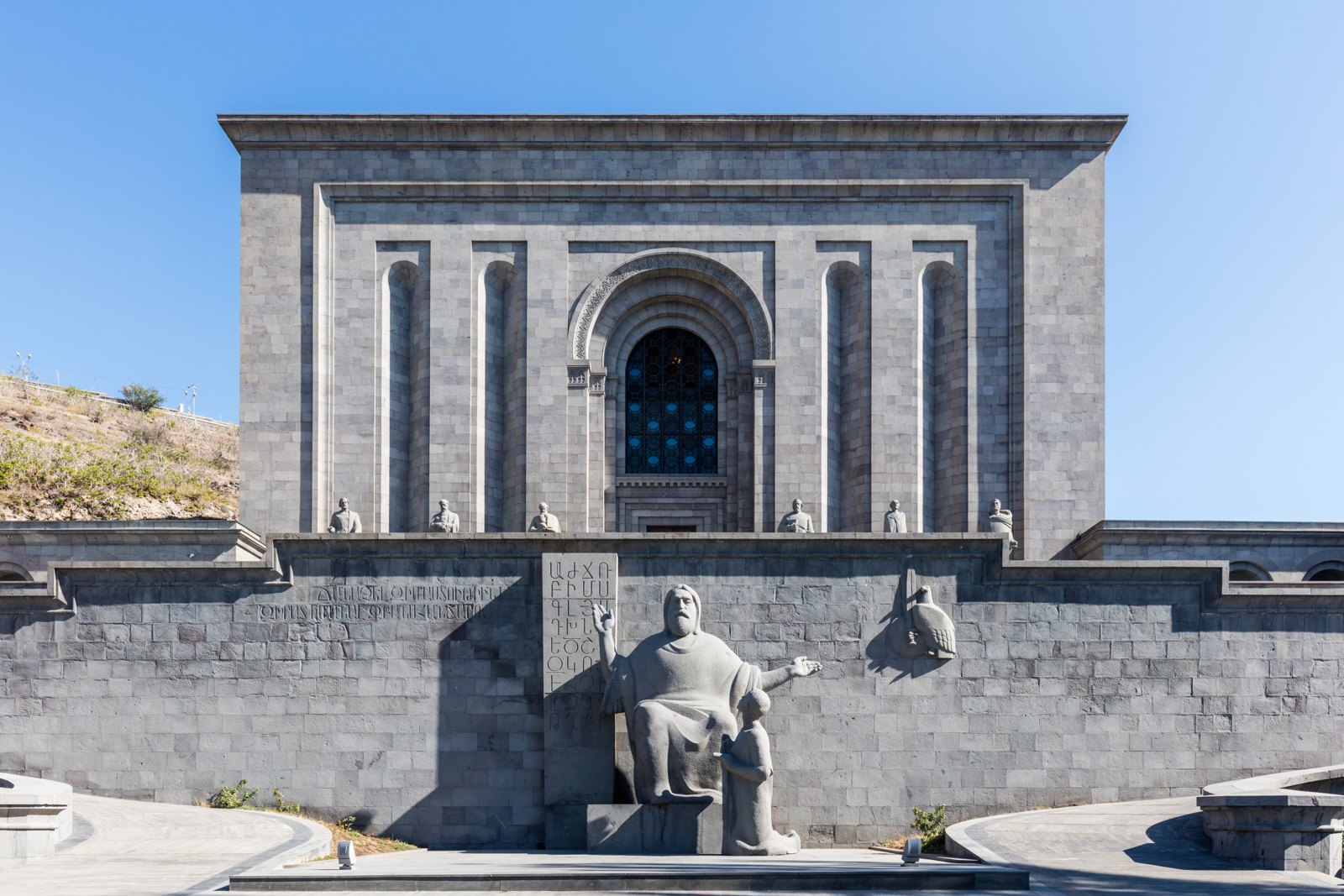
The main museum building was constructed in 1945–1957 to a design by Mark Grigoryan. Its appearance prepares visitors for an encounter with the heritage inside, but close attention to the pages brings further discoveries. Handwriting, miniature painting and the arrangement of text offer different ways of reading the same book.
First look at an entire opening, then choose a detail. Where does the artist direct your eye? How does an image relate to the writing beside it? Even without knowing the language, you can notice the rhythm of lines and the organisation of a page. Translation and commentary help move from that first impression towards meaning. The museum’s account of manuscript making also addresses pigment production and parchment preparation: the beauty of a book depended on practical skills.
Preserving fragile memory
The Matenadaran’s restoration department works with paper, parchment, bindings and miniatures. Specialists strengthen damaged leaves and paint layers, address distortions and monitor the collection’s condition. Moisture, fire, microorganisms and insects are among the threats to manuscripts.
This work requires decisions appropriate to each material. Preserving an old page is not simply a matter of making it look new: evidence of its past and opportunities for further study must remain. The display case is therefore only the visible part of a much larger undertaking that continues outside the exhibition halls.
How to read the Matenadaran
You do not need to remember every date and title during one visit. Choose a manuscript and ask a few questions. Why was it made? Who might have used it? Which aspects belong to the text, and which to art and craft? Then compare it with another book.
Seen this way, the Matenadaran becomes more than a collection of rarities. It is a place to consider how knowledge is transmitted: why certain texts reached us, what efforts made that possible and what we ourselves should pass on.