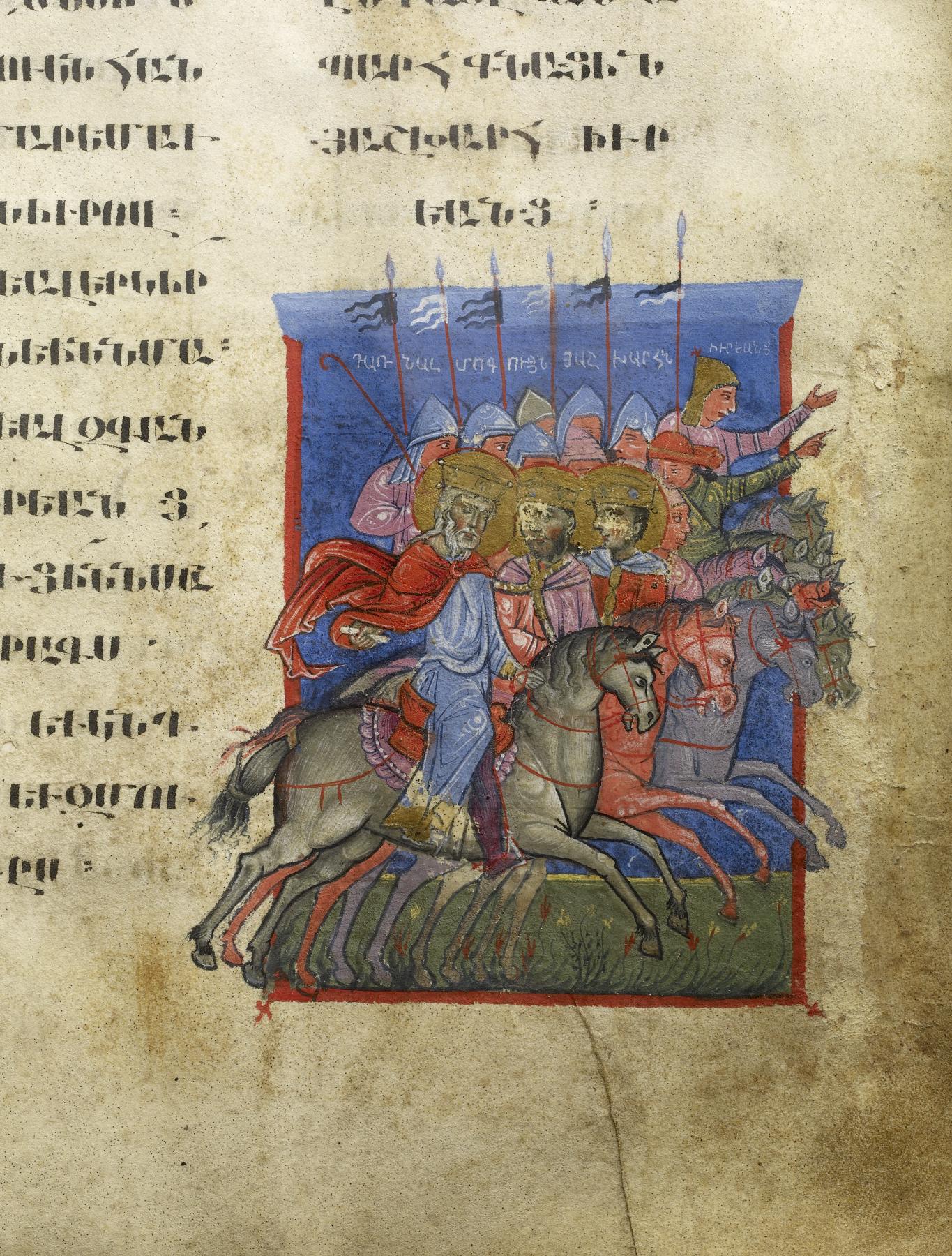
On a page of an Armenian Gospel book, horsemen seem to ride beyond the edge of a small frame. Their horses move in a close group, the riders turn towards one another, and lines of writing continue beside them. This is the Return of the Magi, from a manuscript made by Toros Roslin in 1262. The artist worked almost eight centuries ago, yet his visual storytelling still readily holds our attention.
The book is now in the Walters Art Museum in Baltimore, with the shelfmark W.539. Its digital facsimile lets us examine not only celebrated miniatures but also the way an image inhabits an entire page.
A master from Hromkla
Roslin worked at Hromkla, an important centre of Armenian book culture in the thirteenth century. Museum catalogues identify his documented period of activity as 1256–1268. Surviving works provide firm evidence, while a detailed biography must be pieced together from relatively few records.
The 1262 Gospel book was commissioned by a priest named Toros, a nephew of Catholicos Constantine I. Patron and artist shared a name but were different people. The manuscript is one of seven known books bearing Roslin’s signature. That signature gives us the work of a particular maker, rather than an anonymous example of a “medieval style.”
How a picture begins to move
In the Return of the Magi, look closely at the boundary between the scene and the page. A red border encloses the blue background, but parts of the horses project beyond it. The movement seems too expansive for the space allotted to it. We can test that impression by looking at the miniature itself, without knowing Armenian.
The riders do not form a row of identical silhouettes. Their heads turn in different directions; gestures and folds of clothing connect the figures. Red, blue and pinkish areas help us distinguish individuals within the compact group. A few carefully arranged patches of colour become a coherent action.
Meanwhile, the miniature sits alongside two columns of writing. It neither displaces the text nor becomes a separate painting. A reader can move from a line to the scene and back again. This alternation gives the manuscript book its particular expressive power: a story takes shape through both words and the arrangement of images.
A letter becomes an image
Roslin’s work extended beyond narrative scenes. In the same Gospel book, the opening of Matthew’s text has a decorated initial incorporating the evangelist’s symbol. The opening letter acquires visual prominence: it marks the entrance to a new section while belonging to the book’s artistic world.
It is worth examining such a page as a whole. Where does a line begin? How do the blank margin, writing and ornament relate? Looking only at an isolated detail can obscure an essential part of the design: the artist directs the reader’s attention across the whole surface of the leaf.
Beauty that helps a reader
Another example comes from Roslin’s earlier Zeyt’un Gospels, dated 1256. Its canon tables functioned as an index, helping readers locate corresponding episodes in the four Gospels. Columns of numbers appear within elaborate architectural frames.
Today these leaves might be mistaken for independent decorative compositions. Yet they had a practical purpose. The organisation of the text and the art of decoration work together: beauty makes the book’s structure visible and gives consulting it a distinctive visual character. This relationship is worth remembering when we encounter a medieval manuscript as a museum treasure.
What survives behind the name
Roslin’s significance emerges through a close reading of a single page. It reveals the assurance with which this Armenian artist brings together writing, colour, figures and open space.
These manuscripts preserve a language, an artistic way of thinking and the traces of individual human work. Opening a digital facsimile brings that work closer: we can linger over a rider’s gesture, return to a letter or notice the edge of a frame. Such details make the history of Armenian manuscript illumination more tangible.