A carpet first catches the eye through colour. We look from the border towards the centre, pause at a large shape and notice it appearing again. Then comes the urge to name it. A dragon, a tree, a star? This is where looking becomes both interesting and difficult. Pattern can reveal how an object is composed, the artistic traditions it resembles and the images scholars have recognised in it. To tell the story of a particular person, place and time, we also need inscriptions, materials and the object's recorded history.
Armenian carpet weaving rewards this attention to individual works. One museum record supplies an exact year, another only a century; one names a town, another an entire region. Four carpets in three museums show how much close looking can reveal, and where a question should remain open.
Inscriptions: when a pattern gains a date
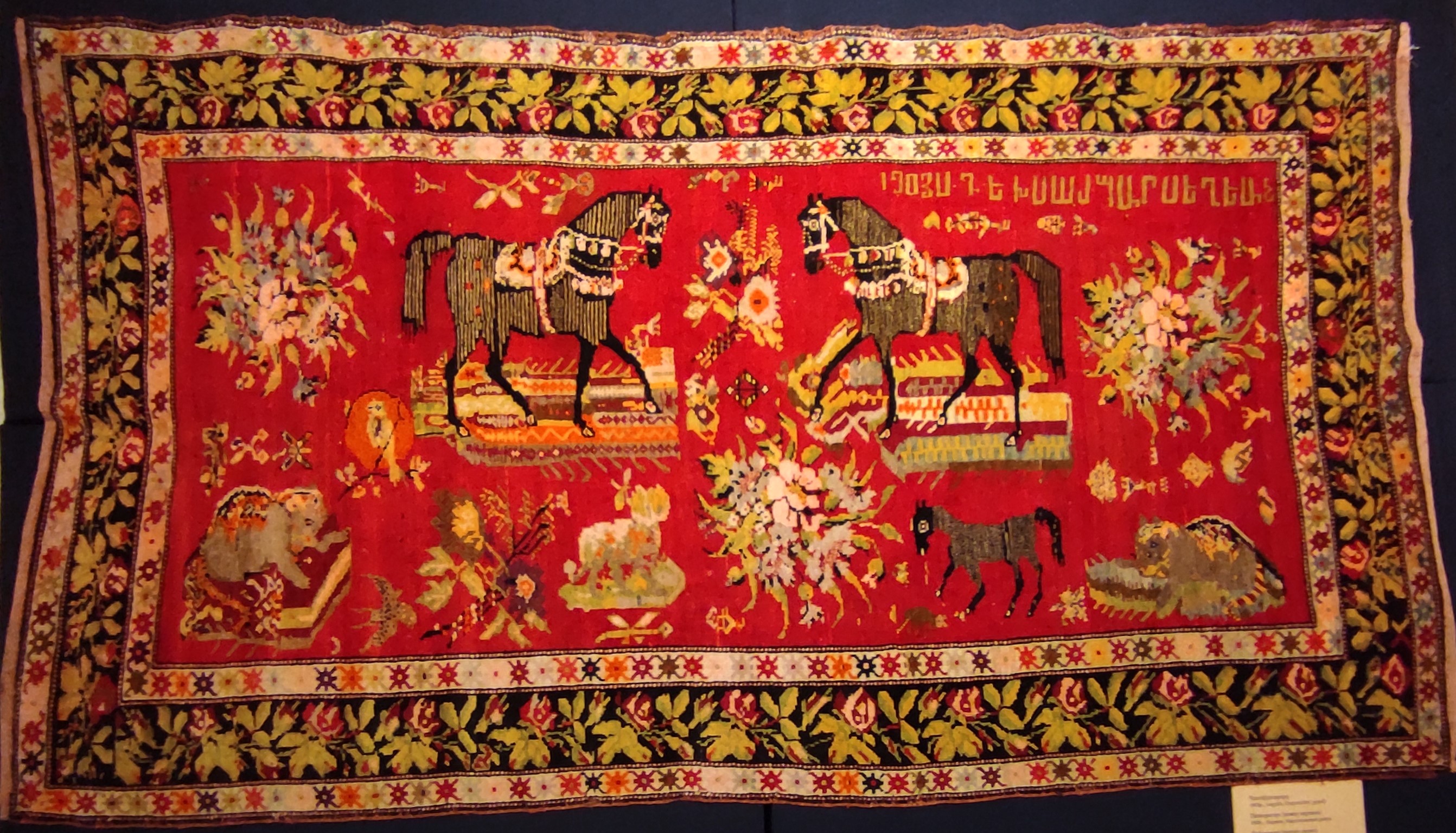
The Armenian Museum of America in Watertown presents an Armenian-inscribed rug dated 1914. Its description identifies the piece as Kazakh-style and names its donor, museum co-founder Haig Der Manuelian. That combination matters: a stylistic designation and a cultural affiliation can describe different aspects of the same object. A type name alone does not establish a weaver's ethnicity or locate a workshop.
An inscription can bring us closer to an object than a general resemblance between patterns. Yet every word needs to be read. A name might identify the maker, the commissioner or the recipient of a gift. A date might commemorate an occasion. Choosing among these possibilities requires the whole text, rather than a few recognisable letters in a small photograph. The brief record for the 1914 rug does not transcribe its inscription, so assigning it a family story would be premature.
The History Museum of Armenia has devoted a catalogue to carpets with Armenian inscriptions. It notes that dates could be recorded in Armenian letters used as numerals or in Arabic numerals. These inscribed works include floral, geometric and pictorial compositions. An inscription therefore connects a carpet with a linguistic and cultural setting without requiring every such carpet to share one decorative vocabulary.
A dragon carpet and the limits of attribution
The Calouste Gulbenkian Museum in Lisbon holds a seventeenth-century dragon carpet, inventory number T96. It measures 5.5 metres in length and has wool warp, weft and pile. The museum attributes it to Transcaucasia, encompassing present-day Armenia, Georgia and Azerbaijan. That broad attribution matters: the carpet can illuminate comparisons with Armenian weaving while retaining the description used by its custodians.
The word “dragon” suggests what to seek among the geometric forms. But stylisation transforms an animal's outline, so following contours and repetitions is more useful than expecting an illustration of a fairy-tale creature. How do the larger forms connect? What spaces lie between them? Where does the field meet its frame? Such questions allow us to describe the composition even when an individual motif remains elusive.
The Armenian term vishapagorg likewise refers to a dragon carpet. A shared group name, however, does not make every example evidence of a single workshop. In his academic overview, Dickran Kouymjian discusses the debate over the origins of dragon carpets and the importance of inscribed examples. Reconstructing a carpet's history requires several independent clues. A later point in T96's journey is securely recorded: Gulbenkian purchased it in London in 1932. The place of purchase is, of course, different from the place of manufacture.
A tree from Salmast: understanding repetition
A wool carpet from Salmast, held by the History Museum of Armenia as number 10743, has a different character. Its current online record dates it to the early twentieth century; a scholarly publication assigns the same inventory number to the nineteenth century. Resolving that discrepancy would require checking the museum inventory. The museum identifies its main motif as a tree of life with apple-bearing branches. It appears three times along the vertical axis, accompanied by branches, leaves and rosettes. Looking begins with a simple observation: the larger elements establish a sequence, while smaller ones tie the surface together.
Imagine removing the rosettes and lateral branches. A vertical arrangement remains, almost a framework for the composition. Concentrating only on the smaller elements, on the other hand, makes it easy to lose the overall rhythm. It helps to look at two scales, taking in the whole carpet before studying its details. The three trees can be counted; the motif's name can be checked against the catalogue. A claim that each tree necessarily represents a generation of a particular family would need separate evidence.
The museum records another feature: towards the top, the whitish ground changes to red. This invites us to see a particular handmade object behind the orderly design. The short description does not explain the change. A shortage of yarn, a deliberate choice or some circumstance of production would all be guesses. Sometimes telling a carpet's story carefully means noticing a detail without inventing its maker's reason for it.
Yerevan in the 1930s: an older design lives on
Dragon rug number 14 in the same museum dates to the 1930s and is associated with the Yerevan Gorg cooperative workshop. The English-language record lists wool and cotton. The museum explains that the workshop reproduced, on a smaller scale, a type of dragon carpet known from seventeenth-century examples. Two timelines thus meet: the age of a design tradition and the date of a particular object.
This distinction is especially useful when a pattern looks “ancient.” A recognisable composition can be continued centuries later. Repetition tells us about makers' choices and the preservation and reinterpretation of an inheritance. A work made long after its model has a history of its own: it shows which images were considered worth bringing back into everyday life.
Materials also call for precise description. Warp, weft and pile perform different functions, so a record stating “wool and cotton” cannot be expanded into a detailed technical account without further examination. A small photograph of the front rarely allows us to verify knot structure or the composition of every thread. An inventory number is more useful here than a confident visual impression: it connects an image with a specific record and helps prevent a later reproduction from being mistaken for an early example.
Looking closely enough to see more
Begin with the carpet's arrangement: its central field, border, large forms and repetitions. Then read the record, distinguishing the date, materials, location and degree of certainty in the attribution. Finally, return to the details: letters, colour changes and small figures between the principal elements. Moving from the whole to its parts keeps the beauty of a design connected to the object's history.
A universal dictionary assigning one permanent meaning to every diamond or hook closes these questions too quickly. It is more useful to ask who proposed an interpretation and on what evidence. The museum's identification of a tree of life on the Salmast carpet can be reported precisely; its maker's personal wishes remain unknown. Armenian carpets become more expressive when we preserve that distinction. We encounter an artistic tradition through many individual human works, each with its own period, construction and surviving evidence.