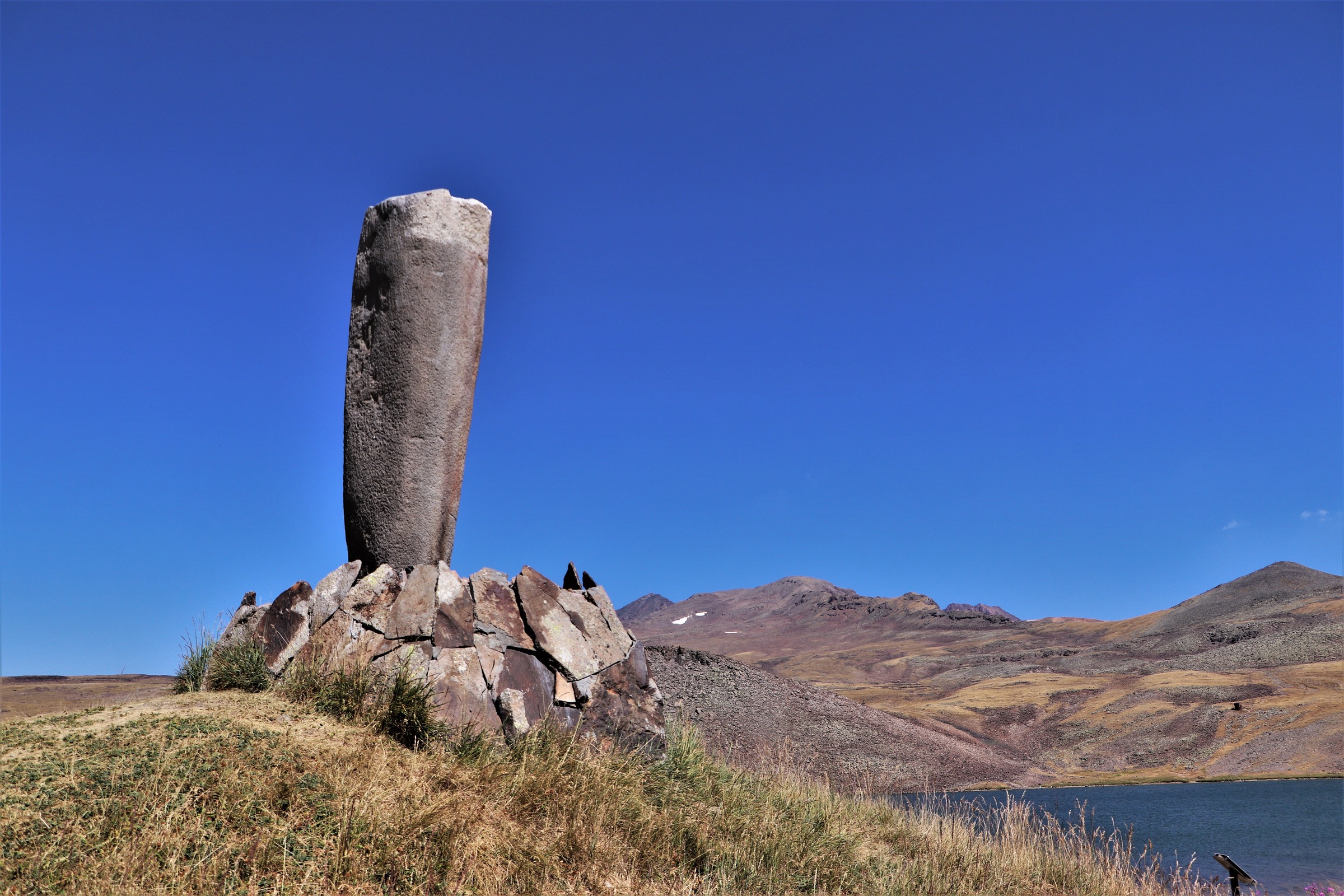
On the southern slope of Mount Aragats, about 2,850 metres above sea level, lies Tirinkatar. Twelve vishapakars have been found here: stone stelae with outlines resembling fish and reliefs depicting animal hides. It seems an unexpected setting for monumental sculpture. High in the mountains, where snow and cold restricted the time available for work, people shaped and erected heavy stones. To understand their choice, it helps to follow the water, from snow on the summits to springs, pastures and fields farther down the slopes.
The Armenian word vishap means “dragon”; vishapakar can be translated as “dragon stone.” The name comes from a folk tradition that preserved stories of extraordinary creatures inhabiting mountains and waters. It does not tell us what the people who made these monuments called them. Thousands of years separate the carving of the stones from the recorded legends. The history of vishapakars therefore requires care from its very first word: the familiar name identifies an object, but cannot by itself explain an ancient belief.
Fish, Hides and Mountain Meadows
The stones offer more definite clues. Researchers distinguish fish-shaped stelae, monuments carved as though a cattle hide had been draped over them, and a hybrid type combining both motifs. On some examples, the animal’s head and limbs are clearly visible. These forms recur in different places, suggesting a shared visual tradition. The meaning of each image remains open to discussion. Identifying a depiction with confidence and reconstructing a prayer addressed to it are tasks of very different difficulty.
The surroundings matter greatly. Vishapakars occur in water-rich mountain meadows, near springs and bodies of water. Archaeologists investigate the sculpture together with hollows in the terrain, stone structures, and nearby traces of camps and burials. Viewed at this scale, an individual monument becomes part of a landscape used by people. Moving it later to a museum or a city park preserves access to its carving, but no longer allows a visitor to experience directly its distance from water or the character of the place originally chosen.
Tirinkatar is especially important because relationships between its finds can still be studied. An Armenian-German-Italian expedition has worked here since 2012, under Arsen Bobokhyan, Pavol Hnila and Alessandra Gilibert. Alongside the vishapakars, the team investigates stone circles, rock carvings and evidence of temporary occupation. These belong to different periods. Such a site cannot be read as a single scene frozen in time: people returned, changed the purposes of places, added their own structures and left new traces beside older ones.
Establishing the Age of a Stone
For many years, the age of the stelae was assessed chiefly through comparisons and indirect evidence. Excavation has made the question more precise. A study published in 2025 dates the erection of two vishapakars at Tirinkatar to approximately 4200–4000 BCE. This rests on radiocarbon analysis of organic samples from associated archaeological layers. The authors explicitly warn that the result cannot be extended to every known vishapakar. There is now a firm chronological anchor for two monuments; the history of the tradition as a whole still needs further testing.
That distinction matters when we think about antiquity more generally. Stone itself cannot be dated directly by radiocarbon analysis. Researchers must establish how a sample relates to a structure, the sequence in which deposits formed, and whether a monument was reused. Finding later pottery nearby does not automatically mean that the sculpture was made at the same time. The longer a significant place remained in use, the more periods intersect there. Careful excavation therefore supplies information that no single photograph can provide.
A connection with water explains much, although the content of any ritual remains unknown. Snow and the streams it feeds on Aragats have an obvious economic importance. A high mountain spring matters both to someone arriving with a flock and to a settlement below. A fish-shaped stone in this setting makes religious reverence for water a persuasive possibility. Yet the finds do not supply a ready-made account of a particular deity, the words of a ceremony or a festival date. Those details cannot be recovered simply from familiar later legends.
What the Canals Can Tell Us
The question of canals is particularly instructive. Ashkharbek Kalantar proposed a connection between the locations of vishapakars and important points in irrigation systems, a hypothesis that continues to be discussed. A study of the Twelve Bander network, published in Rural History in July 2026, nevertheless establishes an important limit: the system is securely documented only from the mid-nineteenth century onward. An earlier origin is possible, but remains unproven. The proximity of ancient stelae and canals is not enough to establish that they were built at the same time.
There is historical interest in that caution itself. Water may have repeatedly drawn people to the same parts of the mountainside. A new canal could cross ground that had acquired special significance long before it, while later communities might give old stones new meanings. Distinguishing between these possibilities requires independent dating of the structures. A map establishes proximity; the sequence of events has to be worked out by other means. Research becomes more convincing when its authors make the limits of their conclusions clear.
Stone and Grain
The choice of material is equally revealing. Geological investigation of stelae in the Tirinkatar and Karmir Sar area identified local rocks, with the makers favouring more workable tuff lavas and tuffs over harder basaltic andesites. This brings practical knowledge into view. People understood the properties of stone and selected suitable material nearby. The findings remove the need to imagine every block being hauled from a distant valley, although shaping and erecting it would still have required considerable effort.
Human presence also emerges from very small finds. Archaeobotanical work at Karmir Sar identified charred wheat and barley grains, including material from the Middle Bronze Age. The researchers suggest that some finds could be associated with offerings or food eaten by ritual participants. This is a possible interpretation, rather than a confirmed menu for an ancient festival. Nevertheless, the grain restores an everyday dimension to visits: people brought food, spent time beside the monuments and incorporated the high mountains into the course of their lives.
Today, Tirinkatar’s significance is considered at the scale of an entire cultural landscape. In January 2024, Armenia submitted it for inclusion on UNESCO’s Tentative List. That list identifies potential future nominations; it is not equivalent to having received World Heritage status. The approach itself matters: interconnected places need protection, as well as the most striking stones. A spring, the ground surface and an inconspicuous structure nearby may prove just as necessary for understanding the past as a well-preserved relief.
Vishapakars bring the early history of the Armenian Highlands into focus through work and attention to place. They lead us to people who chose a stone, gave it a recognisable form and erected it somewhere worth returning to. Water helps explain that choice, archaeology refines its date, and the surviving images leave room for questions. The more carefully we distinguish a find from its interpretation, the more clearly the human significance of these monuments emerges: dependence on the mountain environment, and the wish to give that relationship a visible, enduring form.