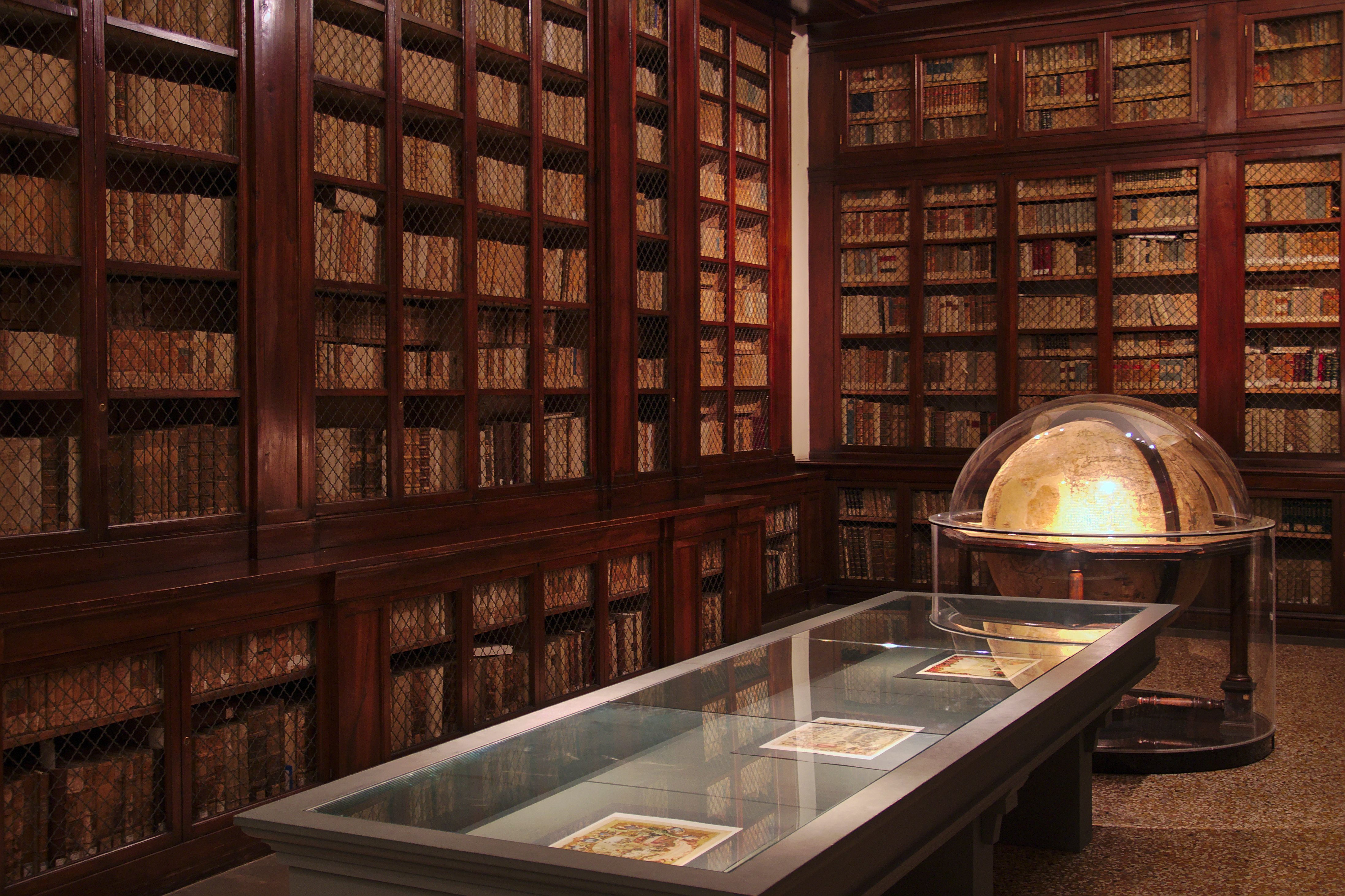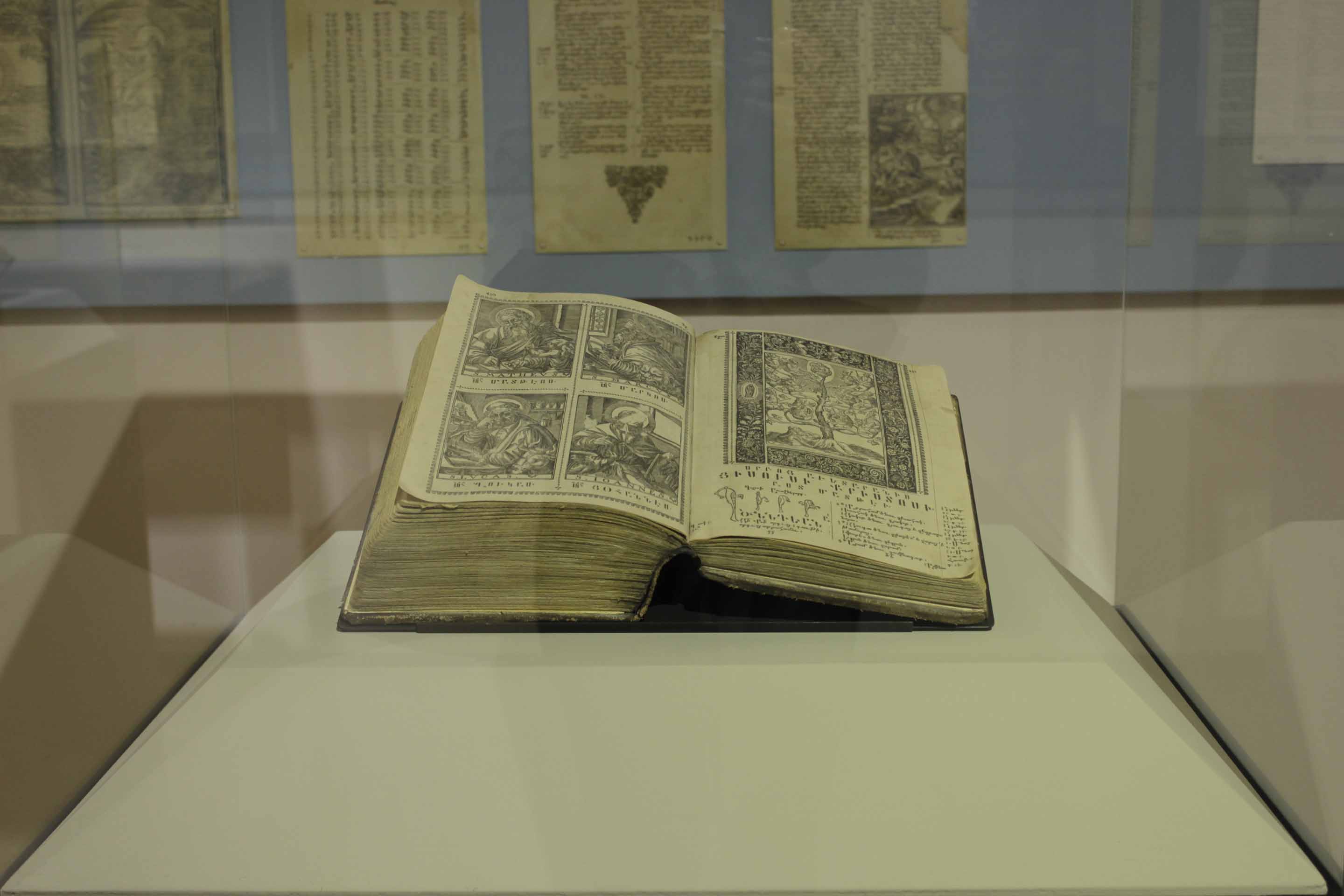
In the margins of a Gospel copied at Gladzor in 1323, two dragons open their jaws at the base of a plant-like design. Above them rises a tree-like form bearing the symbols of the four Evangelists, with a cross crowning the composition. The artist Toros Taronatsi placed it beside the opening of the Gospel of Luke. How did these creatures find their way into a Christian book, and why were they given such a prominent place?
This page, folio 141r of manuscript no. 6289 in the Matenadaran, helps us frame the question more precisely. The beasts are connected to the cross and to the page’s design; viewing them in isolation would strip away an essential part of their meaning. In Armenian manuscript illumination, dragons appear among letters, interlacing plant forms and architectural frames. To understand their role, we need to look at what surrounds each creature, read the text and learn the history of the book itself.
Look closely before naming the creature
A long neck, wings or a curling tail does not make every creature in a manuscript’s margins a dragon. Birds, lions and hybrid beings combining features of different animals also appear there. Artists also shaped the body to fit the design: stretching a neck along a line of text, bending a tail around the outline of a letter or weaving a head into a plant ornament. In work like this, the boundary between animal and pattern could shift.
A cautious description can therefore be more accurate than a striking name. If a museum describes an image as a bird or an animal-shaped ornament, we should not rename it for the sake of a good story. It helps to begin by tracing the whole design: where the body ends, whether it has feet and what the tail connects to. Even a familiar shape may turn out to be part of an initial. A reliable identification usually requires comparison with other images from the same period.
Why the margins?
The margins were part of a medieval book’s carefully considered design. Colorful decoration marked the beginnings and divisions of the text, helped the eye register a transition and brought a sense of ceremony to sacred reading. In its description of an Armenian Gospel from 1583, the Getty Museum explicitly notes that numerous small decorative motifs mark divisions in the text. This practical role matters: an ornate page could also be easy to navigate.
Another example is held at the Walters Art Museum in Baltimore. In the Gospel made by Toros Roslin at Hromkla in 1262, the opening letters of the first three Gospels are formed from the symbols of their authors; on John’s opening page, his symbol sits within the upright stroke of the initial. Here, a living creature helps construct the letter itself. If we admire only the individual animal, we can easily miss this connection between image and writing.
Dragons at the foot of the cross
Let us return to Toros Taronatsi’s page from Gladzor. The open jaws face a plant motif with a cross above it. Art historian Sara Kuehn discusses this composition among images in which the dragon may have a protective meaning. This is a scholarly interpretation of a particular group of works, taking into account the creatures’ positions, the central image and comparisons with architectural decoration.
Kuehn also cites an earlier example: the Mush Homiliary, or “Msho Charyntir,” made at Avag Vank in 1200–1202. On folio 492 of manuscript no. 7729, a lion’s head is joined to two dragon heads by interlacing plant forms. She compares this composition with protective imagery on buildings. It would be a mistake, however, to turn this interpretation into a rule for all Armenian manuscripts. A dragon in a narrative scene, beneath a cross or within an ornament may have different roles; an open mouth alone is not a sufficient explanation.
How a Chinese dragon entered an Armenian book
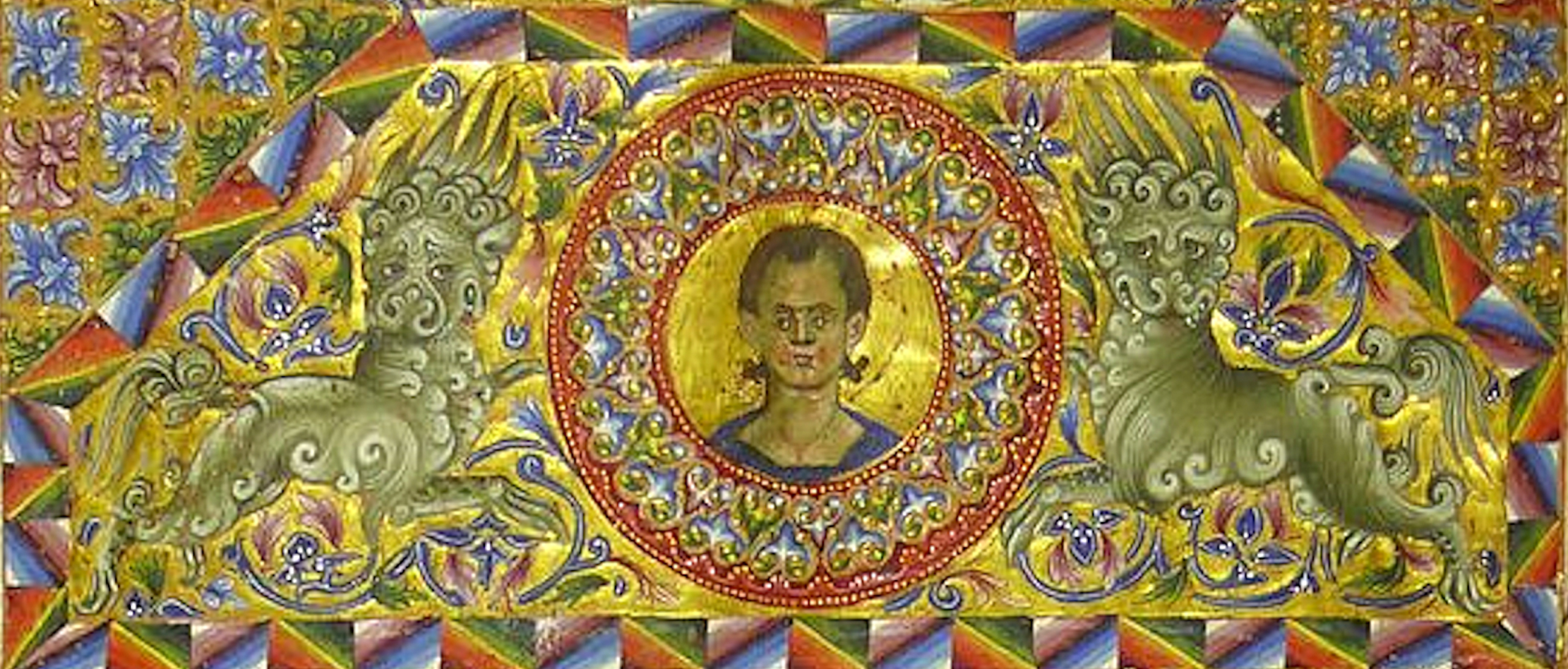
A particularly intriguing case involves Cilician Armenia and its contacts with the Mongol world. In 1286, a richly decorated lectionary was made for Prince Hethum, the future King Hethum II: a book of readings arranged according to the church calendar. It is now manuscript no. 979 in the Matenadaran. On folio 334, which opens the reading for the Feast of the Transfiguration, or Vardavar, dragons and phoenixes appear in the headpiece above the text. Here, our question extends beyond the margins to the design of the whole page.
Armenian studies scholar Dickran Kouymjian compared these creatures in detail with East Asian examples. The dragons have blue heads, open mouths and four-clawed feet; facing them are phoenixes. He connects the appearance of such motifs with courtly circles, diplomacy and the movement of luxury objects between regions. Among the likely carriers of these designs, he singles out Chinese and Central Asian silks that may have reached Armenian patrons as goods or gifts.
The precise route from a textile to this page cannot be reconstructed. Yet the comparison itself changes how we see the manuscript: it is the work of a workshop familiar with a much wider artistic world. Kouymjian also discusses the possible dynastic significance of the dragons and phoenixes. These conclusions should remain what they are: a scholar’s reasoned interpretation, rather than an explanation left by the artist. No such explanation by the artist is known to us.
What the book’s makers had to say
Commemorative notes, or colophons, sometimes tell us about the makers’ intentions. In the Gospel of 1262, Toros Roslin names the patron, a priest also called Toros, and writes of decorating the book with gold and various colors so that it would be dear to the children of the Church. The note does not explain individual ornaments, but it lets us hear the voice of someone who worked on the manuscript. The beauty of the page mattered both to him and to the person who commissioned the book.
This helps explain why a discussion of dragons cannot be reduced to a search for a hidden pagan message. Christian content, inherited artistic traditions, a patron’s taste and borrowed forms could coexist in a single work. Any claim that a particular motif has pre-Christian origins needs evidence of its own. Its unusual appearance establishes nothing by itself, just as neither the number of claws, nor the color, nor the presence of a flower beside it establishes a single meaning.
How to look at a page like this today
Begin with the page as a whole. Find the text, the initial, the headpiece and the margin; then trace how the creature connects to them. Look for a cross nearby, the figure of a saint or repetitions of the motif on neighboring pages. Finally, check the date, place of production and museum description. These simple steps help distinguish observation from guesswork and reveal the choices the artist made.
So why do Armenian manuscripts have dragons? In different books, they could help organize the text, form part of a religious composition or reveal familiarity with the prestigious visual language of another region. The precise answer lies on the particular page. That is what makes it worth returning to: first we notice a fantastical head, then make out a letter and a cross, and gradually glimpse the workshop, the patron and the world in which the book was made.