On 13 October 1668, the printing of the first complete Bible in Armenian was finished in Amsterdam. The work had taken two years and seven months, and preparations had begun long before the first sheets came off the press. Behind the book now known as the Voskan Bible lay a story of raising money, making type, and negotiating permission to publish. To put the book into the hands of readers in Armenian communities, its creators had to draw on the resources of several countries. [1, 3, 5]
By then, Armenians had been using printed books for more than a century and a half. In 1512, Hakob Meghapart published Urbatagirk in Venice; Armenian printing houses later opened in other European cities and in New Julfa, near Isfahan. They produced prayer books, psalters, and collections of liturgical texts. A complete Bible, however, demanded work and investment on an entirely different scale. A total of 156 years elapsed between the first printed Armenian books and the completion of the Amsterdam edition. [2]
Why the Path Led to the Netherlands
For a cleric planning to publish a religious book in Catholic Italy, having a printing house did not necessarily mean that work could begin. Ecclesiastical permission and a review of the text were required. Researcher David Neagu, who studied the correspondence surrounding Voskan’s publishing activities, describes a telling episode: conditional permission to print the New Testament could not be acted on because no reviewer could be found. Negotiations continued, and Catholic intermediaries could also support the publisher’s efforts. The project’s history involved specific conditions, reviews, and attempts to reach agreement, making it difficult to reduce the story to a single prohibition. [3]
Amsterdam offered a more favorable environment for printing religious literature in other languages and had experienced craftspeople. Matteos Tsaretsi arrived there in the 1650s with a commission to prepare an Armenian edition of the Bible. He ordered 170 punches and 240 matrices for Armenian type from the craftsman Christoffel van Dijck. A punch was used to make an impression in a matrix, from which metal letters were cast. Before even a single page could be typeset, the printing house needed its own supply of type. [4]
The Printing House Outlived Its Founder
Tsaretsi died in January 1661 before he could finish even the book he had begun, Jesus the Son. The enterprise was left in debt. The merchant Avetis Ghlijents rescued it by paying off the debts and continuing the printing work. The printing house was named “Holy Etchmiadzin and Saint Sargis,” bringing together the spiritual center of the Armenian Church and the monastery in Ushi where Avetis’s brother, Voskan Yerevantsi, was abbot. It was Voskan whom Avetis asked to come and take charge. [5]
Voskan had the necessary training, but he, too, had to find funding. In the Italian city of Livorno, three Armenian merchants originally from New Julfa agreed to finance the Bible. This publishing venture brought together a Church initiative and the diaspora’s trading connections. People living far apart took care of different parts of the project: some were responsible for the text, while others kept the printing house afloat and paid for the planned print run. [8]
This geography explains the choice of printing location better than the image of a lone craftsman suddenly finding himself in a foreign city. A small Armenian merchant community already existed in Amsterdam. According to the National Library of the Netherlands, its members traded in silk, carpets, spices, and coffee. The book could draw on a community accustomed to maintaining connections between European and Asian cities. [7]
A King’s Manuscript Becomes a Printed Book
The edition was based on a Bible copied in 1295 for the Cilician king Hetum II. The manuscript is now held at the Matenadaran as manuscript no. 180. Voskan brought it to Europe from the Monastery of Saint Sargis and prepared the text for printing. His work included checking it against the Latin Vulgate, changing the division into chapters and verses, and compiling indexes. Readers received a book with new reference tools that helped them find particular passages within a lengthy text. [6]
These decisions went beyond making the book easier to navigate. The influence of the Latin Bible on the contents and organization of the Armenian edition drew criticism. Armen Khachatryan’s research shows how carefully one must distinguish between the underlying manuscript, Voskan’s editorial work, and the characteristics of surviving copies. The printed edition continued a centuries-old Armenian tradition while also giving lasting form to the decisions of a particular editor. On 11 March 1666, Voskan and his assistants Karapet Andrianatsi and Ohan Yerevantsi began printing. [6]
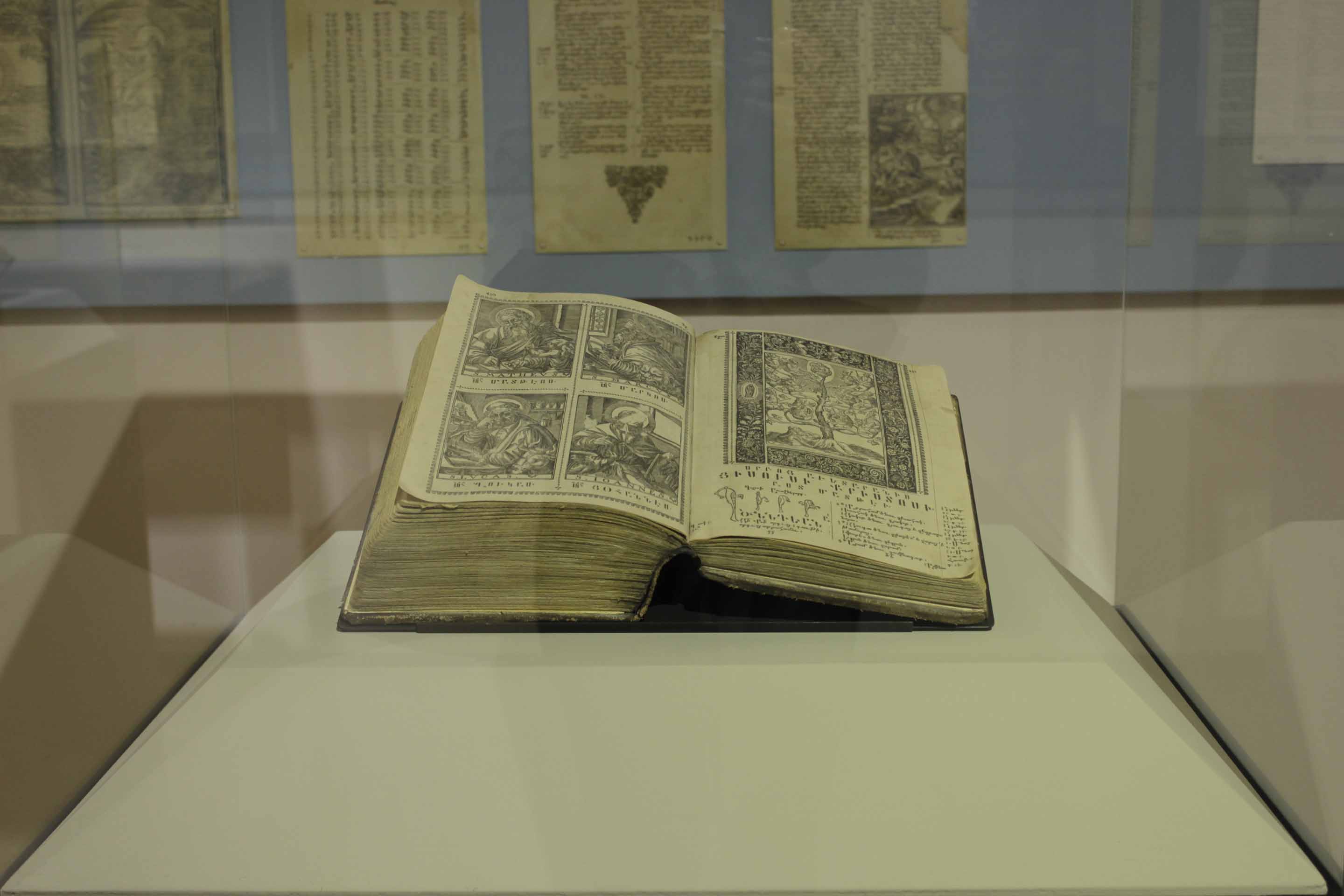
The scale of their work is evident in the book itself. The Museum of Printing in Yerevan describes the edition as a volume of 1,462 double-column pages with 159 illustrations. Dense typesetting appears alongside ornamentation and decorative letters. Christoffel van Sichem’s engravings had previously been used in the Catholic Biblia Sacra published in Amsterdam in 1657. In the new edition, European biblical scenes appeared alongside Armenian script and the animal-shaped initials familiar from the Armenian manuscript tradition. [1, 5]
What Happened After the Final Sheet
Completing the Bible did not bring the printing house financial stability. Costs remained burdensome, and Voskan soon moved some of the equipment to Livorno before continuing his work in Marseille. Even completing a commission of such importance did not spare the publisher the need to seek new conditions in which to work. [5]
Meanwhile, Armenian books printed in Amsterdam were intended for a much wider readership than the local community. A substantial share of the publications, including the Bible, was sent to the Ottoman Empire and Iran. A long journey by sea and overland could separate the place where a book was produced from the place where it was read. The Dutch trading city became part of the cultural life of communities thousands of kilometers away. [4]
Other publishing work developed alongside the Bible project. The list of Armenian books published in Amsterdam during this period includes primers, calendar books, a collection of fables, a geographical work, and Arakel Davrizhetsi’s Book of Histories. Later, another Armenian printing house in Amsterdam published children’s books introducing arithmetic, geography, and natural science. Printing made it possible to share an ever-wider range of knowledge in Armenian. [2, 7]
The story of the Voskan Bible helps explain how a culture was sustained when its readers lived in different countries. It took people who could prepare the text, pay off a debt, make type, and deliver the finished books. Their contributions are rarely visible when an early printed volume sits behind museum glass. Yet it was the joint work of clerics, merchants, and printers that explains why one of the most important Armenian books of the seventeenth century appeared in Amsterdam and was able to travel far beyond it.