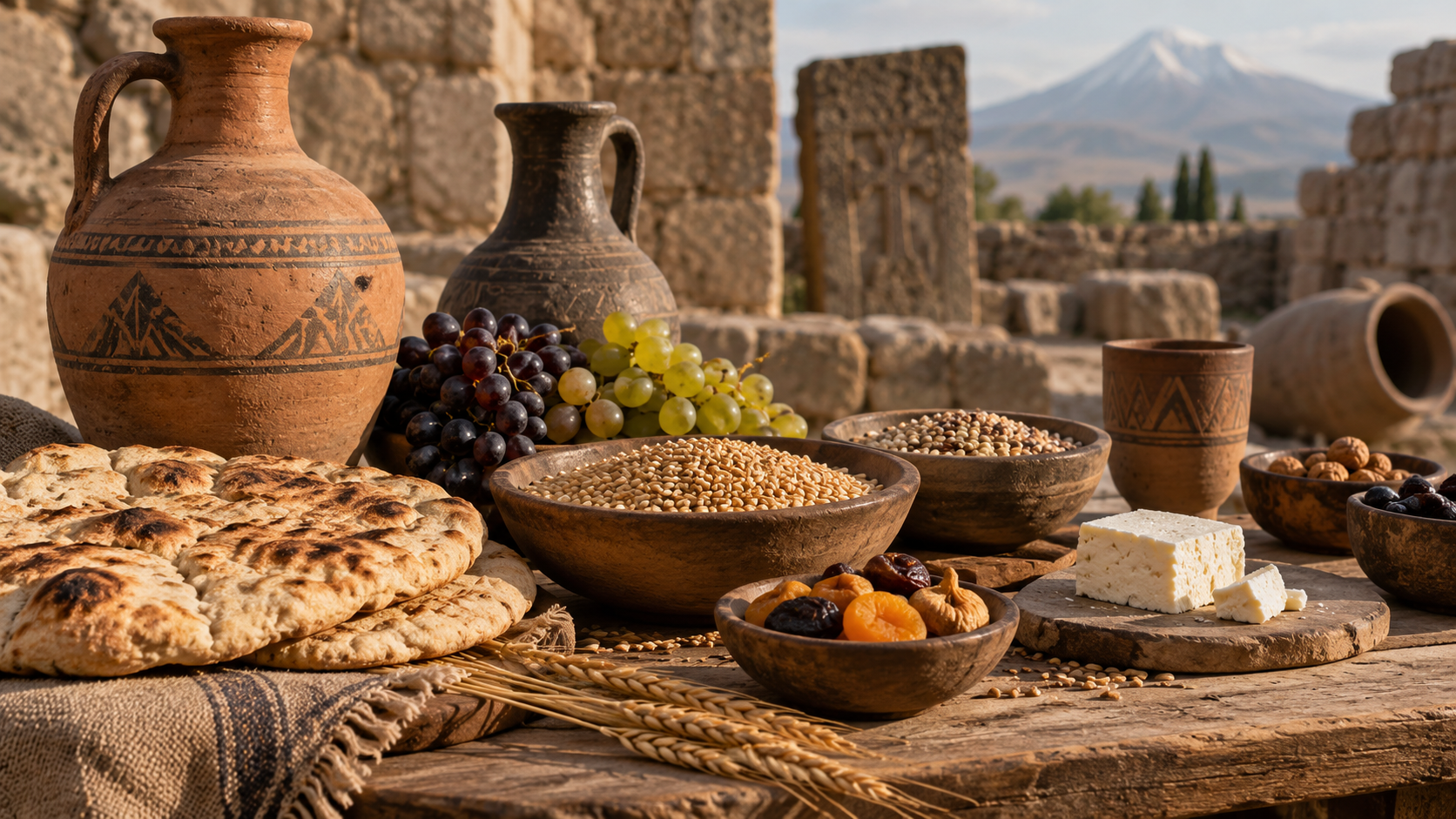
If we could somehow attend a dinner in Artashat two thousand years ago, much of what we saw would feel familiar: grain, meat, wine, and products from animal husbandry. But the moment we tried to reconstruct an exact “menu of ancient Armenia,” we would run into a problem. People of that era left almost no recipes, and archaeologists rarely recover a ready-made meal. Instead, they find charred grains, fruit pits, animal bones, broken pots, enormous storage jars, and sometimes traces of what those containers once held.
It is from these fragments that the picture of food in ancient Armenia is being reconstructed today. In recent years, that picture has become far more precise thanks to new excavations at Artashat, the capital of the Artaxiad Kingdom. Since 2018, an Armenian-German archaeological expedition has been systematically studying the lower city, while specialists in ancient plants, animal remains, and ceramics work alongside the excavators. As a result, we can now discuss not what Armenians “must have eaten because they eat it today,” but what products actually left material evidence.
One of the most reliable ways to look into an ancient kitchen is to study burned seeds. For a person living two thousand years ago, grain that fell into a fire was simply wasted food. For an archaeologist, however, charring can become a form of preservation: organic material stops decomposing in the usual way and may survive underground for centuries. At Artashat, researchers have identified hundreds of such plant remains, and cereals clearly dominate among the cultivated crops. Of the identified species, free-threshing wheat appears especially prominently — a type that can be separated from its husk relatively easily after threshing and processed for food.
This does not mean that the inhabitants of the capital lived on wheat alone. Archaeobotanical research points to a much more diversified agricultural system, with crops that had different requirements for soil and water. That diversity reduced the danger of losing the entire harvest to bad weather. In a society where one failed agricultural year could mean not a modest rise in prices but real hunger, such a strategy was vital. Ancient farming, in other words, was far less primitive than it is sometimes imagined: farmers had to understand local conditions and spread risk without modern weather forecasts or agricultural laboratories.
What people actually made from the grain is much harder to determine. We can say with confidence that cereals were eaten, processed, and stored, but we cannot look at a handful of ancient wheat and declare that it was used to bake a specific kind of bread or cook a particular porridge. This is where the line between history and attractive legend becomes important. A modern dish may have very old roots, but the antiquity of one ingredient does not prove that the same dish existed two thousand years ago in the same form, with the same name and recipe.
When it comes to meat, archaeologists rely on another kind of refuse: bones. Recent studies of thousands of animal bones from Artashat cover roughly the period from the 2nd century BC to the 2nd century AD, the very era in which the ancient city flourished. The picture is fairly clear: sheep and goats played a particularly important role, and their numbers are high enough for researchers to speak of a marked specialization in animal husbandry. Cattle were also present, but a cow was not simply a source of meat. It could provide years of service as draft power, helping to plow fields and move heavy loads.
Chickens and geese were also kept within the urban environment. That fact alone makes the ancient table feel more concrete: we are no longer imagining only herds grazing beyond the city walls, but domestic birds living within the city itself. Yet caution is still necessary. A chicken bone proves the presence of poultry, but it does not tell us how the bird was cooked, which seasonings were used, or who actually ate the meat. Excavations answer the question “what was available?” much better than “what recipe was prepared?”
Livestock provided far more than meat. Sheep and goats could supply milk and wool, while cattle could provide milk as well as labor. But archaeology should not turn possibility into proof. We cannot confidently identify a specific kind of cheese or matsun simply because milk-producing animals were present unless there is direct evidence from vessels, residues, or other analyses. This is one of the strengths of modern food archaeology: the most useful conclusions often begin with “we can confirm,” rather than “it seems logical to assume.”
One product, however, is particularly well documented in ancient Armenia: wine. The Ararat Plain offered favorable conditions for viticulture, and cities such as Armavir, Artashat, and Vagharshapat had surrounding agricultural territories where grape growing and winemaking were important parts of the economy. Archaeologists have found wine-related vessels, production installations, and images of grapevines. Seals from ancient Artashat even depict vessels, grape clusters, and vine leaves, imagery that researchers associate in part with the wine trade.
Wine was not simply a drink for festive occasions. It was a commodity that could be stored, transported, and sold, which means that an entire economic system existed around it — from vineyards and harvests to vessels, cellars, and commerce. Artashat has also produced unusual zoomorphic vessels, including bear-shaped examples from the 1st–2nd centuries AD associated with serving wine. Such objects remind us that food and drink were not merely about satisfying hunger and thirst. They could be used in ceremonies, display status, and become part of artistic culture.
Pottery itself is another major source of information. In the 2nd–1st century BC layers of Artashat, archaeologists find high-quality tableware, including red-burnished ceramics stylistically connected with the Hellenistic world. In later residential contexts, coarse utilitarian wares become especially visible: cooking pots and large storage vessels. This matters because it allows us to move beyond the ceremonial face of the capital and into the ordinary home. Where there is a cooking pot by the hearth and a jar for storing food, palace history gives way to everyday life.
The pottery of Artashat also reveals something else: the capital did not simply import everything fashionable from abroad. Scientific analysis of the clay has shown that most of the studied vessels were made in local workshops. Even pottery that imitated prestigious forms from the Hellenistic East could have been produced directly in Artashat. The result is a familiar pattern for a capital at the crossroads of cultures: local food and local production existed within a much wider world through which vessel shapes, technologies, and dining habits circulated.
This is especially important when we try to imagine an “Armenian cuisine” of antiquity. Ancient Armenia did not exist under a glass dome. Artashat was a major city on international routes, and its inhabitants were connected with the Iranian, Mesopotamian, and Hellenistic worlds. Material culture makes those contacts visible. Food inevitably existed within the same sphere of exchange: products, storage methods, vessels, and ideas about how a table should look all moved with people.
At the same time, social inequality meant that there was no single “ancient Armenian diet.” The royal court, a wealthy urban household, a craftsman, and a farmer did not necessarily eat the same foods or the same quantities. The archaeological record is also uneven. A beautiful vessel from an elite complex is more likely to attract attention than the everyday food of a poor family, which may leave almost no trace at all. Reconstructing ancient cuisine therefore requires combining many different kinds of evidence rather than searching for one ideal table that supposedly represents an entire society.
There is another temptation as well: the desire to prove, at all costs, that every modern national dish is ancient. We know that grain and grapes were cultivated in Armenia for thousands of years and that sheep and goats were widely raised. But this does not automatically prove that a person living under Tigranes the Great ate modern lavash, modern dolma, modern khorovats, or any other dish with the same recipe, name, and method of serving that exists today. Culinary traditions can preserve very old elements, but dishes change along with technology, trade, religion, and the ingredients available at a given time.
The real story may be more interesting than trying to declare every modern recipe “two thousand years old.” We can reconstruct with reasonable confidence a table where grain-based foods, sheep and goat meat, products of animal husbandry, and wine all played important roles. We can see large ceramic vessels filled with provisions, cooking pots used near hearths, tableware, and a city surrounded by agricultural land. But between those secure facts there remains a space where recipes still have to be reconstructed, and sometimes an honest “we do not yet know” is more valuable than an attractive invention.
One of the most fascinating things about food archaeology is that the most ordinary finds become historical documents. A charred grain that an ancient householder would have thrown away without a second thought can tell us about agriculture two thousand years later. A bone from kitchen refuse reveals patterns of animal husbandry. A broken cooking pot shows where food was prepared and stored. A seal with a grapevine motif can point toward commerce. Dozens of such clues together bring back into history something that chroniclers almost never considered worth describing in detail: an ordinary meal.
So if we ask what people ate in Armenia around two thousand years ago, the answer is both simple and complicated. We know many of the principal foodstuffs. We know which animals were raised. We can see the importance of wine production and study the pottery used in kitchens and households. What we do not have is an ancient restaurant menu listing individual dishes by name.
Instead, we have something more reliable: refuse that nobody intended to leave to future generations.
And that refuse has become one of the most honest sources we possess for the everyday life of ancient Armenia.