Sometimes a discovery begins not when a scientist sees something entirely new.
Sometimes it begins when he looks at familiar objects and asks a question that almost no one had seriously asked before.
Why are these stars together?
And why does such a system still exist at all?
In the late 1940s, Viktor Ambartsumian was studying groups of very hot, young stars in our Galaxy. They did not resemble ordinary dense star clusters. The stars were spread relatively far apart, and their motions suggested something unusual: such systems could not remain stable for billions of years.
They had to be gradually dispersing.
That meant that if we could still observe them as recognizable groups, they could not be very old.
From this, Ambartsumian reached a conclusion that became extremely important for astrophysics: there are young stellar systems that formed relatively recently on cosmic timescales, and the process of star formation in our Galaxy is still continuing.
He called these systems stellar associations.
Today, the idea that stars continue to form inside clouds of gas and dust is part of our basic understanding of the universe. But in the middle of the 20th century, demonstrating the youth and dynamical instability of stellar associations became an important argument that star formation was an ongoing process rather than something confined to the distant past.
One of the scientists who played a key role in establishing that idea did not build his scientific school in California, Cambridge, or Paris.
He built it on the slopes of Mount Aragats.
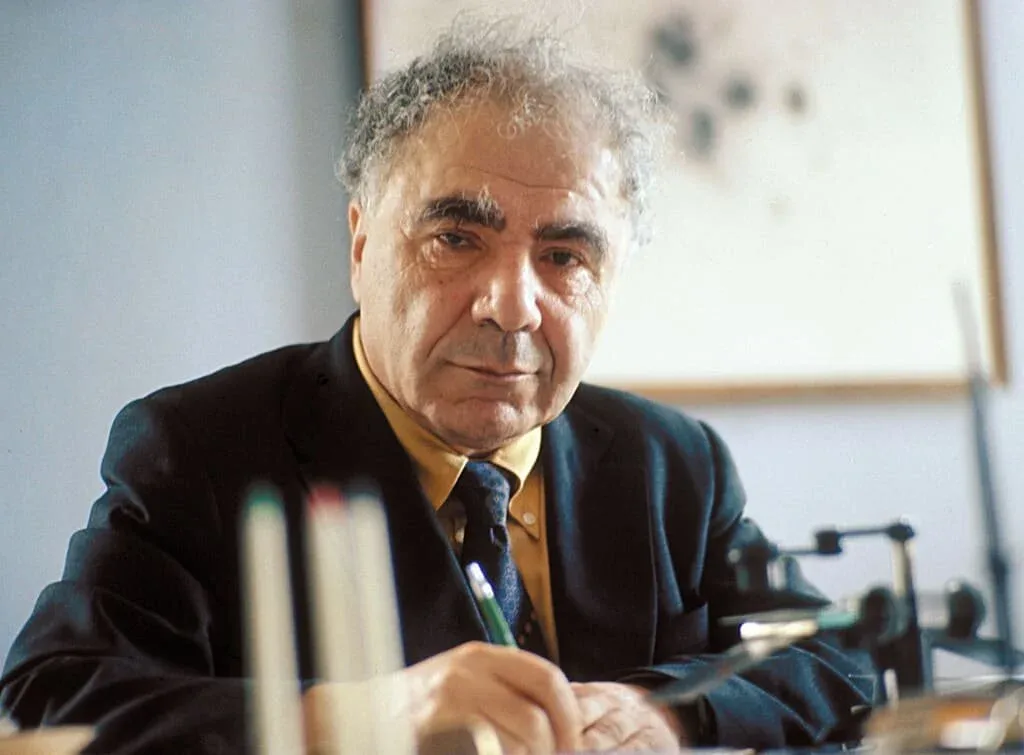
Viktor Hamazaspovich Ambartsumian was born on September 18, 1908, in Tiflis, into an Armenian family. His father, Hamazasp Ambartsumian, was a philologist and translator. Among his works was an Armenian translation of Homer’s Iliad.
The future astrophysicist therefore grew up in a home connected not with telescopes, but primarily with language, literature, and the humanities.
Yet Viktor’s interests turned toward mathematics and the natural sciences at an early age.
As a teenager, he was already fascinated by astronomy. In the 1920s, he left to study in Leningrad. In 1928, Ambartsumian graduated from Leningrad University in astronomy and continued his scientific training at Pulkovo Observatory.
He was barely twenty when his first scientific papers began to appear.
This is important for understanding the rest of his career. Ambartsumian did not first become a powerful scientific administrator and only later turn to research.
The opposite happened.
First came the young theorist capable of working on extremely difficult physical problems. Only later did university departments, scientific teams, and eventually an entire observatory begin to form around him.
One of the subjects he worked on early in his career was the physics of gaseous nebulae.
A star rarely exists in perfectly empty space. Interstellar gas and dust absorb, scatter, and re-emit light. To understand what a telescope actually sees, scientists need to understand what happens to radiation as it passes through matter.
Ambartsumian worked on the theory of radiative transfer and the scattering of light. The principle of invariance that he developed offered new ways of solving difficult problems involving radiation passing through scattering media. These methods later found applications beyond the astronomical problems for which they were first developed.
This was a side of Ambartsumian that was less visible to the general public.
No spectacular photograph of a newly discovered galaxy.
No dramatic explosion in a telescope.
Instead: theoretical physics, equations, and an attempt to understand what happens to light before it reaches the observer.
Yet work of this kind made his name known among professional astrophysicists long before the creation of Byurakan Observatory.
By the mid-1930s, Ambartsumian was already teaching at Leningrad University. In 1934, he founded the first department of astrophysics in the Soviet Union there.
He was only twenty-five years old.
Over the following years, he studied stellar systems, interstellar matter, nebulae, and stellar physics. He was interested not simply in where celestial objects were located, but in their lives: how they formed, how they changed, and why the universe looked the way it did.
Then came the war.
In 1941, scientific divisions of Leningrad University were evacuated to Yelabuga. Ambartsumian took part in organizing the work of the university laboratories under evacuation conditions. Scientific activity continued in circumstances far removed from normal academic life.
In 1943, the Academy of Sciences of the Armenian SSR was established.
Ambartsumian became one of its founders and its first vice president.
That decision gradually changed not only his own life, but Armenia’s place on the scientific map.
He moved to Yerevan.
Armenian science now faced a simple but enormous question: could a serious modern school of astrophysics be built here almost from scratch?
In 1946, the Byurakan Astrophysical Observatory was founded.
The site was chosen on the southern slope of Mount Aragats, near the village of Byurakan. Its elevation, relatively clear air, and observing conditions made the area suitable for astronomical research.
Today, the observatory appears as an established scientific complex with telescopes, domes, and research buildings.
At the beginning, everything was far more modest.
The first researchers carried out observations with small instruments while the infrastructure was still being built. Buildings went up, equipment was acquired, a scientific school was formed, and the main directions of research were defined.
Ambartsumian was not simply the man whose name appeared on the founding documents.
He became the observatory’s first director and scientific leader and remained closely associated with it for decades.
And almost immediately after the creation of Byurakan came the discovery with which his name became most firmly established in the history of astrophysics.
Ambartsumian analyzed the spatial distribution of hot stars of spectral types O and B, as well as young variable stars of the T Tauri type.
Some of these groupings were too sparse to behave like ordinary stable star clusters.
Gravity was not strong enough to hold such systems together for extremely long periods.
This led to a powerful conclusion.
If an association is gradually expanding and dispersing, but we still observe it as a group, then it must have formed relatively recently.
Ambartsumian classified such systems into types, including OB associations and T associations.
The significance of the discovery extended far beyond classification.
The youth of stellar associations indicated that the birth of stars was not an event that had ended in the distant youth of the Galaxy.
Stars are still forming.
In 1949, Ambartsumian also predicted the expansion of stellar associations. Later observations and research strengthened the understanding of their dynamical instability and young age.
From the perspective of modern astrophysics, the idea may seem almost obvious.
We see images of star-forming regions.
We know about protostars.
We observe young stellar objects.
But scientific “obviousness” appears only after someone builds a system of evidence.
That was the importance of Ambartsumian’s work.
He helped transform the question “Can stars still be forming?” into a physical process that could be investigated through observation.
But his picture of a young and changing universe did not stop there.
Ambartsumian became increasingly interested in objects that could not be understood as quiet and unchanging systems.
Young stars.
Ejections of matter.
Non-stationary processes.
Activity in galaxies.
During the second half of the 20th century, the study of variable and active objects became one of the defining characteristics of the Byurakan scientific school.
Ambartsumian’s ideas about the activity of galactic nuclei were particularly bold.
In the 1950s, he argued that the nuclei of galaxies could be regions of extraordinary activity and could play an important role in the evolution of galactic systems.
Today, active galactic nuclei are fundamental objects in modern astrophysics. Their enormous energy output is associated with processes occurring around supermassive black holes.
Ambartsumian did not have the modern physical picture of supermassive black holes that developed later. Some of his own hypotheses about the nature of galactic nuclei did not become part of the accepted modern model.
But his insistence that galactic nuclei should be studied as sites of powerful activity proved highly productive.
He encouraged astronomers to look at galaxies not merely as calm collections of stars, but as systems capable of hosting processes of enormous energy in their central regions.
That scientific approach influenced the later work of Byurakan Observatory as well.
Astronomer Benjamin Markarian and his colleagues later began large-scale spectral surveys of the sky.
The First Byurakan Survey identified many galaxies with unusually strong ultraviolet emission. They became known as Markarian galaxies.
In this way, the scientific ideas of one generation continued through the work of the next.
Byurakan gradually became a place whose name professional astronomers knew far beyond Armenia.
This is perhaps one of the most interesting aspects of Ambartsumian’s legacy.
He left behind more than his own scientific papers.
He created an environment in which other people could make discoveries.
Building a scientific school is far more difficult than constructing a building with a telescope.
It requires students.
Teachers.
Observers.
Theorists.
Engineers.
International connections.
And decades of continuous work.
Ambartsumian worked on all of these levels at once.
From 1947, he headed the Academy of Sciences of the Armenian SSR and remained its president until 1993, after which he became honorary president.
Almost the entire second half of the 20th century in Armenian academic science unfolded with his direct participation.
Yet his position was not limited to the Soviet Union.
Ambartsumian was elected a member or honorary member of numerous foreign academies and scientific societies.
From 1961 to 1964, he served as president of the International Astronomical Union, one of the leading professional organizations in world astronomy.
For a scientist from a small Soviet republic, this level of international recognition cannot be explained by administrative position alone.
He was known above all because of his scientific work.
Over the course of his life, Ambartsumian worked in fields ranging from mathematical physics and radiative transfer to stellar dynamics, the origin of stars, nebulae, and galactic activity.
Not all of his hypotheses survived later scientific scrutiny.
That is how science works.
A great scientist is not someone whose every idea remains correct forever.
A great scientist is someone who asks questions, creates methods, and opens directions that force others to look at a problem differently.
Ambartsumian had that quality.
At times, he challenged prevailing ideas with unusual boldness.
At times, he proposed models that were later replaced by other explanations.
But again and again, he pushed astronomy to search for signs of evolution, youth, and activity in places where it was easier to imagine the universe as slow, stable, and unchanging.
In that sense, many different areas of his research were connected by one underlying idea.
The universe is not a motionless museum of celestial objects.
It acts.
Stars are born.
Systems disperse.
Matter moves.
Galaxies become active.
The sky has a history.
Ambartsumian spent much of his life in Byurakan. His house stood near the observatory and later became a museum.
He died on August 12, 1996, and was buried in Byurakan, near the tower of the large telescope.
The geography of his life became almost symbolic.
He was born in Tiflis.
He studied and became a scientist in Leningrad.
He achieved international recognition.
But the central place of his life became an Armenian village on the slopes of Aragats.
It was there that a scientific school emerged that made the name “Byurakan” part of the international history of astronomy.
Today, it is especially easy to judge science by the size of a country.
Large states build enormous telescopes, launch spacecraft, and operate with billion-dollar budgets.
The history of Byurakan reminds us of something else.
Sometimes a scientific center appears because a group of people decides to ask world-class questions from a place that had never before been regarded as a world center of science.
Ambartsumian could have continued his career in the largest scientific institutions of the Soviet Union.
Instead, he devoted a significant part of his life to creating such a center in Armenia.
And that may be no less important a part of his legacy than any individual formula or discovery.
He did not simply study the stars.
He created a place from which Armenia could study the universe at the level of the leading scientific schools of its time.
And his most famous discovery contained an idea that fits his own biography surprisingly well.
Even where a system appears already formed, something new can still be born.
Ambartsumian saw that among the stars.
And then, by the same principle, he showed that major science could be born in Byurakan.