Imagine that we know the name of an ancient capital, know the ruler who built it, possess accounts describing its enormous walls, palaces, and wealth, and even know the details of a battle fought outside the city — yet still cannot point with complete confidence to its exact location on a modern map.
That is the story of Tigranakert.
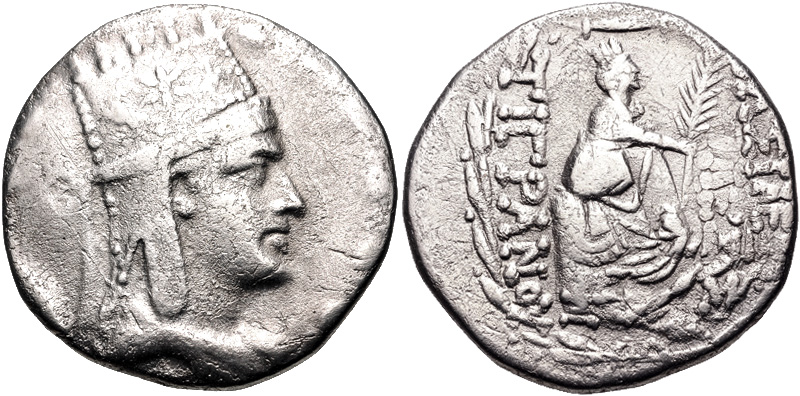
In the 1st century BC, it became the new capital of the empire of Tigranes II the Great, the most powerful Armenian king of the ancient period. Greek and Roman authors described the city. Roman legions besieged it. We know why it was built and who was brought there to populate it.
Yet the exact location of the principal Tigranakert remains a matter of scholarly debate.
The reason is not simply that the city disappeared.
There was more than one Tigranakert.
Tigranes the Great founded or renamed several cities in his own honor, and over the centuries the same name became associated with different regions of historic Armenia. As a result, when a researcher encounters the name “Tigranakert” in an ancient or medieval source, it is not always immediately clear which city is being discussed.
To understand why one king might need several cities bearing his name, we first need to understand the scale of the changes taking place during the reign of Tigranes.
When Tigranes II came to the throne around 95 BC, Artashat in the Ararat Plain remained the traditional political center of Armenia. Over the following decades, however, the boundaries of his kingdom changed dramatically. Tigranes brought a number of neighboring territories under his control, extended his influence into northern Mesopotamia, Syria, and other regions, and adopted the title “King of Kings.”
Artashat was now too far north for the greatly expanded state.
Tigranes needed a new capital.
It had to stand closer to the geographical center of his new possessions, control the routes connecting the Armenian heartland with northern Mesopotamia and Syria, and at the same time project the king’s new political status.
This is how the principal Tigranakert was created.
The name itself was direct: “the city of Tigranes.” The Armenian element “-kert” is associated with building or creating, so Tigranakert could be understood literally as a city built by Tigranes.
This practice was not unusual in the Hellenistic world. Alexander the Great founded cities named Alexandria. Seleucid rulers established cities called Antioch and Seleucia. A ruler was not simply constructing an urban center — he was placing his own name onto the political map.
Tigranes was acting within the same international tradition.
But his new capital was meant to be far more than another administrative center.
Ancient authors describe it as a grand Hellenistic-style city. Tigranes transferred people there from different parts of his realm. Strabo reports that inhabitants of several Greek cities were resettled in the new capital. Craftsmen, merchants, and urban populations were brought from Cappadocia, Cilicia, Adiabene, Corduene, and other regions.
Some of these relocations were forced.
That point should not be romanticized. By modern standards, this was coercive population transfer. In the monarchies of the ancient Near East and Hellenistic world, however, moving populations was one of the tools rulers used to create new administrative and economic centers.
Tigranes wanted a major city quickly.
He was not going to wait several generations for a small settlement to grow naturally into a capital.
As a result, Tigranakert was multicultural and multilingual from the beginning. Its population was expected to sustain commerce, crafts, administration, and the royal court.
Royal parks and hunting grounds lay around the city. Ancient testimony allows us to imagine Tigranakert both as an Armenian royal residence and as a city shaped by the urban principles of the wider Hellenistic world.
And here the first paradox appears.
The capital intended to symbolize the lasting power of a new empire served in that role for only a short time.
In 69 BC, a Roman army commanded by Lucius Licinius Lucullus approached Tigranakert.
One of the central causes of the conflict was Tigranes’ relationship with Mithridates VI of Pontus, his father-in-law, who had sought refuge in the Armenian king’s territories after suffering defeats at the hands of Rome. Tigranes refused to surrender Mithridates.
The Romans invaded Armenia.
Near Tigranakert, one of the best-known battles of the Roman-Armenian wars took place. Tigranes’ army was defeated, and the city fell to Lucullus.
According to the ancient sources, the new capital had not even been fully completed at the time.
That is one of the most striking details in the entire story: the city designed as the great symbol of Tigranes’ empire was captured by an enemy before its construction was fully finished.
After the fall of the city, many people who had been forcibly resettled there were able to return to their former homes. The political project of the capital had been closely tied to the fate of the empire for which it had been built.
After 69 BC, Tigranakert’s role changed, but the city did not immediately disappear. Sources continued to mention it in later centuries. It appears again in military events during the 1st century AD and remained a notable urban center into Late Antiquity.
And yet today a simple question remains.
Where was it?
There is still no final answer.
Researchers are relatively confident about the general region. The principal capital of Tigranes should be sought in the southwestern part of historic Armenia, in the region of Aghdznik, associated by Greco-Roman authors with Arzanene, not far from northern Mesopotamia.
But that does not give us an exact location.
For more than a century, historians have proposed different sites.
One of the most famous candidates was modern Silvan. For a long time it was widely identified with ancient Tigranocerta, and this theory appeared in numerous books, atlases, and popular publications.
Modern Diyarbakır has also been proposed.
Other researchers have searched for the city near Kızıltepe, Tell Armen, in the Siirt region, and at several other locations.
Today, one of the strongest candidates is ancient Arzan, or Arzn, in the Tigris basin. Historian Michał Marciak, after comparing the ancient literary evidence, regional geography, and the major proposed locations, concluded that Arzan currently appears to be the most plausible candidate.
But “most plausible” does not mean “proven.”
A final identification would require archaeological evidence that could be connected to the new capital of Tigranes II with little serious doubt.
That combination of evidence has not yet been found.
This is why a professional historical account should not simply state: “Tigranakert was located here.”
A more accurate formulation is that the general region is approximately known, several competing hypotheses exist, and the precise location of the capital remains unresolved.
But the story becomes even more complicated.
While researchers continue to search for the principal Tigranakert, other cities with the same name appear in written sources and archaeological discussions across different parts of historic Armenia.
Traditional Armenian historical geography usually recognizes at least several Tigranakerts. In addition to the capital in Aghdznik, the name is associated with Golt'n, Utik, and Artsakh.
For that reason, the number four is often repeated.
But it would be misleading to present this as an undisputed official list of four cities personally documented by Tigranes the Great.
No royal inscription has survived saying, “I founded four Tigranakerts.”
The picture has been reconstructed from sources written in different centuries, historical geography, place names, and archaeology. Some scholars use broader language and speak simply of several or numerous settlements that bore the king’s name.
So the question “How many Tigranakerts were there?” has a surprisingly complicated answer.
We know for certain that there was more than one.
Four is the best-known traditional scheme for historic Armenia.
But the final number depends on which settlements we regard as true foundations of Tigranes II, which may have been renamed under his rule, and which may have acquired or preserved a similar name later.
One of the most interesting examples of how archaeology can enter this debate lies far from the proposed location of the principal capital, in the lower valley of the Khachenaget River.
In 2005, an expedition from the Institute of Archaeology and Ethnography of the National Academy of Sciences of Armenia identified a major ancient city there that researchers interpreted as Tigranakert of Artsakh.
Large-scale excavations were carried out from 2006 to 2020.
What archaeologists uncovered was not a small settlement with an impressive name.
It was a real city.
The ancient urban area covered more than 70 hectares. Archaeologists identified massive fortifications, a citadel, urban districts, a necropolis, a winery, water infrastructure, and sections of a canal system.
Some of the defensive structures were cut directly into the bedrock. Excavations revealed hundreds of meters of fortification walls.
The layout of the ancient districts also shows features associated with Hellenistic urban planning: straight alignments, regular walls, and rectangular organization of space.
This is particularly significant.
Tigranes the Great built cities at a time when Armenia was deeply connected to the broader Hellenistic cultural world. Archaeology here reveals not merely the existence of a settlement, but the use of urban and defensive principles characteristic of that period.
At the same time, this Tigranakert was not the southern capital captured by Lucullus in 69 BC.
It was another city with the same name.
And that reveals the central trap in the entire subject.
Finding a “Tigranakert” does not automatically mean finding the capital of Tigranes the Great.
The name alone proves nothing.
The early medieval historian Sebeos adds another layer to the problem by referring to two Tigranakerts in the eastern part of historic Armenia, located relatively close to one another. One is associated with Utik and the other with Artsakh.
In other words, even medieval authors had to distinguish between cities that shared the same name.
For 21st-century historians, the problem has only become more complicated.
Why did Tigranes establish several cities in his own name?
The answer was probably not simply personal vanity, although the public display of a ruler’s name was certainly part of the political culture of the period.
New cities were tools for organizing a vast state.
The realm of Tigranes included very different regions, from the Armenian heartland to territories with Hellenized cities in Syria and Mesopotamia. Governing such a system exclusively through old local centers was difficult.
A new city could serve as a fortress.
An administrative headquarters.
A center of commerce.
A place for concentrating population.
A base for royal power within a specific region.
And the name of Tigranes turned that urban center into a political statement.
A person entering Tigranakert was literally entering “the city of Tigranes.”
Geography became propaganda.
In this sense, a network of Tigranakerts may tell us even more about the state of Tigranes than a single palace or battlefield.
It reveals an attempt not merely to conquer an enormous territory, but to organize it.
Yet that entire project was closely tied to one ruler.
After his defeats in the war with Rome, Tigranes retained the Armenian throne but surrendered most of his conquests. His enormous empire rapidly contracted to its core Armenian territories.
The new capital, built for a far larger geopolitical world, now found itself in a position where much of its original strategic logic had disappeared.
Artashat regained special importance.
This explains another paradox of Tigranakert.
Tigranes built a new capital because Artashat lay too far north for his expanded empire.
A few years later, the empire shrank — and now Tigranakert itself was too far from the new political center.
The city was architecture created for a particular geopolitical moment.
That moment ended before the city itself had even been fully completed.
But the name survived longer than the empire.
It remained in written sources, geographical traditions, and several archaeological sites.
That leaves us today with an unusual situation.
One of the most famous cities of ancient Armenian history is well described in written sources, yet its precise location remains debated.
At the same time, another Tigranakert has been discovered and studied in far greater archaeological detail, but it was not the capital described by Plutarch and Appian.
And somewhere between written sources, ancient roads, ruins, and modern maps lie the other cities that bore the name of the same king.
So the question “Where was Tigranakert?” is not quite the right question.
First, we have to ask:
Which Tigranakert?
Only then can the search begin.