Seen from a distance, Garni can give the impression that a small ancient temple was somehow transported from Greece or Rome and placed on the edge of an Armenian gorge. Its Ionic columns, elevated podium, monumental entrance, and triangular pediment evoke the classical architecture of the Mediterranean world. Yet Garni was not a foreign structure that happened to appear in Armenia. It emerged within the political and cultural environment of Arsacid Armenia and became one of the clearest examples of interaction between local traditions and the Hellenistic and Roman worlds.
More importantly, the famous temple is only one part of a much larger complex. Behind its columns lies the story of an ancient fortress, a royal residence, baths with mosaic floors, a Christian church, a devastating earthquake, and one of the best-known restorations in the history of Armenian architecture.
Garni Existed Long Before the Famous Temple
The history of this site begins long before the 1st century AD. Archaeological research shows that the territory of Garni was inhabited in deep antiquity. The area already had strategic importance during the Urartian period, and a cuneiform inscription of King Argishti I connects the region with the expansion of the Urartian state in the 8th century BC.
After the fall of Urartu, the area continued to form part of the political landscape of Armenian states. Garni became especially important during the Artaxiad and Arsacid periods. The location was almost ideal for a fortress: the Garni plateau forms a natural promontory surrounded on several sides by the deep gorge of the Azat River. Nature itself created a powerful defensive position, while the more accessible approach was additionally protected by stone walls and towers.
Garni was therefore not simply an attractive royal residence. It was a strategically important stronghold controlling one of the approaches to the Ararat Plain.
Garni and the Armenian Kings
In antiquity, Garni functioned as both a fortress and a royal residence. The Roman historian Tacitus mentions a fortified place known as Gorneae, which scholars associate with Garni. The complex became particularly important during the reign of the Armenian king Tiridates I.
His reign came at a time when Armenia stood between the two greatest powers of the region — the Roman Empire and the Parthian Kingdom. The struggle for the Armenian throne became part of the wider Roman-Parthian confrontation. Eventually, an unusual political compromise was reached: the Armenian king would remain a member of the Parthian Arsacid dynasty, but he would receive his crown from the Roman emperor.
In AD 66, Tiridates I traveled to Rome, where Emperor Nero formally crowned him. After the king returned to Armenia, a new phase of construction and restoration began at royal centers. The famous colonnaded building at Garni is most often associated with this period.
When Was the Temple Built?
The most widely accepted interpretation dates the building to the second half of the 1st century AD, during the reign of Tiridates I. Of particular importance is a Greek inscription discovered at Garni in 1945, which mentions King Tiridates and the eleventh year of his reign.
On the basis of this inscription, construction at the complex has traditionally been associated with AD 77. However, an important qualification is necessary. Popular accounts often present this date as the unquestionably established year in which the surviving temple itself was built, while the scholarly picture is more complicated.
The inscription does refer to building activity by Tiridates at Garni, but its exact connection with the surviving colonnaded structure, as well as the interpretation of parts of the text, continues to be discussed by researchers. It is therefore more accurate to say that the monument is generally dated to the 1st century AD and associated with Tiridates I, while its precise dating remains a matter of scholarly debate.
To Whom Was Garni Dedicated?
Almost every tourist guide describes Garni as a temple dedicated to Mihr, an Armenian deity associated with sunlight and related to the Iranian Mithra. This is the most common interpretation of the monument and is based on the religious history of pre-Christian Armenia as well as a number of indirect indications.
However, a traditional interpretation should be distinguished from a fully established fact. No direct dedicatory inscription survives that clearly states that the building was a temple of Mihr. Some scholars have proposed other interpretations, including the possibility that the structure served a royal funerary or commemorative function.
The most accurate formulation, therefore, is that Garni is traditionally regarded as a pagan temple, probably associated with the cult of Mihr, while the building’s exact original function continues to be debated. This uncertainty makes the monument even more fascinating: nearly two thousand years after its construction, some of the most fundamental questions about its purpose remain unresolved.
Why Does Garni Look Like a Greek Temple?
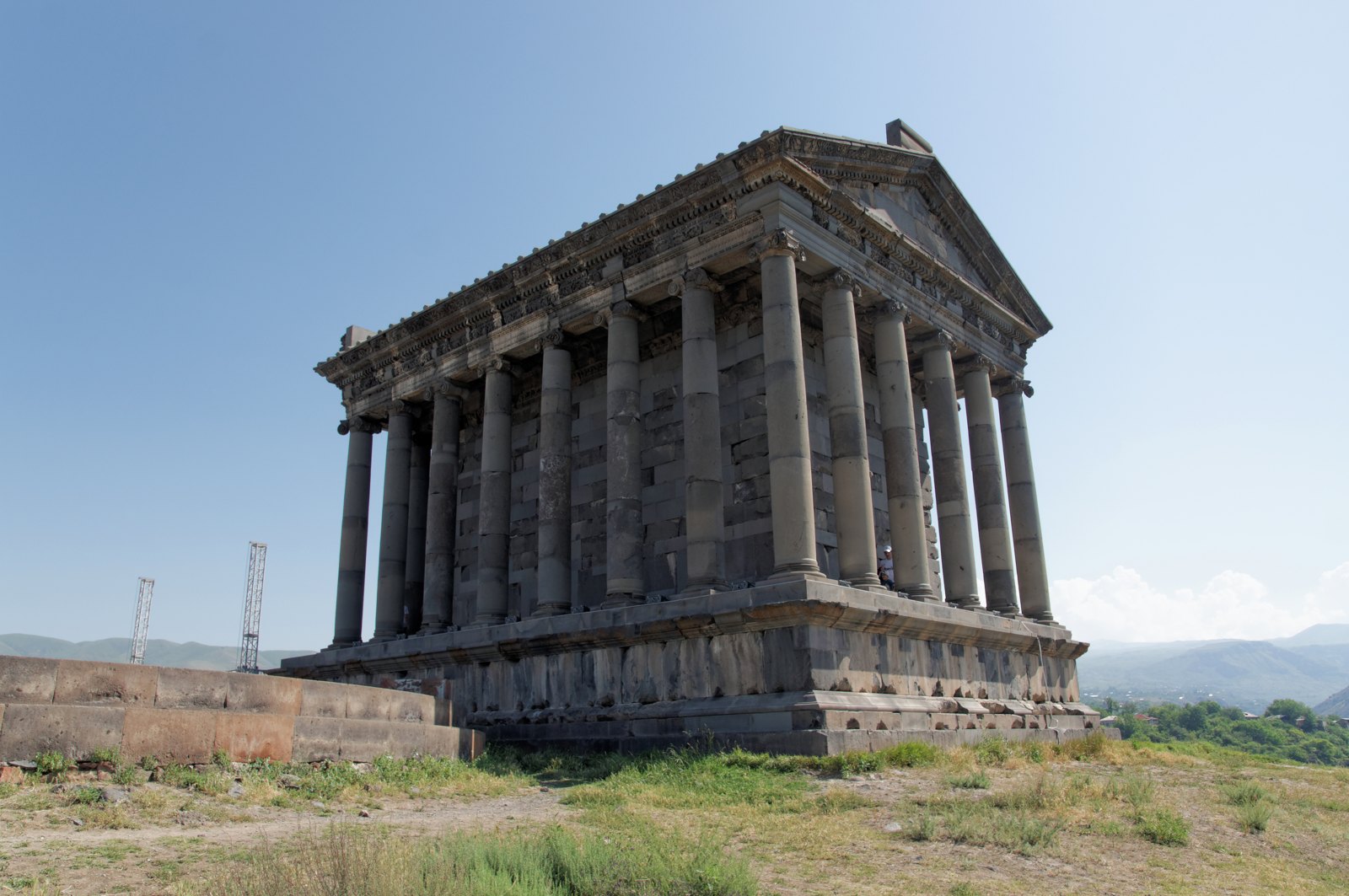
Garni’s most obvious feature is visible at first glance. Its architect used a composition derived from the classical Greco-Roman architectural tradition. The building stands on a high stone podium, a broad monumental staircase leads to the main entrance, and 24 Ionic columns surround the structure.
Above the columns runs the entablature, while the principal façade ends in a triangular pediment. At the center is an enclosed chamber, or cella. If we consider only the overall composition, Garni is indeed closely related to ancient temples of the Mediterranean world. A closer look, however, shows that it is not simply a copy of a Greek monument.
An Ancient Form in Armenian Stone
One of Garni’s most important distinctions lies in the material itself. The monument is built from local basalt. The dark volcanic stone gives the building a very different character from the pale marble associated with many famous Greek structures.
The stone blocks were carefully cut and joined with metal fastenings. Decorative carving is especially striking: cornices, capitals, and other architectural elements feature vegetal and geometric motifs. Here, the classical order is combined with artistic solutions that belonged to the local cultural environment.
For this reason, Garni is far more interesting than the simple label “a Greek temple in Armenia” suggests. It is a monument of cultural exchange created within the Armenian kingdom at the intersection of several cultural worlds. Armenia stood between Rome, Iran, the Caucasus, and the eastern Mediterranean and interacted with all of them. Garni’s architecture reflects that reality exceptionally well.
Why Exactly 24 Columns?
The structure is surrounded by 24 Ionic columns. Popular stories sometimes claim that each column symbolized one hour of the day. There is, however, no reliable historical evidence for such symbolism.
The number of columns is primarily determined by the architectural composition of the building. This is a good example of how easily modern legends can develop around an ancient monument. Garni’s real architecture is interesting enough without the need for invented symbolism.
More Than a Temple: The Royal Complex of Garni
One of the most common misunderstandings about Garni is the idea that only a single isolated building once stood here. In reality, this was an entire fortified royal complex.
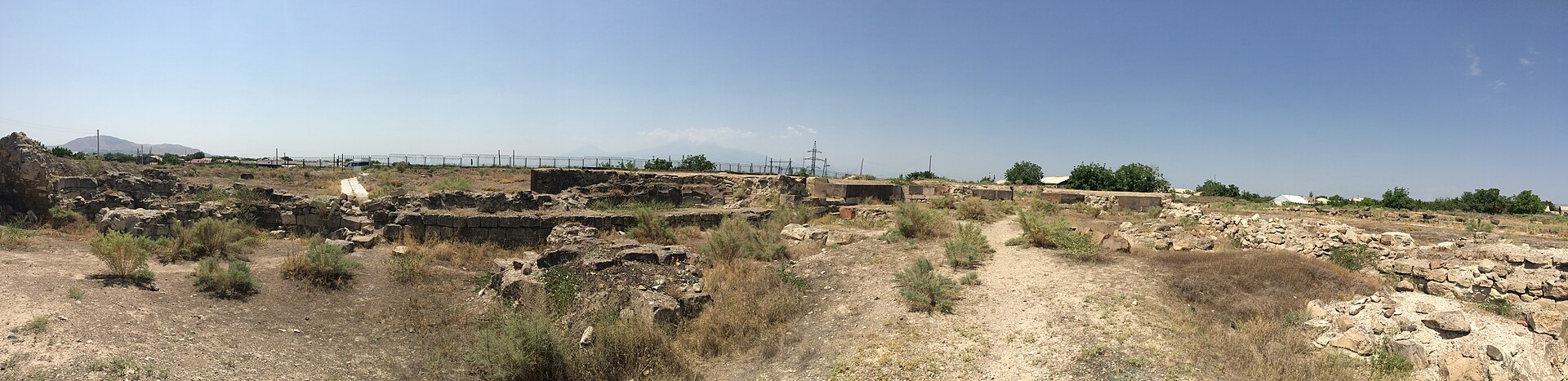
Archaeologists have discovered remains of palace buildings, defensive walls, service structures, and a bath complex. In other words, a visitor arriving here nearly two thousand years ago would not have seen a lone temple overlooking the gorge. They would have encountered a complete fortified residence of an Armenian ruler.
The temple was simply the most monumental part of this environment and the one that is best known today.
Royal Baths and Heating Beneath the Floor
Remains of an ancient bath complex survive near the temple. They are especially important because they reveal something about daily life at an Armenian royal residence.
The baths used a hypocaust system — an underfloor heating method widely known in the architecture of the Roman world. Floors were raised on small supports, allowing hot air to circulate beneath them and heat the rooms from below. This technology demonstrates how closely the architectural and engineering culture of Armenia at the time was connected with broader traditions of the ancient world.
But the value of the baths goes beyond their heating system. One of their most remarkable features is the surviving mosaic.
Ocean and the Sea in the Heart of Armenia
The floor of one of the bath chambers was decorated with an elaborate mosaic composition. It depicts marine creatures and figures from Greek mythology. At the center are Oceanus and a marine divine figure, surrounded by other characters, fish, and sea-related motifs.
For a landlocked country, such imagery may seem particularly striking. The inscriptions on the mosaic are written in Greek. One of the best-known phrases is usually translated approximately as: “We worked without receiving anything.”
What exactly the craftsmen meant is unknown. It may have been a complaint about payment, or perhaps a formula whose precise meaning has been lost. Whatever its meaning, the mosaic is important evidence of the cultural environment of ancient Armenia. Far from the Mediterranean Sea, an Armenian royal residence used an artistic language that was understood across the wider Hellenistic world.
What Happened After the Adoption of Christianity?
In the early 4th century, Armenia adopted Christianity. Pre-Christian sanctuaries gradually lost their former religious role, and many were destroyed or transformed.
Garni is an unusual case because the colonnaded building survived. Why it escaped the fate of many other pagan monuments is not known with certainty. One common explanation is that Garni continued to serve as a royal residence and that the building may have lost its original religious function.
Later tradition associated the complex with the royal family and, in particular, with Khosrovidukht, the sister of Tiridates III. Whatever the precise circumstances, the site was not abandoned. The Christian period simply added another historical layer to Garni.
A Christian Church Beside the Ancient Structure
In the 7th century, the Church of Surb Sion was built immediately beside the ancient monument. Today, only its ruins survive.
Its construction created an extraordinary architectural juxtaposition: a classical colonnaded structure and a Christian church stood almost side by side. This makes visible the way Armenia changed over time and how new historical periods were layered over earlier ones.
Garni should therefore not be understood only as a monument of pre-Christian Armenia. It is an archaeological record of several historical eras at once.
Medieval Garni
Life at Garni continued after antiquity. The fortress remained in use during the Middle Ages, and the site came under the control of different Armenian rulers and princely houses at various times.
Khachkars, inscriptions, and monuments belonging to an entirely different artistic tradition appeared here. Within a relatively small area, Garni preserves traces of prehistoric settlement, Urartu, the Hellenistic world, Arsacid Armenia, early Christianity, and medieval Armenian culture.
It is this historical layering that makes Garni far more significant than a single impressive ancient building.
The Earthquake That Destroyed the Temple
On June 4, 1679, a powerful earthquake struck the region. It caused severe damage to Yerevan and many settlements across Eastern Armenia. The ancient structure at Garni also failed to withstand the shock.
The colonnade and much of the upper structure collapsed. For nearly three centuries, the famous appearance of Garni as we know it today effectively did not exist. Large sections of columns, cornices, and stone blocks lay scattered across the plateau.
Yet the fact that so many of these elements remained close to the monument later made something extraordinary possible: the structure could be assembled again.
How Garni Was Restored Almost 300 Years Later
Research on the ruins became increasingly systematic in the 19th and 20th centuries. Archaeologists and architects documented surviving elements, studied the plan, and attempted to reconstruct the original appearance of the building.
Large-scale archaeological investigations of the Garni fortress began in 1949. One of the leading specialists to study the monument itself was the architect Alexander Sahinian. A restoration project was approved in late 1968, and work began in 1969, continuing until 1975.
The restoration followed the principle of anastylosis. The aim was not to build a modern replica of an ancient structure, but to return surviving original elements to their presumed historical positions. Many of the stones scattered after the earthquake were studied and reused, while new elements were introduced where original material was missing.
Modern Garni therefore cannot accurately be described as simply a replica or a newly built imitation. It is a restored ancient monument containing a substantial amount of original historical material. At the same time, it is important to understand that the complete appearance visible today is the result of a major scholarly restoration carried out in the 20th century.
Why Garni Matters to the History of Armenian Architecture
Armenian architecture is most often associated with medieval churches — Etchmiadzin, Zvartnots, Geghard, Tatev, Haghpat, and many other monuments. Garni reminds us that the architectural history of Armenia began long before the Christian Middle Ages.
Before domed churches, there were fortresses, palaces, sanctuaries, public buildings, and royal residences. Garni provides one of the rare surviving opportunities to see the architecture of that earlier world.
At the same time, it represents not an isolated culture but an Armenia that actively participated in the international world of its age. The classical order stands beside Armenian basalt; Greek inscriptions are linked to the history of an Armenian royal dynasty; Roman engineering techniques appear alongside local building traditions; and the pre-Christian past exists beside later Christian architecture.
The Garni Gorge as Part of the Monument
The architecture of Garni is difficult to separate from the landscape in which it stands. The temple rises almost directly above the enormous gorge of the Azat River.
Below lies one of Armenia’s best-known natural monuments — a system of basalt columns commonly called the “Symphony of Stones.” These geometric vertical formations were created naturally as volcanic lava cooled and contracted.
The result is a remarkable visual relationship. Above, people created a colonnade from basalt. Below, nature formed its own basalt “colonnade.” Architecture and geology become part of the same landscape.
This is one reason Garni often makes a much stronger impression in person than it does in a simple photograph of the façade.
Garni and UNESCO
In 2025, Armenia added the “Archaeological Complex of Garni and the Basalt Organ” to UNESCO’s Tentative List of World Heritage sites.
The distinction is important. Garni is not yet inscribed on the UNESCO World Heritage List. Inclusion on the Tentative List means that the state is considering the site for possible future nomination to the main list.
The proposal includes not only the ancient temple but the entire archaeological complex together with the natural landscape of the gorge and the famous Basalt Organ. This approach is logical because the significance of Garni lies in the site as a whole.
It is not enough to look only at the 24 columns.
Garni Is More Than a Pagan Temple
Calling Garni simply a “pagan temple” is convenient, but it is far too limited.
This is a place whose history began long before the famous colonnade was built and continued long after the disappearance of Armenia’s pre-Christian religion. Garni was a fortress and a royal residence, a center of monumental ancient construction, a place with a palace and baths, and later a site where a Christian church stood nearby.
Medieval generations left their own traces here. An earthquake nearly destroyed the principal monument of the complex, and almost three centuries later Armenian specialists reassembled it using surviving ancient stones.
Garni makes the workings of history particularly visible. One era rarely erases the previous one completely. More often, one layer is placed over another.
That is why the ancient columns standing on the edge of an Armenian gorge do not look foreign here.
They stand exactly where they were raised nearly two thousand years ago — within the history of Armenia.