About 35 kilometers south of modern Yerevan, near the village of Hnaberd, lie the ruins of a city that was once one of the largest political and economic centers of the entire South Caucasus.
This is Dvin.
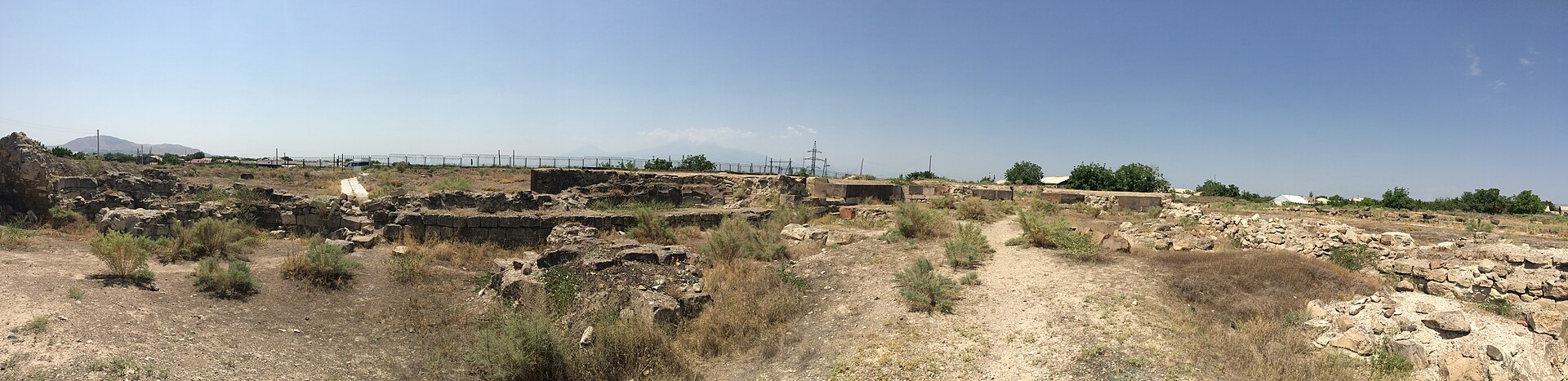
Unlike Ani, where monumental walls and churches still rise above the landscape, the former grandeur of Dvin is much harder to imagine today.
Much of the city remains underground or survives only at the level of foundations.
Yet for centuries, this was where the residences of Armenia’s rulers, state archives, the seat of the Armenian Catholicos, craftsmen’s workshops, and markets connected to international trade were located.
Dvin lived through the age of the Sasanian Empire, wars with Byzantium, the Arab conquest, devastating earthquakes, the Bagratid period, and a renewed revival under the Zakarian princes.
The history of the city spans nearly a thousand years of struggle for one of the most important centers of the Armenian Highlands.
Dvin Existed Long Before It Became a Capital
The history of Dvin is often begun with the 4th century and King Khosrov Kotak.
Archaeology, however, shows that people lived here much earlier.
Traces of settlement on the territory of Dvin reach deep into antiquity.
Excavations have revealed material dating to the 3rd, and possibly even the 4th millennium BC.
UNESCO also notes evidence of settlement from the 2nd millennium BC and the existence of a fortified site as early as the 1st millennium BC.
Archaeologists have also discovered substantial material from the Hellenistic period.
Dvin therefore did not suddenly emerge in the 4th century.
The future capital developed in a place that had been inhabited and used for thousands of years.
Was Dvin Founded by Khosrov Kotak?
According to Armenian historical tradition, the development of Dvin is associated with King Khosrov III Kotak, who ruled in the 4th century.
He is credited with building a royal palace and establishing a large royal reserve in the surrounding area.
Popular accounts often state that Khosrov Kotak founded Dvin and immediately transferred the capital there from Artashat.
That claim, however, should be treated with caution.
Archaeology proves that a settlement existed here long before Khosrov, while modern scholars consider the evidence insufficient to state with certainty that Dvin had already become Armenia’s new capital during his reign.
It is therefore more accurate to say the following.
In the 4th century, the area of Dvin gained special importance as a place associated with royal authority, but its undisputed role as the principal administrative center belongs to a later period.
A Capital After the Fall of the Arsacid Kingdom
The year 428 became a turning point for the city.
That was when Sasanian Persia finally abolished the rule of the Armenian Arsacid dynasty in the eastern part of Armenia.
There was no longer an Armenian king.
But the administrative system did not disappear completely.
Dvin became the principal center of Persian Armenia.
The marzpan — the governor of Armenia appointed by the Sasanian Empire — had his residence here.
His palace and the state archives were located in the city.
In effect, after the disappearance of the Armenian monarchy, Dvin continued to function as the political center of the country, even though supreme authority now belonged to the Sasanian shahanshah.
This was one of the most unusual periods in the history of the city.
Dvin was a capital without its own king.
State Archives and Palaces
Dvin’s importance was not determined by its size alone.
The administration of a large part of Armenia was concentrated here.
Government offices operated in the city, along with archives that preserved documents connected with the administration of different regions of the country.
Members of the Armenian aristocracy also lived around the residence of the marzpan.
The city therefore became a place of constant interaction between the Armenian nobility and the Sasanian administration.
Archaeological excavations have uncovered remains of palace complexes and administrative buildings.
Researchers, however, caution that the precise dating and original function of some structures are still debated.
Dvin is gradually being revealed not as a single palace or fortress, but as a complex urban organism.
One of the Main Centers of the Armenian Church
The political importance of the city was soon joined by religious significance.
In the second half of the 5th century, Dvin became the residence of the Armenian Catholicos.
Over the following centuries, major church councils were held here.
Questions of church administration, theology, and the relationship of the Armenian Church with other Christian centers were discussed in Dvin.
The councils of the 6th century were especially important.
At one of them, the Armenian Church definitively rejected the decisions of the Council of Chalcedon and consolidated its own ecclesiastical tradition.
Dvin is also associated with the development of a distinct Armenian ecclesiastical calendar.
The exact dating of some of the councils remains a matter of scholarly discussion, but the importance of the city itself is beyond doubt.
At one stage, Dvin was both the administrative center of Armenia and the seat of the head of the Armenian Church.
The Great Cathedral of Saint Gregory
One of the principal structures of Dvin was the cathedral dedicated to Saint Gregory the Illuminator.
It was built in the early medieval period and was later reconstructed several times.
Archaeological research has revealed a large three-aisled basilica and a number of adjoining structures.
Armenian sources associated the site of the cathedral with an earlier Zoroastrian sanctuary.
This reflects the complex history of Dvin particularly well.
For several centuries, the city stood at the intersection of Armenian Christian and Iranian religious-political traditions.
It was here that the religious policy of the Sasanian state could come into direct conflict with the resistance of Armenian Christian society.
The Fire Temple and the Revolt Against the Sasanians
Sasanian rulers repeatedly attempted to strengthen the influence of Zoroastrianism in Armenia.
Dvin, as the administrative center of Persian Armenia, became one of the main places where this policy was implemented.
Sources mention the construction of a Zoroastrian fire temple in the city.
Archaeologists have also found evidence associated with structures of this kind.
In 571–572, religious and political tension developed into a major revolt against Sasanian rule.
The construction of a Zoroastrian temple in Dvin became one of the immediate causes of the conflict.
The struggle of great powers over Armenia was therefore not only a question of territory.
It also concerned religion, political autonomy, and the structure of Armenian society.
A City of Craftsmen and Merchants
Dvin was far more than an administrative capital.
It was one of the major economic centers of the region.
Weavers, potters, jewelers, and many other craftsmen worked in the city.
Local textile production was especially renowned.
Sources mention famous carpets and fabrics from Dvin that were traded far beyond Armenia.
Archaeological finds reveal developed pottery production, glassmaking, metalworking, and jewelry manufacture.
The city’s location also allowed it to participate in international trade.
Roads connected Dvin with Iran, Mesopotamia, the Caucasus, and more distant regions of Central Asia.
As ancient Artashat gradually declined, Dvin took its place as one of the most important commercial centers of the region.
Between Persia and Byzantium
Dvin’s geographical position brought wealth to the city.
But the same location also made it a constant target of military campaigns.
In the 6th and 7th centuries, Armenia stood between two superpowers of its time — Sasanian Persia and the Byzantine Empire.
The border between their territories changed repeatedly.
After the territorial settlement of 591, Dvin found itself very close to the new Byzantine-Persian frontier, while remaining on the Sasanian side.
At the beginning of the 7th century, one of the most devastating wars between the two empires began.
In 623, the Byzantine emperor Heraclius captured Dvin during his campaign against the Sasanians.
The city suffered serious destruction.
But soon a new power emerged that would transform the entire political map of the region.
The Arab Conquest
In the first half of the 7th century, the Arab Caliphate expanded rapidly.
The Sasanian Empire collapsed, while Byzantium lost vast territories.
Armenia also came under attack from the new armies.
In 640, Arab forces captured Dvin.
A new era began.
In Arabic sources, the city was known as Dabil.
Dvin became one of the principal administrative centers of Arab rule in Armenia and for a long period served as the residence of the caliphate’s governor.
But a change of political power did not mean the disappearance of the city’s Armenian population and culture.
Dvin continued to be a large multiethnic and multireligious center where different commercial and cultural traditions intersected.
Dvin Did Not Disappear After the Rise of the Bagratid Kingdom
In the 9th century, Armenian statehood was restored under the Bagratids.
Dvin, however, did not become the capital of the new kingdom.
The Bagratid kings established their political centers in other cities, and later Ani became the principal capital.
Even so, Dvin remained important.
During the 9th and 10th centuries, the Armenian Bagratids and various Muslim emirs fought for control of the city.
To control Dvin was to control a wealthy commercial center and a strategically important part of the Ararat Plain.
The city experienced a particularly noticeable revival during the reign of Gagik I Bagratuni at the end of the 10th and beginning of the 11th century.
Interestingly, a substantial part of the archaeological material discovered at Dvin belongs precisely to the Bagratid period.
In other words, the city continued to develop even when it was no longer the principal capital of the country.
The Earthquake of 893
Armenia lies in a seismically active region, and Dvin suffered from earthquakes more than once.
One of the most destructive occurred in 893.
The city sustained severe damage.
Many buildings were destroyed or seriously damaged.
Historical sources give very high numbers for the dead, but modern researchers treat such medieval estimates cautiously.
The exact number of victims cannot be established today.
Archaeology, however, confirms major destruction and the subsequent reconstruction of urban structures.
Once again, Dvin did not disappear.
The city was rebuilt and continued to exist for several more centuries.
The Final Revival
By the 12th century, Dvin had changed hands repeatedly.
Different regional rulers controlled the city, while constant warfare gradually weakened it.
At the beginning of the 13th century, however, another period of revival began.
The Zakarian princes grew powerful in Eastern Armenia.
Under their rule, many Armenian cities experienced economic and cultural renewal.
Dvin also gained an opportunity to recover from earlier conflicts.
But this final period of prosperity was short-lived.
A new power was approaching from the east.
The Mongols and the End of the Great City
In the 1230s, Mongol armies invaded the region.
Between 1233 and 1236, Dvin was destroyed.
Unlike earlier catastrophes, after which the city had repeatedly returned to life, this time it never regained its former importance.
Trade routes were changing.
Political centers were moving elsewhere.
The population gradually abandoned the ruined city.
Dvin, which for centuries had survived the rise and fall of kingdoms, empires, and conquerors, ultimately became an archaeological site.
What Archaeologists Have Found
Systematic excavations at Dvin began in the 20th century.
From 1937 onward, archaeologists investigated different parts of the ancient city.
They uncovered remains of fortifications, palaces, the cathedral, the residence of the Catholicos, residential houses, craft workshops, and engineering structures.
Thousands of objects from everyday life have been found.
Pottery, jewelry, coins, seals, glass, and metal objects allow us to reconstruct the life of the city in far greater detail than written chronicles alone.
The archaeological layers of different periods are especially important.
The same city preserves traces of the Hellenistic age, Arsacid Armenia, Sasanian administration, the Arab period, the Bagratids, and the Zakarians.
Dvin is literally made up of historical periods layered one above another.
Dvin Today
Today, there is no modern metropolis on the site of the enormous medieval city.
Visitors see hills, the foundations of ancient buildings, and several reconstructed sections of the archaeological complex.
For this reason, Dvin may appear less visually dramatic than Ani or Garni.
But here, it is necessary to look not only at what rises above the ground.
The most important part still lies beneath it.
The archaeological site of Dvin has been included by Armenia on UNESCO’s Tentative List of World Heritage sites.
Its particular value lies in its exceptional historical continuity.
For centuries, the same city was connected with Armenian kings, Sasanian marzpans, Catholicoi, Arab governors, Bagratids, and Zakarian princes.
Empires disappeared around it.
Borders changed.
Religions and political systems came into conflict.
Yet Dvin was rebuilt again and again.
That is why its history is not simply the story of another vanished capital.
It is the story of how one Armenian city remained at the center of the region’s political, religious, and economic life for nearly a thousand years.