Some creations begin as solutions to a specific problem and eventually become something far greater. The Armenian alphabet was created in the early 5th century as a writing system for the Armenian language, but it quickly became a foundation for literature, education, theology, historiography, book art, and the preservation of Armenian culture itself. More than sixteen centuries later, Armenian letters are still used to write books and messages, print newspapers, design typefaces, build websites, and create apps. At the same time, the letters remain artistic forms: they have been carved into stone, transformed into manuscript ornamentation, and woven into carpets and embroidery.
By the beginning of the 5th century, Armenia was already a Christian country, but its political situation was becoming increasingly complex. After the division of the Armenian kingdom, the country found itself between two powerful political and cultural spheres — the Roman Empire and Sasanian Persia. Greek and Syriac were widely used in worship and education. Sacred texts were read in those languages and then explained to the people in Armenian. For a society whose primary spoken language was Armenian, the absence of a fully developed writing system of its own was a serious limitation.
This does not mean that Armenians had no experience with writing before Mesrop Mashtots. Different writing systems had been used in Armenia for centuries, including Aramaic, Greek, Middle Persian, and others. Scholars have also debated whether there were earlier attempts to write Armenian. But by the beginning of the 5th century, there was no generally accepted writing system capable of fully representing the Armenian language and supporting literature, education, and widespread church use.
The solution to this problem is associated above all with Mesrop Mashtots. He was born around the middle of the 4th century in the province of Taron, received an education, knew several languages, and for a time served in the royal administration. He later devoted himself to religious and educational work. It was during his missionary activity that he encountered the problem directly: spreading education and transmitting Christian texts in Armenian was extremely difficult without a suitable writing system.
The creation of the alphabet was not the private project of one man working alone. Mashtots acted with the support of Catholicos Sahak Partev and the Armenian king Vramshapuh. That cooperation was essential. Creating a writing system required more than inventing signs. Schools had to be established, translators trained, people taught to read and write, and the new system introduced into public life. The support of both the church and royal authority made this possible.
Armenian sources tell us that an earlier attempt was made to use the so-called Danielian letters, a set of characters associated with a Syriac bishop named Daniel. It was hoped that these signs could be adapted for Armenian. In practice, however, the system proved unable to represent all the sounds of the Armenian language accurately. Mashtots needed more than an approximate way of writing Armenian speech. He needed a complete alphabet suited to the phonetic structure of the language.
Around AD 405, that system was created. The original Armenian alphabet consisted of 36 letters. One of its greatest strengths was the unusually close correspondence between the sounds of the language and the written signs. Mashtots was certainly familiar with Greek, Syriac, and other writing traditions, but the system he created was not simply a copy of an existing alphabet. It was designed specifically for the Armenian language.
This is how the letters still instantly recognizable to Armenian readers today came into being: Ա, Բ, Գ, Դ, Ե, and the rest of the Mashtotsian alphabet. To a modern reader, they may seem like an ordinary set of letters. For Armenia in the early 5th century, they meant something far greater: the country gained the ability to build a written culture in its own language and pass it directly to future generations without depending on another language as an intermediary.
Armenian belongs to the Indo-European language family, but it forms an independent branch within that family. Its sound system differed significantly from Greek, Syriac, and Middle Persian. That is why simply borrowing another alphabet would not have solved the problem completely. Mashtots created a tool for one particular language, and that helps explain why the system proved so durable.
According to Armenian tradition, one of the first sentences written in the new alphabet came from the Book of Proverbs: «Ճանաչել զիմաստութիւն եւ զխրատ, իմանալ զբանս հանճարոյ»։ Its meaning can be rendered as: “To know wisdom and instruction, to understand words of insight.” It is difficult to imagine a more symbolic beginning for a new written culture. From the start, the alphabet became not merely a way to record speech, but a vehicle for knowledge and education.
After the creation of the script, a major translation movement began. A school of translators and students formed around Mashtots and Sahak Partev. Biblical books, works of the Church Fathers, theological writings, and other texts were translated into Armenian. Very quickly, however, Armenian scholarly activity expanded beyond religious literature. Philosophical, historical, grammatical, and scientific works were also translated.
At the same time, original Armenian literature began to emerge. Historical and theological works were written directly in Armenian. One of the most important early texts was The Life of Mashtots, written by his student Koryun. Thanks to this work, we possess one of the principal written sources on the life of Mashtots and the creation of the alphabet. The 5th century later became known in Armenian cultural tradition as the Golden Age. Within only a few generations, a language that had previously lacked a developed literary tradition acquired a substantial written heritage.
The importance of the Armenian translation school eventually extended far beyond Armenia itself. Medieval Armenian scholars translated works from Greek, Syriac, and other languages. In some cases, Armenian versions preserved the content of ancient works whose originals were later lost or survived only in fragments. Armenian literary culture therefore became not only a means of preserving Armenian heritage, but also one of the repositories of the intellectual legacy of the ancient and early medieval world.
The appearance of Armenian writing changed over the centuries. Modern Armenian letters do not look exactly the same as the forms found in the earliest manuscripts, but they remain part of the same writing system. The oldest major style is known as erkatagir, literally “iron script.” It is characterized by large, monumental letterforms particularly well suited to formal manuscripts and inscriptions carved in stone.
Beginning around the 10th century, bolorgir became increasingly widespread. Its letters were more rounded and compact, and by the 13th and 14th centuries it had become one of the principal book hands used in Armenian manuscripts. Later came notrgir, a faster and more compressed style convenient for documents and everyday writing. Still later, shghagir developed as a more connected cursive form and influenced modern Armenian handwriting. These were not different alphabets, but different ways of writing the same Armenian letters.
For centuries, Armenian letters also had numerical values. Before modern numerals became widespread, each letter could represent a number. The first nine letters represented 1 through 9, the next nine represented the tens from 10 to 90, followed by the hundreds and then the thousands. For example, Ա could represent 1, Ժ represented 10, Ճ represented 100, and Ռ represented 1,000. This system was used in manuscripts, inscriptions, dates, and many other contexts.
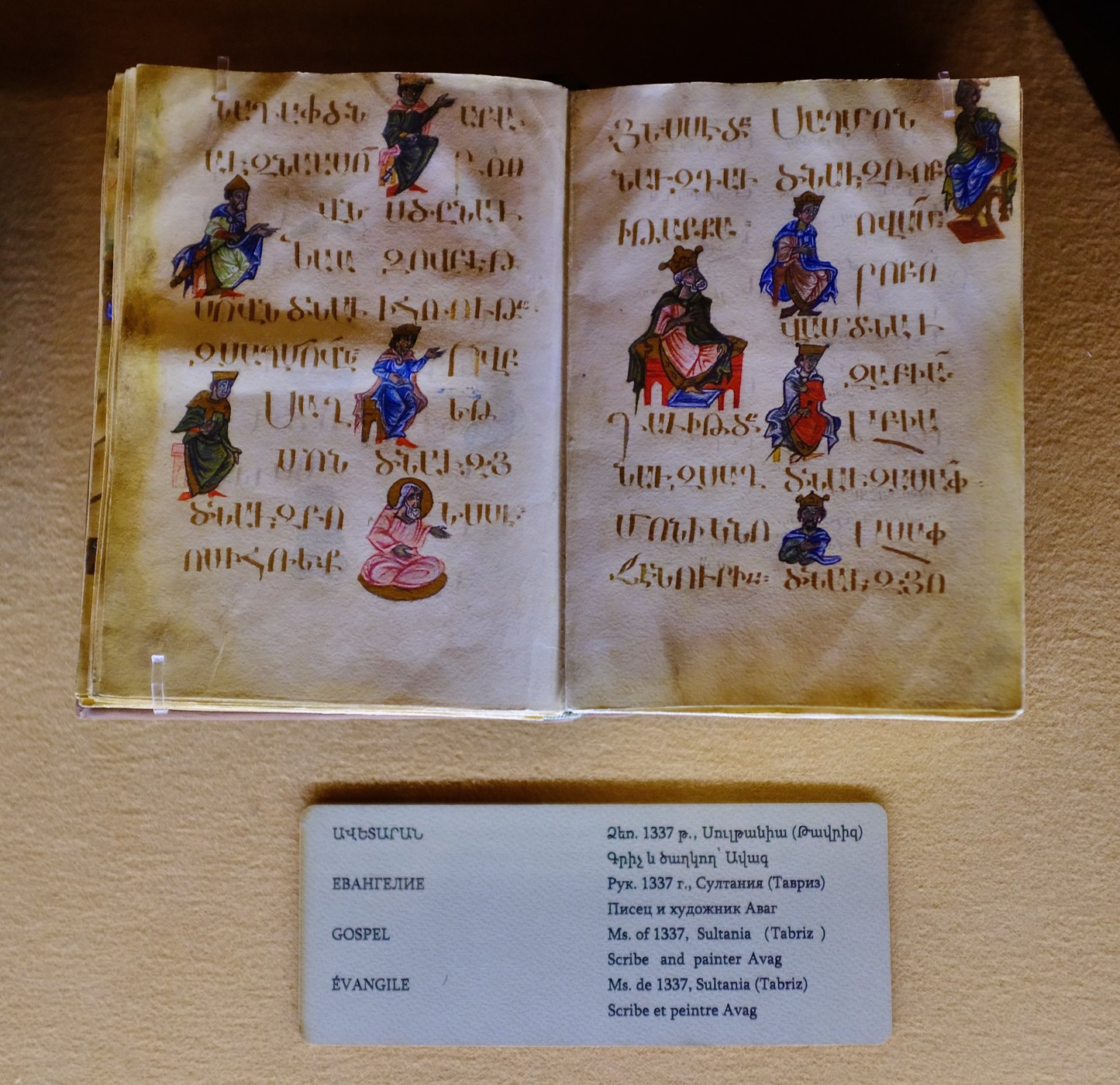
Over time, however, an Armenian letter became more than a sound, a written sign, or a number. It became an independent work of art. Medieval Armenian manuscripts reveal this artistic dimension especially clearly. The first letter of a chapter or page could be transformed into an elaborate miniature. Its lines could become plant stems, birds, animals, fish, or imaginary creatures. Human figures and geometric ornament could also be incorporated into the letterform.
The scribe was no longer simply writing text. He was creating an image out of the writing itself. Zoomorphic, vegetal, anthropomorphic, and fantastical initials emerged. For that reason, Armenian manuscript art cannot be fully separated from the alphabet itself. The letter could function simultaneously as text and image.
Producing a single medieval Armenian manuscript could require an enormous amount of labor. Scribes copied the text, artists created miniatures, and other specialists prepared parchment, pigments, bindings, and decorative elements. Gospels were often among the most richly ornamented books. Centers of Armenian manuscript production existed across different regions of historic Armenia and beyond. Cilician Armenia became especially famous, and in the 13th and 14th centuries its art of manuscript illumination reached an exceptional level.
A new era began in the 16th century. In 1512, Hakob Meghapart established an Armenian printing press in Venice and published Urbatagirk, the earliest known printed book in Armenian. This marked the beginning of Armenian printing. The printing press fundamentally changed the circulation of texts: books no longer had to be copied entirely by hand, and multiple copies could be produced from the same typeset pages.
One distinctive feature of Armenian book history is the major role played by the diaspora. Armenian printing houses were established in Venice, Rome, Amsterdam, Constantinople, New Julfa, and other centers. The Armenian alphabet successfully moved from the world of medieval manuscripts into a new technological age without losing its fundamental structure.
Mashtots created 36 letters, but the alphabet later acquired additional signs. During the Middle Ages, Օ and Ֆ were added, in part to represent sounds in words of foreign origin more precisely. The history of the character և is more complex. It originally developed as a ligature of ե and ւ, and in modern Eastern Armenian orthographic tradition it is treated as a separate letter. For this reason, the modern Eastern Armenian alphabet is generally described as having 39 letters.
Today, Armenian exists in two principal modern literary varieties: Eastern Armenian and Western Armenian. Eastern Armenian is the official language of the Republic of Armenia and is also used in a number of Armenian communities elsewhere. Western Armenian developed historically above all among Armenians of the Ottoman Empire and today survives primarily in diaspora communities. The two varieties differ in pronunciation, grammar, vocabulary, and certain spelling conventions, but both use Armenian writing.
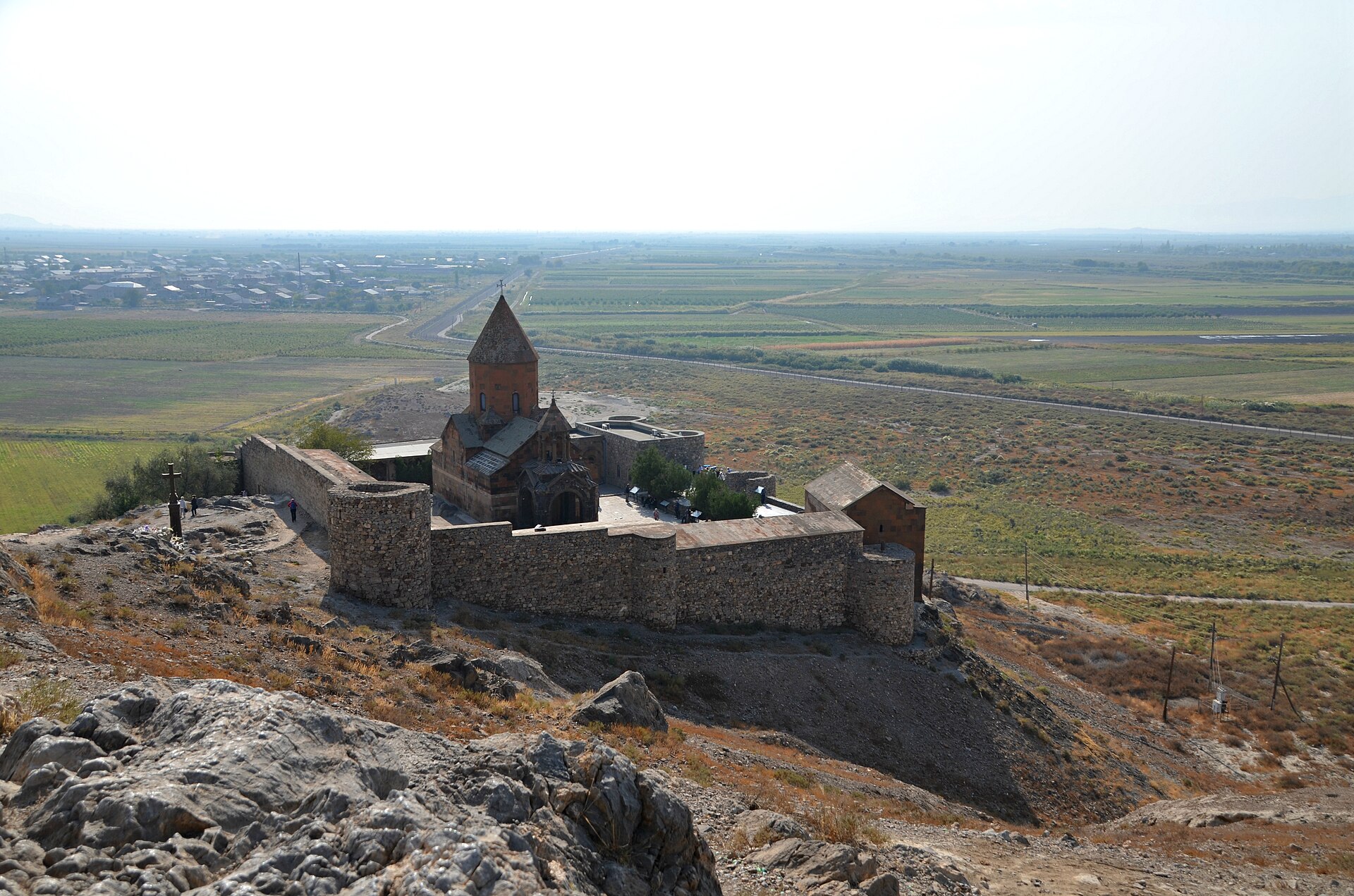
For centuries, Armenian letters have lived not only in books. They were carved into the walls of churches, monasteries, fortresses, bridges, tombstones, and khachkars. Building inscriptions recorded the names of patrons and craftsmen, commemorative texts preserved information about events and donations, and inscriptions on khachkars became part of the overall stone composition. As a result, Armenian epigraphy is now one of the most important sources for studying the country’s history.
Names, dates, and events have survived in stone even when they were never recorded in chronicles. In a very literal sense, part of Armenia’s history is written on the walls of its churches, monasteries, and fortresses.
In 2019, “Armenian letter art and its cultural expressions” was inscribed on UNESCO’s Representative List of the Intangible Cultural Heritage of Humanity. An important distinction should be made here: UNESCO did not inscribe the alphabet simply as a set of characters. What was recognized was the living, centuries-old tradition of using Armenian letters as an artistic and cultural form.
Armenian letters can be transformed into knots, plants, birds, animals, human figures, and imaginary creatures. This tradition did not remain confined to medieval manuscripts. It continues today in calligraphy, embroidery, carpet weaving, jewelry, carving, sculpture, graphic design, and other artistic practices.
Perhaps one of the most remarkable features of the Armenian alphabet is its ability to survive major technological changes. At first, Armenian was written on parchment and carved into stone. Later came paper manuscripts and printed books. Armenian letters then moved onto typewriters and typesetting machines, and eventually into computers, Unicode, websites, apps, and smartphones.
Today, a person can send a message across the world in a fraction of a second using signs whose foundations were created more than sixteen centuries ago. The technology has changed almost beyond recognition. The alphabet has remained.
That is why the history of Armenian writing cannot be reduced to the story of the creation of 36 letters. The alphabet made it possible to translate texts systematically into Armenian, develop an original literature, record history, produce theological and scholarly works, and preserve them for future generations.
Centuries later, the letters became an art form in manuscripts. More than a thousand years later, they became printed type. Today, they also exist as digital code on a screen.
Mesrop Mashtots created a writing system. History transformed it into books and inscriptions carved in stone, into miniatures and ornament, into a tool of education and historical memory.
And more than sixteen centuries later, the Armenian alphabet remains not a museum relic, but a living part of Armenian culture.