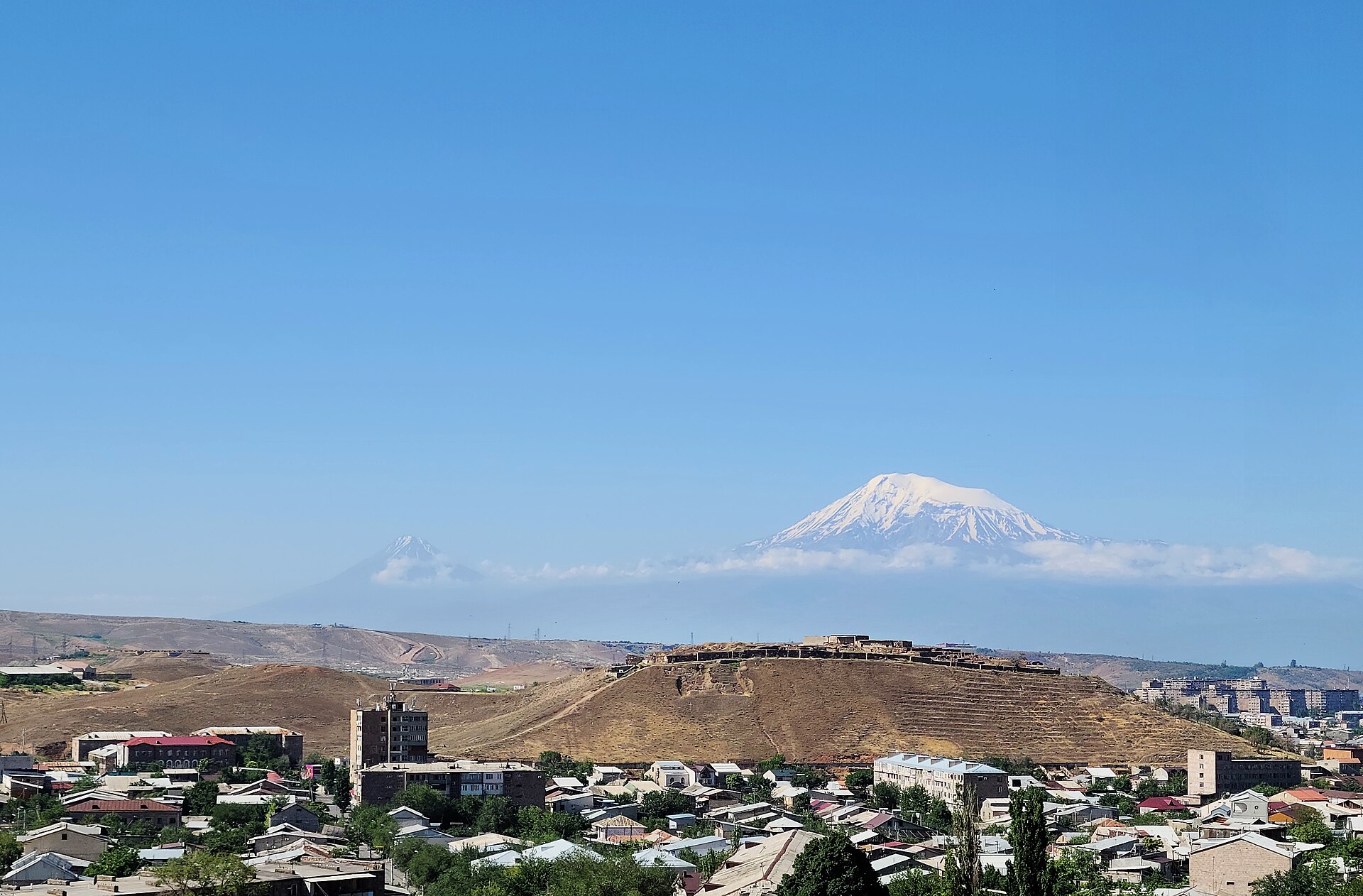
In the southeastern part of modern Yerevan rises Arin Berd hill. Today it is surrounded by city neighborhoods, roads, and apartment buildings, but more than 2,800 years ago the landscape looked completely different. At the top of the hill stood the powerful fortress of Erebuni — an important military, administrative, and religious center of the state known in Assyrian sources as Urartu and in the inscriptions of its own kings as Biainili.
Yerevan traditionally traces its age back to Erebuni. The connection between the names Erebuni and Yerevan is widely accepted in scholarly literature, while the cuneiform building inscription discovered here has become a kind of “birth certificate” for the city. Few modern capitals possess an ancient text that preserves the name of the ruler who ordered the construction of a fortified center on the territory where the future city would develop.
Erebuni was founded by King Argishti I, one of the most powerful rulers of Urartu. He reigned in the 8th century BC, during a period when the state was expanding northward into the Ararat Plain and the South Caucasus. According to the traditional chronology, Erebuni was founded in 782 BC. In scholarly literature, the absolute date can occasionally vary by a few years because of uncertainties in reconstructing royal chronology, but 782 BC has become the accepted founding date of the fortress and the date used when calculating the age of Yerevan.
Argishti did not leave historians to guess who built Erebuni. He literally wrote it in stone. A cuneiform inscription states that, by the greatness of the god Haldi, Argishti, son of Menua, built this mighty fortress and named it Erebuni. The king connected its construction with strengthening the land of Biainili and demonstrating its power to its enemies.
For ancient history, this is an exceptionally valuable case. We know not only the approximate period when the fortress was built, but also the name of its builder, its political purpose, and its original name directly from a text created by the people of that time.
Erebuni did not grow gradually from a small village. It was a planned state project. The site was chosen with great care. Arin Berd rises roughly 60 meters above the surrounding landscape and provided a commanding view over a large part of the Ararat Plain. From the summit, roads and nearby territories could be monitored, while the steep slopes made the position easier to defend.
The fortress itself was only the central core of a larger settlement. It served several functions at once: military, administrative, economic, and religious. It contained palace rooms, temples, storage areas, granaries, and spaces connected with governing the surrounding territory.
The foundation of Erebuni formed part of the broader policies of Argishti I. At this time, Urartu was strengthening its control over the Ararat Plain, constructing fortresses, organizing agriculture, and establishing new administrative centers. These were not simply isolated military outposts. Fortresses became tools for governing large territories.
Ancient inscriptions also record the movement of people into the new center. Argishti’s annals mention 6,600 warriors relocated from western regions, including the land of Supa. Such population transfers were common instruments of ancient Near Eastern states: a new fortified center could receive a population, a garrison, and an economic base almost simultaneously.
Erebuni should therefore not be imagined as a lonely fortress standing on an empty hill. It was a living state center. Soldiers, officials, priests, craftsmen, and people responsible for maintaining the economy of the fortress lived and worked here.
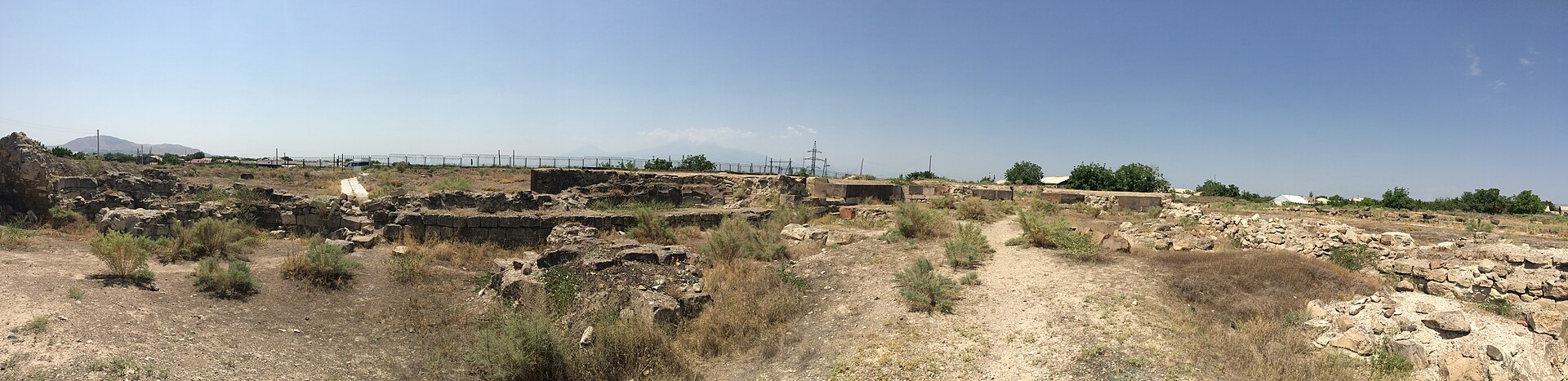
The complex was built using construction methods characteristic of Urartu. The lower parts of the walls were made from large stone blocks, while mudbrick was used above them. This is important for modern visitors to understand: much of the original architecture could not survive nearly three thousand years because the upper sections of the walls were made from materials far less durable than stone.
In antiquity, the buildings of Erebuni would have looked far more monumental than the ruins visible today. Archaeological research shows that some structures were richly decorated. Particularly remarkable are the surviving fragments of wall painting — rare examples of monumental Urartian art.
The walls of palace and religious rooms were covered with brightly colored murals featuring geometric patterns, plant motifs, and images of deities. Among the most famous finds are fragments associated with the supreme Urartian god Haldi. Some compositions include human figures and sacred symbols, offering a glimpse of how colorful the architecture of Erebuni once was.
Ancient fortresses are often imagined today as worlds of gray or brown stone. Erebuni was not. It was colorful. Walls were plastered and painted, and the interiors may have appeared much brighter than the archaeological remains that survive today.
A special place within the fortress was occupied by the temple of Haldi, the principal deity of the Urartian pantheon. In Urartu, the cult of Haldi had not only religious but also political significance. Royal victories, the construction of fortresses, and military campaigns were frequently described in inscriptions as being accomplished “by the greatness of Haldi.”
The temple of Haldi at Erebuni formed part of the fortress’s most important religious complex. Nearby, archaeologists discovered another sanctuary identified in inscriptions by the term “susi” and dedicated to a deity whose name scholars render as Iubsha or Iuarsha. This indicates that the religious life of Erebuni was not limited to the worship of a single god.
Administrative and palace rooms were located near the temples. From here, a governor or representative appointed by the king could oversee the fortress and the surrounding region. Erebuni was intended to demonstrate not only military strength, but also the presence of royal authority.
The state depended on an organized economy. Large storage areas and enormous ceramic vessels known as pithoi have been discovered inside the fortress. These vessels were set into the floors and used to store grain, wine, and other products. The stored supplies helped support the garrison, administration, and local population while also forming part of a centralized economic system.
These storehouses tell us a great deal about Urartu. Maintaining a large fortress required far more than building walls and stationing soldiers. Produce had to be collected from the surrounding lands, recorded, stored, and distributed. Erebuni was part of a sophisticated administrative structure.
Archaeologists have discovered not only buildings and pottery here, but also weapons, seals, cuneiform inscriptions, and many other objects. More than twenty stone inscriptions from different rulers are known from the territory of Erebuni. They record construction projects, granaries, and other works that continued after the reign of Argishti I.
This is important because Erebuni was not simply the project of one king that stopped developing after his death. Argishti’s successors continued to use and expand the fortress.
Another important discovery was an ancient street near the temple complex. It was paved with stone and shows that the internal space of the fortress was organized according to a deliberate plan. Archaeological research has also uncovered a complex system of water supply and drainage.
In a dry climate, managing water was essential. The Urartians are generally known for their hydraulic engineering — canals, reservoirs, and irrigation systems. Erebuni shows that engineering solutions were also applied inside fortified centers themselves.
The name of the state that built Erebuni also requires some explanation. The word “Urartu” comes from the Assyrian tradition. The rulers of the state themselves used the name Biainili in their cuneiform inscriptions. Its core territory lay around Lake Van, and during the 9th to 7th centuries BC it controlled a significant part of the Armenian Highlands and neighboring regions.
Erebuni was founded in the northern part of this state, but it quickly became one of the most important centers of the Ararat Plain. Its construction reflects a period when the political and economic structure of the region was changing significantly under Urartian expansion.
The history of Erebuni did not end with the weakening of Urartu. Archaeology shows that life at the site continued in later periods. Particularly important are finds associated with the post-Urartian period and the Orontid era.
One of the most interesting structures from this later period is a large columned hall. Researchers date it to the end of the 7th century or the first half of the 6th century BC. Its existence shows that the fortress was not simply abandoned and forgotten after the collapse of the Urartian political system.
Some scholars connect later Erebuni with the administrative system of the Achaemenid Empire, although the exact political status of the center remains a subject of debate. Archaeological finds from the Yerevan area, including material from the Achaemenid period, confirm that cultural and economic life continued in the region.
For this reason, it would be too simple to draw a perfectly straight line between Erebuni of the 8th century BC and the much later city of Yerevan, as though exactly the same city had existed unchanged for almost three thousand years. Settlements, political centers, and urban spaces changed over time. Yet the connection between the name Erebuni and the name Yerevan, the ancient history of the territory, and the continuity of life in the region allow us to speak of a deep historical connection.
For a long time, the exact location of ancient Erebuni was unknown. Historians knew the name of the fortress from cuneiform texts, but proving that Arin Berd hill actually concealed Erebuni became possible only in the 20th century.
A breakthrough came in 1950. During investigations at Arin Berd, basalt blocks bearing Urartian cuneiform inscriptions were discovered. One of the texts was connected with the construction of Erebuni by Argishti I. The discovery gave archaeologists strong reason to believe that the ancient city had been found.
But scholars still needed definitive proof, because an individual inscribed stone could theoretically have been moved from another location. In 1958, another building inscription of Argishti I was discovered directly within an ancient wall. After that, the identification of Arin Berd with Erebuni became effectively unquestioned.
Large-scale archaeological excavations followed. Fortress walls, palace rooms, temples, storage areas, and fragments of painted decoration gradually emerged. A city whose name had been written by its builders almost three thousand years earlier was returning from beneath the earth.
Archaeological research at Erebuni continues today. Modern Armenian and international expeditions are revisiting some earlier dates, investigating previously unknown structures, and studying periods that received less attention during the Soviet era. One of the most important questions concerns what happened at the site after the decline of Urartu.
This is normal in archaeology. The history of an ancient monument does not become fully known after the first excavations. New methods can reveal information that researchers in the mid-20th century simply could not detect.
In 2025, Armenia added “The Urartian Heritage of Yerevan” to UNESCO’s Tentative List of World Heritage sites. The proposed group includes the most important Urartian monuments within modern Yerevan, above all Erebuni and Teishebaini at Karmir Blur.
This does not yet mean that Erebuni is inscribed on UNESCO’s World Heritage List. The Tentative List is the stage at which a state identifies a property as a possible candidate for future nomination.
One of the most remarkable features of Erebuni is that the ancient fortress is not isolated from modern life. It has become part of Yerevan itself. From the top of Arin Berd, visitors can see the modern city stretching around the ancient hill, while the Erebuni Museum at its base preserves finds from archaeological excavations.
The contrast is striking. In front of the visitor stand walls from the 8th century BC, while immediately beyond them begins a modern metropolis.
The enormous distance of time is especially easy to feel here. When Argishti I ordered the construction of Erebuni, the Roman Empire did not yet exist. Classical Athens had not yet reached its height. The campaigns of Alexander the Great were still more than four centuries in the future.
And yet the founder of the fortress left behind a message that can still be read today.
For Yerevan, that inscription has become much more than an archaeological document. It gives the city the rare ability to name a specific ruler and an approximate moment from which its written history begins.
But the importance of Erebuni should not be reduced to a striking comparison between the age of Yerevan and that of other world capitals. The fortress is significant in its own right.
It shows how the state of Urartu expanded into the Ararat Plain, how it built fortified administrative centers, organized its economy, stored food, managed water, and connected royal authority with religion.
It preserved the cuneiform writing, architecture, and wall painting of the ancient world.
It outlived the state that built it.
And its name, passing through the centuries, became connected with the name of modern Yerevan.
That is why Erebuni is more than an ancient fortress within the Armenian capital.
It is one of those rare monuments where a city can literally point to the stone on which its written biography begins.