In the most famous story about Khrimian Hayrik, paper proves powerless. The Armenian delegation arrives before the European powers carrying a petition, while other peoples, in his vivid comparison, bring “iron ladles” — weapons and the ability to support their demands with force. The story outlived the man who told it and became one of the best-known political parables in Armenian history.
Yet there is a paradox in that memory. Long before the Congress of Berlin, Khrimian worked precisely with paper: he published journals, wrote books, opened schools, and taught people to read. And after the famous speech, he did not stop doing so. His life cannot be reduced to a simple opposition between education and resistance, words and weapons.
To understand the man behind the parable, we have to begin not in the diplomatic halls of Berlin, but in the Armenian communities around Lake Van.
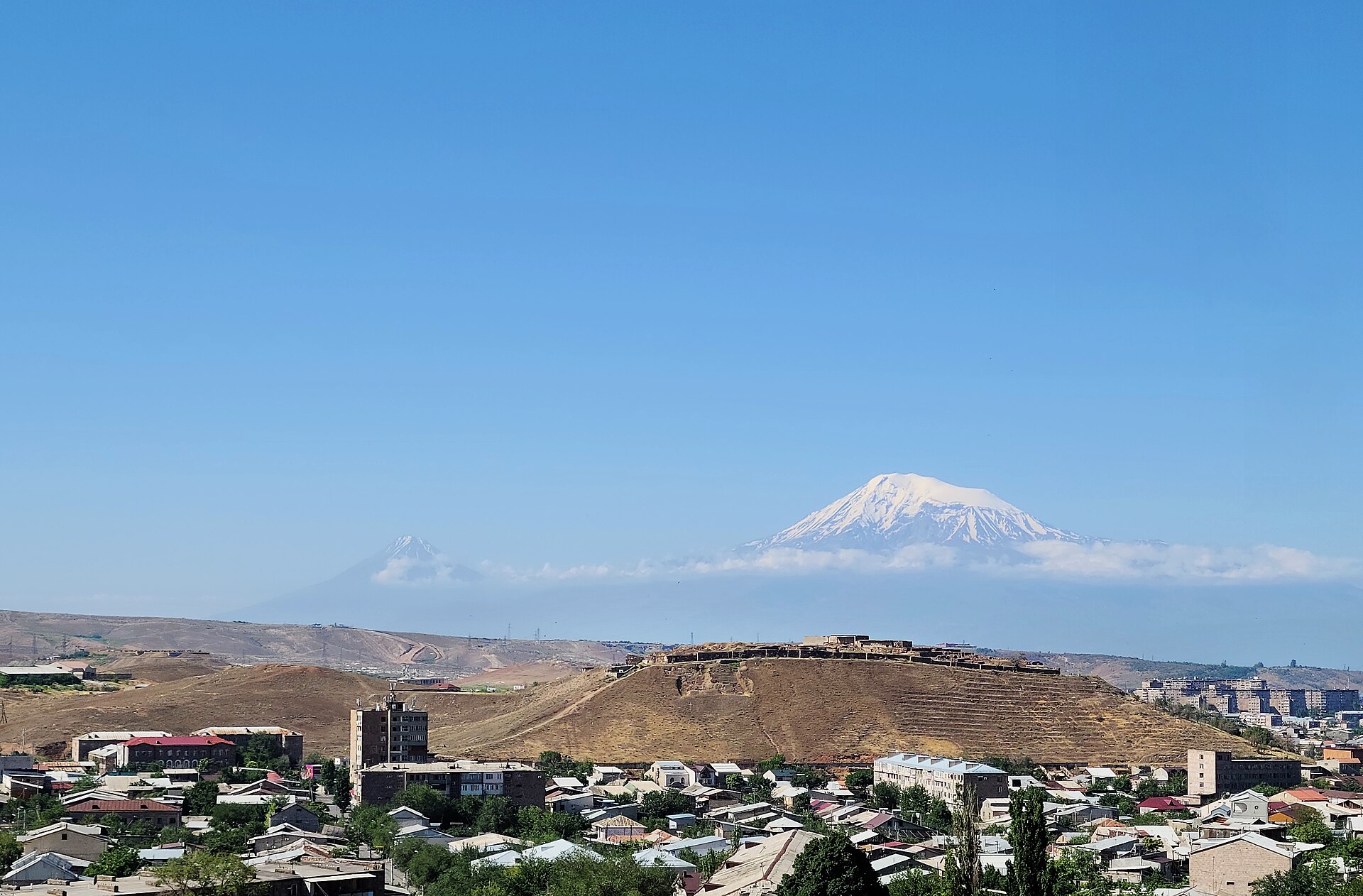
Mkrtich Khrimian was born in Van in 1820. He received his education in the local church environment, including at monasteries on Lim and Ktuts islands. His early life was not a straight path toward the highest ranks of the Church: he traveled, taught, married, and had a daughter. After the deaths of his wife and child, Khrimian devoted himself to religious service. In 1854, he entered the clergy.
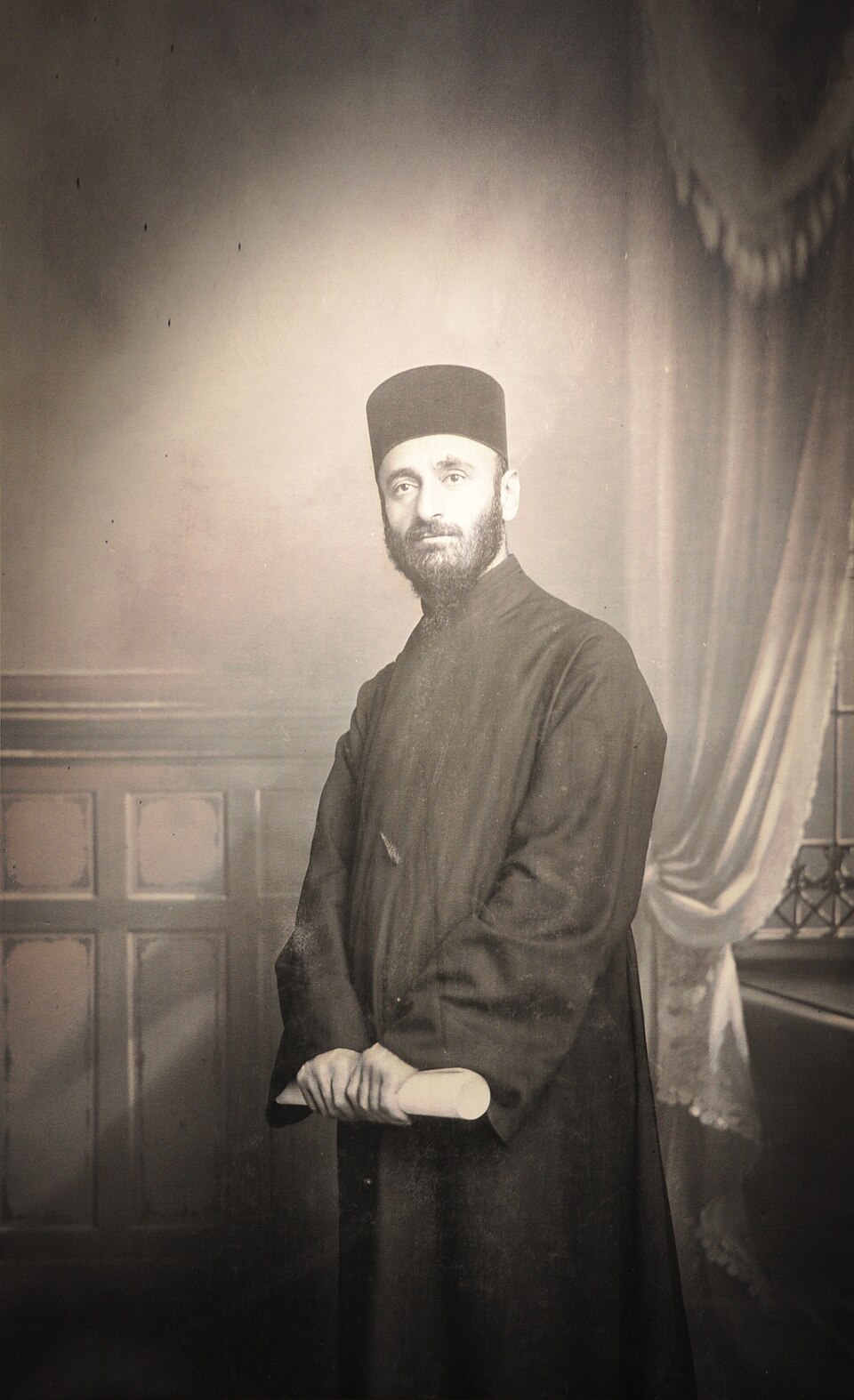
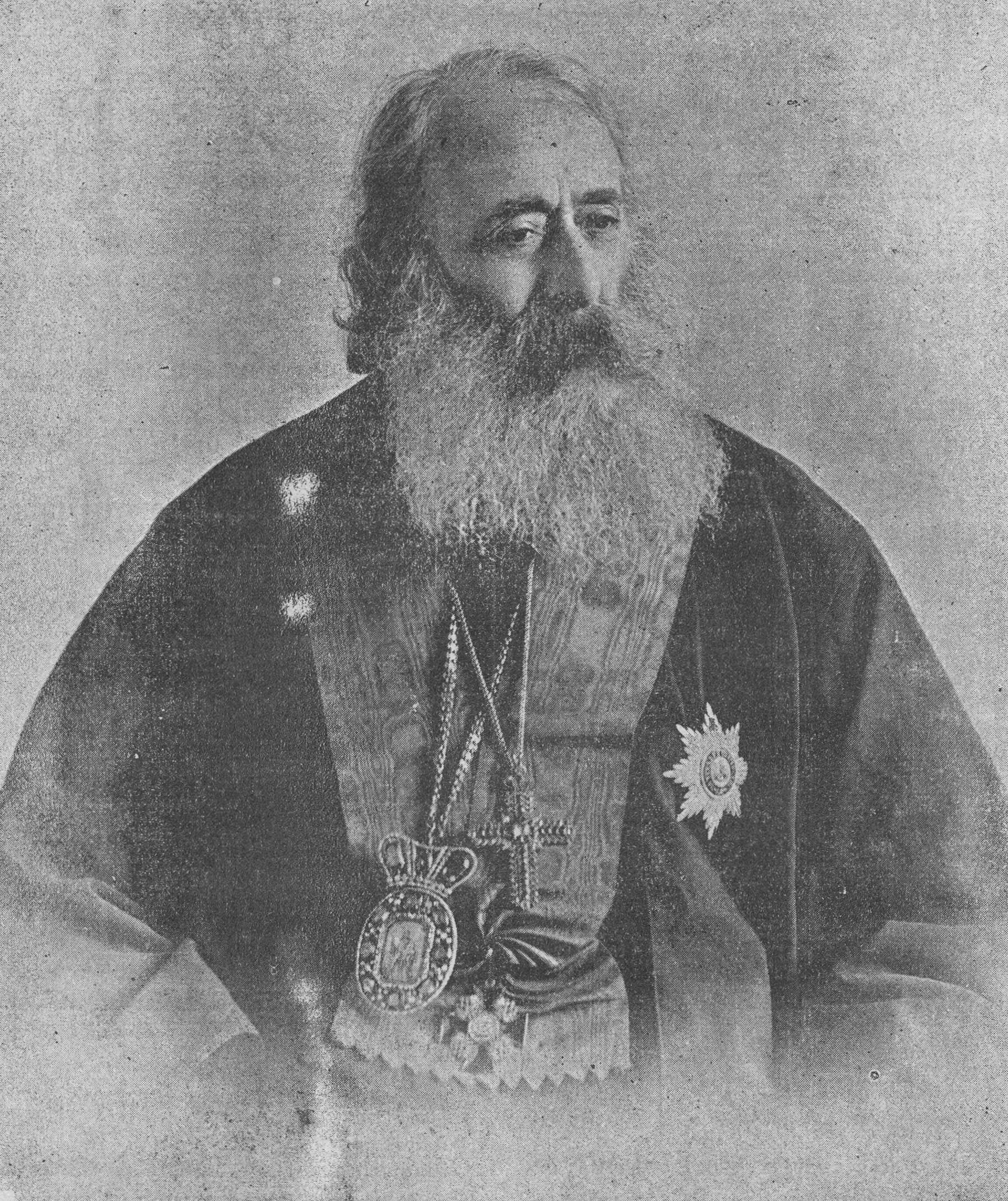
In the best-known photographs from later in life, we see an elderly Catholicos with a long beard. That image can easily overshadow other parts of his biography. Even before becoming a clergyman, he had taught at a girls’ school in Constantinople. Questions of education, family, and upbringing would remain recurring themes in his writings.
In 1855, Khrimian began publishing the journal Artsvi Vaspurakan — “The Eagle of Vaspurakan.” The first issues appeared in Constantinople, but the publication was later moved to Varagavank, near Van. There, Khrimian also established a school and a printing press.
The location mattered. Armenian print culture already had important centers far from Van. Khrimian, however, was creating a publishing platform directly in the provincial environment — among the people he wrote about. Rural life, local traditions, the history of the region, and education became subjects not only of oral discussion but of print.
The journal gathered writers and collaborators around it. Raffi was among those connected with the publication and also helped distribute it. This was not simply the work of one man writing and printing only his own ideas. Gradually, a circle of people formed around a shared publishing project.
Later, Khrimian developed similar work at the Monastery of Surb Karapet near Mush. A school was established there, and in 1863 the journal Artsvik Tarono — “The Eaglet of Taron” — was founded. In this model, the monastery remained a religious institution but also became a place of education, literary work, and the circulation of knowledge.
A broader environment of interest in popular culture also formed around Khrimian. Garegin Srvandztiants, who was connected with his circle, became the first scholar to record and publish one version of the epic Sasna Tsrer. For this intellectual environment, peasant speech, oral tradition, and song were material worth recording and studying. The provinces were not seen only as places in need of assistance, but also as sources of cultural heritage.
Yet educational and literary questions could not be separated completely from the actual conditions of local residents. Taxes, land relations, the behavior of local authorities, and security directly affected the lives of rural communities. Historian Nadir Özbek, writing about the late Ottoman Empire, treats taxation not simply as a fiscal procedure but as an arena of relations between the state, local power holders, and the population.
That context is essential for understanding Khrimian. The issue was not only whether a village had a school. Other questions mattered just as much: who determined the obligations of local residents, where people could submit complaints, and which institutions had the authority to hear them.
In 1869, Khrimian was elected Armenian Patriarch of Constantinople. The office combined church responsibilities with representation of the Armenian community before the Ottoman authorities. A man who had worked in provincial monasteries now found himself inside the capital’s system of community administration.
His proposals addressed the condition of provincial Armenians, their participation in communal institutions, and protection from abuses. At the same time, conflict did not arise only with state officials. There were competing interests within the Armenian community itself: influential circles in the capital and residents of distant provinces did not always imagine necessary reforms in the same way.
In 1873, Khrimian stepped down from the patriarchal throne. But leaving office did not mean leaving public life. Five years later, he led the delegation connected with the most famous episode of his career.
In 1878, after the Russo-Turkish War, the European powers met in Berlin to revise the postwar settlement. Armenian representatives sought reforms and security guarantees for the Armenian-populated provinces of the Ottoman Empire. Proposals for forms of autonomous administration were also discussed.
It is important not to project modern ideas of diplomacy backward onto the 19th century. Khrimian was not an ambassador of an independent Republic of Armenia, and the Armenian delegation did not participate in the congress as an equal signatory power. It sought meetings, submitted proposals, and tried to influence the decisions of states that actually had a formal voice at the negotiating table.
There is another detail that is often lost: Khrimian did not go to Berlin as Catholicos of All Armenians. At that time, he was the former Armenian Patriarch of Constantinople. He would become the head of the Armenian Apostolic Church much later.
The Treaty of Berlin, signed on July 13, 1878, did not ignore the Armenian question. Article 61 required the Ottoman Empire to carry out reforms in the provinces inhabited by Armenians and to provide security for their residents. The Porte was to report on the measures taken, while the powers were to monitor their implementation.
But Article 61 did not create Armenian autonomy. Nor did it establish a separate executive mechanism that would directly carry out the promised reforms. A wide gap remained between placing an obligation in an international treaty and changing life in an individual village.
The story of the “iron ladle” is tied to the disappointment that followed this mission.
In the version of the speech that has come down to us, the Congress of Berlin becomes a feast centered on a large pot of harissa — a thick dish made from wheat and meat. Other peoples take their share with iron ladles, while the Armenian representative has only a paper one — a petition that softens and collapses. Khrimian used the image to contrast written appeals with demands backed by armed force.
This was a political parable, not a description of a real diplomatic dinner. It should also not be presented as a speech delivered by Khrimian from the official floor of the congress. The story is associated with remarks he made after returning to Constantinople.
The widely circulated text has another important feature. One well-known version comes through the recollection of a listener, Khachik Khan Sarajian, published in Hayk Ajemian’s book Hayots Hayrik in 1929. It is therefore more accurate to read the text as a remembered account of the speech, not as a verbatim transcript from 1878.
The popularity of the parable sometimes overshadows everything else. It is easy to draw a neat conclusion from it: Khrimian became disillusioned with diplomacy and thereafter believed only in armed struggle. His later activity, however, was more complex. He supported self-defense, but he also continued to petition authorities, work in education, and act through church and community institutions.
Historians emphasize different aspects of his political legacy. Richard Antaramian draws attention to Khrimian’s attempts to pursue reform by changing the relationship between Armenian institutions and the Ottoman state. Other scholars place greater emphasis on his role in the development of the Armenian national movement and armed resistance. These differences are a reminder that one powerful speech cannot substitute for the study of decades of activity.
After Berlin, Khrimian returned to work in Van. In 1879, he became head of the local diocese. His public activity was accompanied by increasingly close surveillance from Ottoman authorities, and in 1890 he was sent to Jerusalem. Officially, the journey was presented as a pilgrimage, but scholars of his biography generally treat it as a form of exile.
Even there, he continued to write. In Jerusalem he worked on Papik yev Tornik — “Grandfather and Grandson” — published in 1894. Its setting and advice are directed toward the rural world of Vaspurakan. Through a conversation between generations, Khrimian returned to themes of labor, upbringing, and practical knowledge of everyday life.
For a man usually remembered because of the Congress of Berlin, this is a revealing literary perspective. His intended audience was not only the diplomat or ruler. It could also be a young reader receiving knowledge about land, work, and life from an older generation.
In 1892, Khrimian was elected Catholicos of All Armenians. More than a year, however, separated the election from his actual assumption of office. Ottoman authorities did not immediately allow him to leave Jerusalem and travel to Etchmiadzin. His enthronement as Catholicos took place only in 1893.
His work now unfolded partly within the Russian Empire, where Etchmiadzin was located. Yet his concerns continued to extend beyond a single state border: Armenian communities, monasteries, and schools existed in different countries and remained connected to one another.
This period also intersects with the story of Komitas. Khrimian supported the young musician and his work, a relationship noted by scholars of Khrimian’s cultural activity. In 1896, Komitas went to Berlin to study with a scholarship funded by Alexander Mantashev. The roles should be distinguished: support from church leadership and financial backing from a benefactor were different parts of the same educational opportunity.
In this way, two biographies usually studied separately come into contact. In one are schools, journals, and public petitions. In the other are folk-song collection, musicology, and composition. Their point of intersection is not a slogan, but the practical creation of conditions in which a person could study and work.
One of the last major conflicts of Khrimian’s life came in 1903. Russian authorities decided to transfer the property of the Armenian Church into state administration. This affected more than the economic interests of the clergy: church resources were also tied to the support of educational and charitable institutions.
Khrimian opposed the transfer. The protest brought together clergy, parishioners, and political organizations, and demonstrations and clashes with authorities followed. It would therefore be misleading to describe the events simply as a personal dispute between the Catholicos and the emperor. It was a broad public conflict over the powers of the state and the autonomy of Armenian institutions.
In 1905, amid revolutionary unrest in the Russian Empire and a broader reconsideration of policy in the Caucasus, the decision was reversed. Khrimian had participated in resistance to the measure, but its reversal cannot be explained by the actions of one man alone while ignoring the public movement and the wider political crisis.
Even in his final years, he did not abandon publishing projects. Historian Emma Kostandyan cites his correspondence about reviving the Jerusalem journal Sion. Khrimian offered financial assistance and urged his correspondents to resume publication. The plan was not realized during his lifetime.
That small episode brings us back to the beginning. The man whose name became associated with the image of a useless paper ladle spent his old age trying to create more printed pages. The paper of a petition and the paper of a book served different purposes for him.
Khrimian died in Etchmiadzin in 1907. In church history, he remained Catholicos Mkrtich I Vanetsi. In public memory, another name endured: Khrimian Hayrik. The Armenian word “Hayrik” is an affectionate form of “father”; it was not the title of a church office.
If his biography is reduced to one story about Berlin, decades of work before and after the congress disappear. We lose the teacher, the publisher, the author, the monastery leader concerned with schools, and the elderly Catholicos still discussing subscriptions and journals.
The parable of the “iron ladle” holds an important place in the history of Armenian political thought. But Khrimian himself did not live inside a single parable. Across a long life and changing circumstances, he worked with different tools — books, schools, petitions to authorities, church institutions, and support for self-defense.
His story therefore should not be read simply as an explanation of why words supposedly mean nothing. There is another line running through his life: how words become textbooks, journals, testimony about people’s conditions, and a reason for public action.
That line is less famous than the iron ladle.
But without it, the story of Khrimian Hayrik remains incomplete.