Imagine a merchant at the beginning of the 18th century.
He needs to send capital from Persia to India, buy textiles there, move part of the cargo farther into Southeast Asia, receive silver from Manila, settle accounts with a partner he has not seen in years, and inform his family in Isfahan that the deal is complete.
There is no telephone.
No email.
No international bank.
No instant transfers.
A letter may take months to arrive. A ship may sink. A caravan may be robbed. A partner may die on the road. War may begin in one country, a ruler may change in another, and in a third a European trading company may try to eliminate a competitor.
And yet Armenian merchants of the 17th and 18th centuries built a commercial system that linked Amsterdam and London with Persia, India with Southeast Asia, and Madras with Spanish Manila.
They had no empire of their own.
No navy.
No colonial armies capable of forcing foreign ports to accept their ships.
And yet, at certain moments, some of the largest European trading companies actively tried to bring Armenians into their own commercial systems.
To understand how this became possible, we have to begin with a catastrophe.
At the beginning of the 17th century, Old Julfa on the Araxes River was already known as an important trading city. Its merchants participated in the international silk trade and maintained connections with markets in the Ottoman Empire and Europe.
But in 1604, Shah Abbas I, while fighting the Ottoman Empire, ordered the forced relocation of populations from a number of frontier regions into the interior of the Safavid state. This was part of a scorched-earth strategy: territories through which the enemy might advance were to be deprived of population and resources.
Among those deported were the inhabitants of Julfa.
The old trading city effectively ceased to exist in its previous form.
But Shah Abbas had no intention of destroying the commercial expertise of the Julfan merchants.
Quite the opposite.
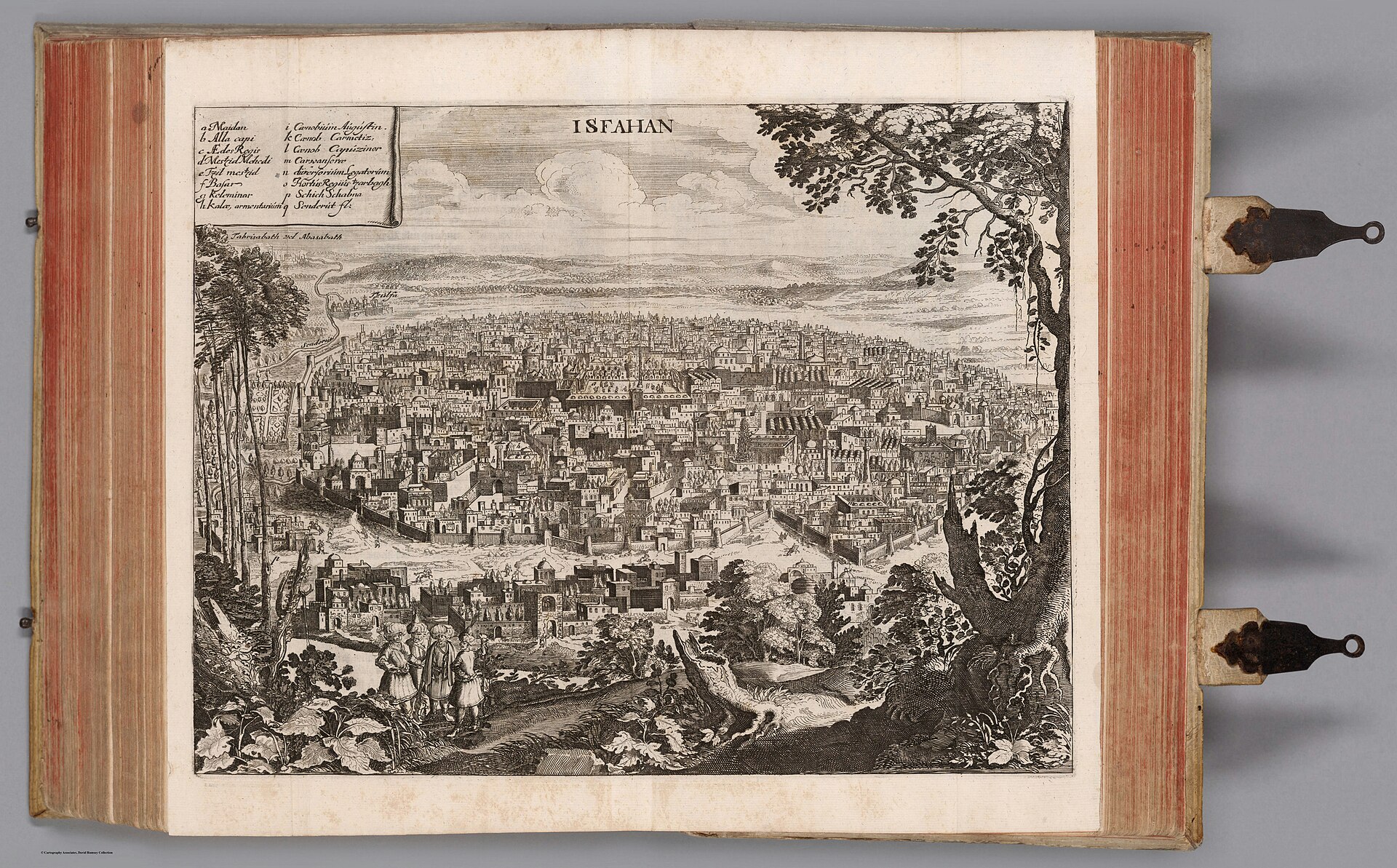
Some of the deportees were settled near Isfahan, the new capital of Safavid Iran. There, New Julfa emerged.
And this is where one of the most remarkable stories of the early modern world begins.
People who had been forcibly uprooted from their city created, within a few decades, a new center of international trade.
Silk was one of the key export commodities of Safavid Iran. European markets wanted it, while Persia needed European silver and other goods.
The Armenian merchants of Julfa already had experience trading between different states. They knew routes, markets, and languages, understood how to negotiate with authorities, and worked through relatives and trusted agents scattered across many cities.
Safavid authorities granted commercial privileges to some merchants because the state was interested in exporting Iranian silk.
But New Julfan trade soon became more than a service to the shah.
The network began to develop a life of its own.
Merchants from New Julfa appeared in Russia, the Ottoman Empire, Italy, the Netherlands, France, and England. To the east, their routes extended through India and Southeast Asia.
Historians find Armenian merchants in Amsterdam and London, Venice and Moscow, Isfahan and Aleppo, Surat, Madras, and Manila.
This was not a single company with a headquarters, a chief executive, and formal branches.
The system worked differently.
At its core were families, relatives, fellow townsmen, trusted partners, and agents.
One person’s capital could travel much farther than its owner.
A merchant could entrust money or goods to an agent who traveled to another city and traded on his behalf. Profits were then divided according to prior agreement. Such commercial arrangements made it possible to conduct business across enormous distances.
The central problem was not simply moving goods.
The central problem was trust.
Today, a company can check a partner’s banking history, go to court, insure cargo, and contact an overseas office instantly.
In the 17th century, a Julfan merchant might entrust a large share of his wealth to someone who would be gone for years.
How could he know the money would come back?
The Armenian commercial network developed its own mechanisms of control.
Family reputation, written contracts, debt obligations, constant correspondence, and community pressure all played a role. News of an unreliable partner could travel through the network and close off future opportunities.
Trust did not mean naivety.
It was an economic instrument.
A person who had spent decades building the reputation of his family risked losing far more than the profit from one dishonest transaction.
Interestingly, New Julfa even had forms of training for future merchants.
Sources mention a school associated with Kostand Vardapet where young men were introduced to commercial practice. Teaching materials attributed to him contained information about currencies, weights, and measures used in different regions.
More than one hundred trading cities were listed.
In other words, a young Armenian from the Julfan quarter of Isfahan could prepare for a profession in which he needed to know how much a commodity was worth in another monetary system, how to convert units of weight, which route led to a foreign port, and whom to deal with once he arrived.
The scale of this geography becomes especially clear in the Armenians’ relations with European trading companies.
In the 17th century, the English, Dutch, and French created enormous companies for Asian trade. Behind them stood state charters, warships, major capital, and political power.
At first glance, a relatively small Armenian diaspora should not have been able to compete with such institutions.
In practice, the picture was more complicated.
European companies had ships, but they did not always possess what the Julfans had: long-established personal relationships, knowledge of local markets, linguistic skills, and familiarity with regional politics.
The year 1688 is a revealing example.
The English East India Company signed an agreement in London with Khoja Panos Kalantar, who represented Armenian merchants.
The reason was practical.
The English wanted to use Armenian commercial knowledge and networks to expand trade between India, Persia, and Europe.
The agreement granted Armenian merchants substantial opportunities to reside, travel, trade, and practice their religion within areas controlled by the Company.
This turns the familiar image of the colonial era on its head.
We are used to imagining Asian merchants seeking access to European trading systems.
Here, a European company was trying to incorporate an already existing Armenian commercial network into its own structure.
The English were not the only ones.
France also attempted to make use of Armenian commercial expertise.
The career of Martin Marcara Avachinz is especially revealing. His life stretched across several continents.
In 1666, the French minister Jean-Baptiste Colbert recruited him to work for the newly established French East India Company.
Why would the French state need an Armenian merchant?
Because Marcara understood the political and commercial environment of India better than many employees arriving directly from Europe.
He helped the French obtain permission to establish a trading post at Masulipatam on India’s eastern coast.
But the relationship ended in conflict.
Marcara clashed with the Company’s French leadership, was arrested, harshly treated, and sent to France. A major legal case followed.
The story reveals another side of global commerce.
Armenian merchants cooperated with European companies, but they were not simply subordinate agents.
They had their own interests, their own capital, and their own networks.
And precisely because of that, cooperation could easily turn into competition.
The Armenian presence in India is even more striking.
Armenians had reached the subcontinent before the rise of New Julfa, but in the 17th century Julfan trading networks expanded significantly.
Armenian communities and merchants appeared in different parts of India, from western ports to Madras and Bengal.
Madras became an especially important hub.
From there, Armenian trade moved farther east.
To Manila.
Today, the journey between Chennai and Manila can be made by airplane in a matter of hours.
In the 18th century, it meant a sea voyage across a vast stretch of Asia.
Why did Armenian merchants go to the Philippines at all?
The answer was silver.
Manila was part of the Spanish colonial system and one of the key points in the famous trade between Asia and Spanish America. American silver crossed the Pacific to Manila, while Asian goods moved in the opposite direction.
Silver was essential to Asian trade.
But Spanish restrictions made direct access to Manila difficult for many European merchants.
Once again, intermediaries became important.
Armenian and Indian merchants could operate where European companies found it harder to trade directly.
Research on the Madras–Manila trade shows that Armenians became important participants in this system while also pursuing their own profits.
The result was a chain that only a few generations earlier would have seemed almost impossible.
Iranian silk could move west.
Indian textiles could travel across the Indian Ocean.
Silver from Spanish America could enter Asian trade through Manila.
And between these markets operated people whose families came from an Armenian town on the Araxes.
At the same time, the network was not always controlled from New Julfa as though it were a modern corporate headquarters.
Over time, centers such as Madras gained greater independence.
A merchant living in India could act according to local opportunities without waiting for instructions from Isfahan.
The network evolved.
New centers emerged.
But the connection to Julfa remained powerful through origin, family, church, correspondence, and commercial reputation.
This system generated more than wealth.
Merchant money financed churches, schools, manuscript copying, printing, charitable assistance, and cultural projects.
A merchant could live thousands of miles from Julfa for years and still support Armenian institutions.
The economic network therefore became a cultural network as well.
Trade helped build the infrastructure of the diaspora.
The church provided spaces of trust and communication.
Letters connected relatives.
Books and clergy traveled along many of the same routes as money and goods.
That is why the history of the Julfan merchants cannot be reduced to the story of a few wealthy individuals.
They built a system.
It becomes especially interesting when compared with the great European trading companies of the same period.
The Dutch and English East India Companies had shareholders, official monopolies, ships, and armed forces.
The Julfans had none of those things.
And yet they could compete with them in some markets, cooperate with them in others, and act as intermediaries where European traders lacked their own connections.
Their advantage was flexibility.
If political conditions made one route dangerous, capital could move along another.
If one merchant settled in India, a relative could continue the family business in Persia, while another family member might be living in Europe.
The border of a state did not define the border of the network.
But this model also had weaknesses.
The merchants had no army to protect their commercial privileges.
They depended on the attitudes of local rulers.
War, persecution, dynastic change, or the expansion of European colonial control could destroy commercial conditions that had taken decades to build.
In the 18th century, the political situation in Iran changed dramatically. The Safavid state collapsed, Isfahan experienced catastrophic upheaval, and European companies increasingly dominated maritime trade in the Indian Ocean.
New Julfa gradually lost its former position as a single central hub.
But the network did not disappear overnight.
Its people were already living in India, Europe, and elsewhere.
Some families continued trading for generations.
Others became landowners, officials, philanthropists, or publishers in the societies where they settled.
What remained from the original commercial system were new Armenian communities.
And this may be the most remarkable part of the entire story.
Shah Abbas had deported the Armenians of Julfa because he wanted to use their economic abilities within his own empire.
But the network they created became far larger than the Safavid Empire itself.
It crossed the borders of states, religions, and colonial systems.
At one point, European companies backed by warships and royal charters discovered that they needed people who possessed neither naval guns nor a state of their own.
Because Armenian merchants possessed another kind of capital.
They knew whom to write to.
Whom to trust with goods.
In which city to find a relative.
Where to exchange currency.
How to negotiate with local authorities.
How to send cargo to places where a European company itself did not yet know how to operate.
Today, we might call this a network of information, trust, and human capital.
In the 17th century, it was simply called trade.
And if we trace the routes of these merchants on a map, the result is striking.
Amsterdam.
London.
Venice.
Isfahan.
India.
Southeast Asia.
Manila.
Between them moved letters, debt obligations, silk, textiles, silver, and people who sometimes did not see their business partners for years.
The history of New Julfa is therefore not only the history of an Armenian diaspora community in Iran.
It is a chapter in the history of early globalization.
And it is one of those parts of Armenian history that becomes much more interesting once we stop viewing it only within the borders of a single country.