In Jerusalem's Old City, it is easy to walk past a ceramic street sign without giving it a second thought. Its white background, dark lettering and coloured border seem a familiar part of the city. Yet behind many of these signs lies the story of Armenian craftspeople and families who have kept their craft alive here for more than a century.
That story did not begin in Jerusalem. Nor did it begin in the twentieth century.
The Journey from Kütahya
Long before workshops appeared in Jerusalem, Armenian potters and painters worked in Kütahya, a city in what is now Turkey. They made painted pottery and tiles commissioned for churches, public buildings and private homes.
Ceramics from Kütahya also reached Jerusalem. In the early eighteenth century, a consignment of tiles was made for the Church of the Holy Sepulchre. Disagreements between religious denominations prevented the original plan from being carried out. The tiles were later used in renovations of the Armenian Cathedral of St James and monastery buildings.
Even then, the work of Armenian craftspeople was part of the city. But almost two more centuries would pass between those imported tiles and the emergence of Jerusalem's own school of ceramics.
A Craftsman Who Lost His Home
One of the people who helped establish that school was David Ohannessian. Born in 1884, he opened his own workshop in Kütahya in 1907.
His work was known beyond the Ottoman Empire. In 1911, British diplomat Mark Sykes commissioned ceramic tiles from him for his country house in England. At the time, the commission seemed merely one episode in a craftsman's life. A few years later, his acquaintance with Sykes would play an important part in his fate.
During the Armenian Genocide, Ohannessian was arrested, and in 1916 his family endured deportation to Syria. They ended up in Aleppo. Their home, their former life and the workshop were left behind.
In late 1918, Sykes met Ohannessian again and put him in touch with Ronald Storrs, the British military governor of Jerusalem. Restoration of the damaged tiles on the Dome of the Rock was then being discussed in the city. An experienced craftsman was needed for the work.
The Ohannessian family arrived in Jerusalem in December 1918. The following year, he returned to Kütahya for materials and assistants. Potter Neshan Balian, painter Megerditch Karakashian and other craftspeople came with him to Jerusalem. Thus, in 1919, the Dome of the Rock Tiles workshop was established.
An Unfinished Project
The idea was to make new tiles to replace damaged ones on the Dome of the Rock. The craftspeople did produce samples and replacement tiles. However, the group never completed the monument's extensive exterior tiling: the work encountered technical difficulties and changes in the project's leadership.
The story of Armenian ceramics in Jerusalem could have ended with that commission. Instead, the workshop continued to operate.
For people who had lost so much during the genocide, their craft became a way to rebuild their lives. Armenian orphans were also trained at the workshop. What was passed on there was not only the ability to work with clay and paint, but also knowledge that might have disappeared with the people who held it.
From One Workshop to an Entire City
Gradually, Ohannessian's work began to appear in different parts of Jerusalem. His workshop took commissions for hotels, hospitals, churches, public buildings and private homes. These included decoration for the American Colony, a fountain at St Andrew's Church and ceramic work for the courtyard of what is now the Rockefeller Museum.
His clients came from different faiths and communities, including Arab Christian and Muslim families. The workshop operated in a city where religions, languages and cultures had existed side by side for centuries. That proximity was reflected in its art.
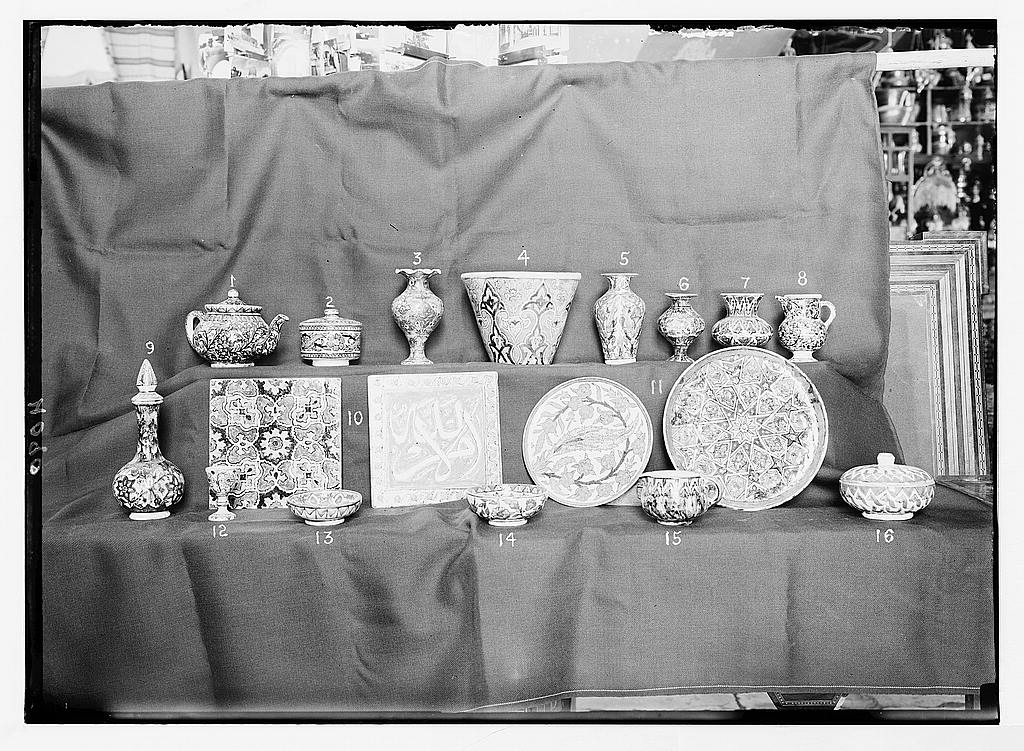
Birds, flowers, trees, grapevines and geometric patterns appeared on tiles and pottery. These images brought together Kütahya's Armenian heritage, Ottoman and Persian artistic traditions, and imagery from Jerusalem itself.
Ohannessian also made street signs. Everyday markers became small works of art seen by the city's residents and visitors.
The Balians and the Karakashians
In 1922, Neshan Balian and Megerditch Karakashian opened their own workshop, Palestine Pottery, on Nablus Road. Each brought a different skill: Balian was responsible for pottery production, while Karakashian created designs and painted the ceramics.
Their children continued the business. In the mid-1960s, the family enterprise split, and the two families went their separate ways.
The artist Marie Balian, wife of Setrak Balian, holds a special place in the history of this school. Working with traditional motifs, she developed a distinctive style of her own: the birds, trees and flowers in her work seem to be in constant motion. In 1992, an exhibition of her work was held at the Smithsonian Institution.
The Karakashians' story is also connected with the Old City's street signs. A commission for a new series was approved in 1965, and production began in 1966. At first, the inscriptions were in Arabic and English; Hebrew was added later. Today, these signs help people find their way around the city while also recalling its complex history.
An Art That Lives On
Armenian ceramics in Jerusalem have not become merely a museum legacy. The Balian and Karakashian workshops continue to operate, and new artists have emerged. In 1983, Garo Sandrouni opened his own workshop. Together with Sonia Sandrouni, he developed original compositions drawing on floral ornament, birds and Armenian manuscript illumination.
Over the course of a century, generations, materials and methods of production have changed. Yet the connection itself has endured: a master taught an apprentice, a family passed its knowledge to its children, and artists found new ideas in old motifs.
David Ohannessian and his colleagues arrived in Jerusalem intending to restore the tiles of a single monument. That project was never completed in its original form. Yet their work gave the city something greater: a living artistic tradition that can still be seen in its streets, courtyards and workshops.
And so the art of people forced to leave their home found a new home in Jerusalem.