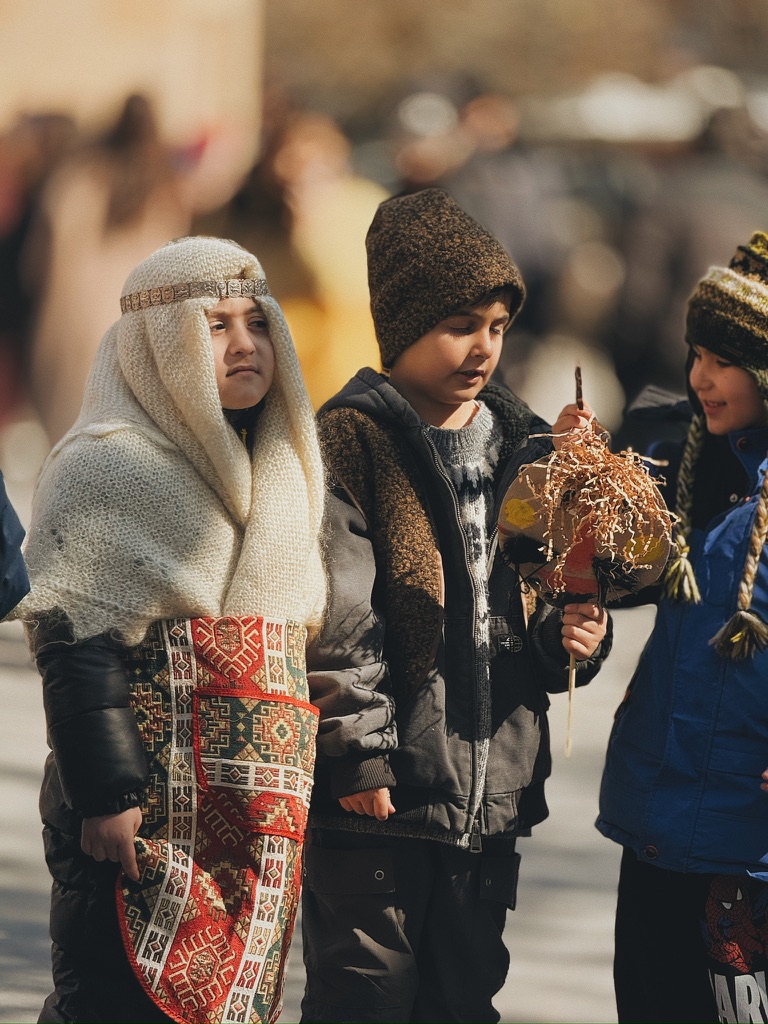
“Armenian Halloween” might be one way to introduce Barekendan to someone seeing its masks and costumes for the first time. The comparison is catchy: familiar surroundings suddenly fill with unusual characters, and grown-ups are given permission to be children for a while. But this is a visual analogy, not a historical explanation.
Barekendan is neither an Armenian version of Halloween nor evidence that the two share a common origin. To understand its place in the calendar, the more useful comparison is a pre-Lenten carnival: festive abundance gives way to abstinence, and noise to reflection. It is precisely as the eve of Great Lent that the Armenian Apostolic Church’s official calendar explains Boun Barekendan. [1]
What the Name Means—and When the Holiday Comes
The Armenian word “Բարեկենդան” conveys a sense of a good, prosperous life and the joy of living. The name does not refer exclusively to a single day of the year: in the church calendar, the Sundays preceding the major fasts are called barekendans. Boun Barekendan—the Sunday before Great Lent—holds a special place. Its date therefore shifts with the Easter calendar. [1]
It is important, however, to distinguish the church’s designated day from the period of popular festivities. Armenia’s Intangible Cultural Heritage portal describes two weeks of celebrations in late winter and early spring. Seen this way, Barekendan is not just one Sunday but a whole stretch of gatherings, games, dancing, and feasts. The seasonal anticipation of spring sits alongside preparation for Lent. [2]
This distinction explains the apparent contradiction between accounts of “Barekendan day” and “the weeks of Barekendan.” They describe the same holiday on different scales: the liturgical calendar sets its high point, while popular life unfolds its own celebrations around it.
Why Celebrate Before a Fast?
If we see Barekendan only as a final chance to eat heartily, much of it remains unexplained. In the church’s understanding, it recalls humanity’s life in paradise. The website of the Mother See of Holy Etchmiadzin explicitly connects the holiday with humanity’s time in paradise and the beginning of the journey toward Easter. [3]
This is an important shift in perspective: joy is not necessarily the opposite of spiritual life. It can be a reminder of its fullness. What follows is a time in which people are invited to examine themselves more closely—not simply to change what they eat, but to reconsider their habits, their words, and their relationships with others.
An explanation from the Araratian Patriarchal Diocese, reported by Armenpress, speaks of moderation in entertainment and of fasting as abstaining not only from certain foods but also from lies, slander, and other harmful habits. The formula “first everything is allowed, then nothing is” therefore distorts the meaning of the holiday. [4]
Popular carnival and the church’s observance before Lent should not be forced into a single explanation. They have different means of expression. One speaks through costumes and laughter; the other through worship and moral preparation. What makes the holiday’s history interesting is precisely their coexistence.
A Mask Does Not Have to Be Frightening
In the contemporary imagination, a mask can easily suggest a monster. But the world of Barekendan was broader than that. The heritage register’s description emphasizes its theatrical character: participants performed sketches, imitated real people, and drew on everyday life, love stories, and other familiar subjects. For a while, the usual rules of behavior were turned upside down. [2]
The important question, then, is not only “Who does this costume represent?” but also “What does dressing up allow someone to do?” On an ordinary day, people are constrained by their age, social position, and the expectations of those around them. In play, they can try out a different role. From this perspective, a mask is more than something worn over the face: it is a theatrical device that creates distance between performer and character.
Regional examples reveal the variety of this expressive language. An article on masquerading from the Araratian Patriarchal Diocese mentions a character called “meymun,” meaning “monkey,” and a similar figure in Javakhk known as “gadi.” In New Nakhichevan, groups of costumed performers called “jamals” portrayed, among other things, a wedding procession, clergy, and soldiers. They visited homes, sang, and danced. [5]
This is not a single list of required costumes shared by every Armenian community. Quite the opposite: local names and casts of characters remind us that the tradition was rooted in particular places. We cannot take one striking mask, declare it a national symbol, and consider the picture complete.
Marash: A “Bride” Made from Household Objects
A particularly vivid example survives in Houshamadyan’s account of Armenian Marash. Here, women dressed a shovel or broom as a “bride,” adding clothes, a veil, and their own jewelry. They carried the figure through the neighborhood from house to house, singing humorous songs, then placed it in a courtyard, where they danced around it and continued the festivities. The source attributes its description of these mid-nineteenth-century celebrations to the account of Krikor Kalustian. [6]
For a reader today, the inventiveness itself is remarkable: a tool of everyday work becomes a character, and a courtyard becomes a stage. No elaborate set is needed to put on a performance. What matters is having participants, a familiar figure, and a willingness to join in the game.
But this scene does not automatically justify identifying the doll with a particular goddess or reconstructing an entire lost cult around it. There is a gap between a documented custom and a hypothesis about its distant origins. Preserving that distinction does not diminish the tradition; it means taking it seriously.
What People Ate—and Why There Is No Single Menu for All of Armenia
In Marash, the principal festive dish was harisa; the Houshamadyan author tentatively connects the local name for the holiday, “Herius,” with that dish. After church, the family gathered around the table. The account also mentions hadig, a grain dish, and a local soup. This abundance of food had a clear boundary in the calendar: the fast began next. [6]
None of this means there was one mandatory Barekendan menu for every region. It is more accurate to speak of local festive tables and a shared principle of abundance before abstinence. Replacing that diversity with a universal list of the “right dishes” makes the story easier to tell, but less rich.
For a family exploring the holiday, a more useful question is: what did your own family cook? What did older relatives call the dish? Do they remember a local pronunciation of the holiday’s name? Such conversations are no substitute for research, but they help distinguish family memory from a general overview someone has only recently read.
The Twentieth Century: More Than a Simple Story of Disappearance
The Intangible Cultural Heritage portal notes Barekendan’s popularity until the early twentieth century and the subsequent interruption of traditional celebrations. Yet this brief account should not be read as meaning that the holiday disappeared everywhere in the same way and at the same time. [2]
For Marash, Houshamadyan describes a decline in public festivities already following the anti-Armenian massacres of 1895: insecurity and political pressure restricted public celebrations, leaving a greater role for church services and family gatherings. [6]
The story unfolded differently in different communities: family memory, church life, and public festivities did not always endure in the same ways. It would therefore be wrong to suggest that the holiday disappeared completely everywhere after a single date.
Barekendan Today: Tradition Meets a Changing City
One concrete example is the celebration in Kapan, which coincided with the opening of the new TUMO building on March 2, 2025. According to the published report, wolf and goat figures led a procession of masks, a tightrope walker performed, the Vorotna ensemble drew participants into traditional dances, and the folk band Katil provided the musical program. An audiovisual work responding to the building’s architecture brought the event to a close. [7], [8]
This was not a literal re-creation of a nineteenth-century village celebration. It was a contemporary cultural program in which older forms—masks, processions, communal dancing—met new technologies and a new public space. That is how it should be described: not as proof that every custom has remained unchanged, but as an example of thoughtful engagement with heritage.
For a living tradition, the question is not only how faithfully a costume has been reproduced. Who takes part matters just as much: do people remain spectators, or do they join the dance, make masks, learn songs, and talk about family memories? Heritage becomes part of life not when people can recite the right paragraph about it, but when it gains participants.
A Holiday That Needs No Borrowed Name
The Halloween analogy can open a conversation—but it should not replace one. If we stop there, we lose the holiday’s pre-Lenten meaning, its regional diversity, its homegrown theater, and the very idea of a good life contained in its name.
Barekendan is compelling without anyone having to prove that it is “older,” “scarier,” or “more authentic” than another holiday. It makes room for religious experience, playful dressing-up, the family table, and community gatherings. It also has a complicated history of change, one that need not be hidden behind a beautiful legend.
Perhaps the best way to get to know it is not to search for an Armenian equivalent of a familiar holiday, but to call it by its own name: Barekendan. And to ask what kind of good life we want to share with one another.