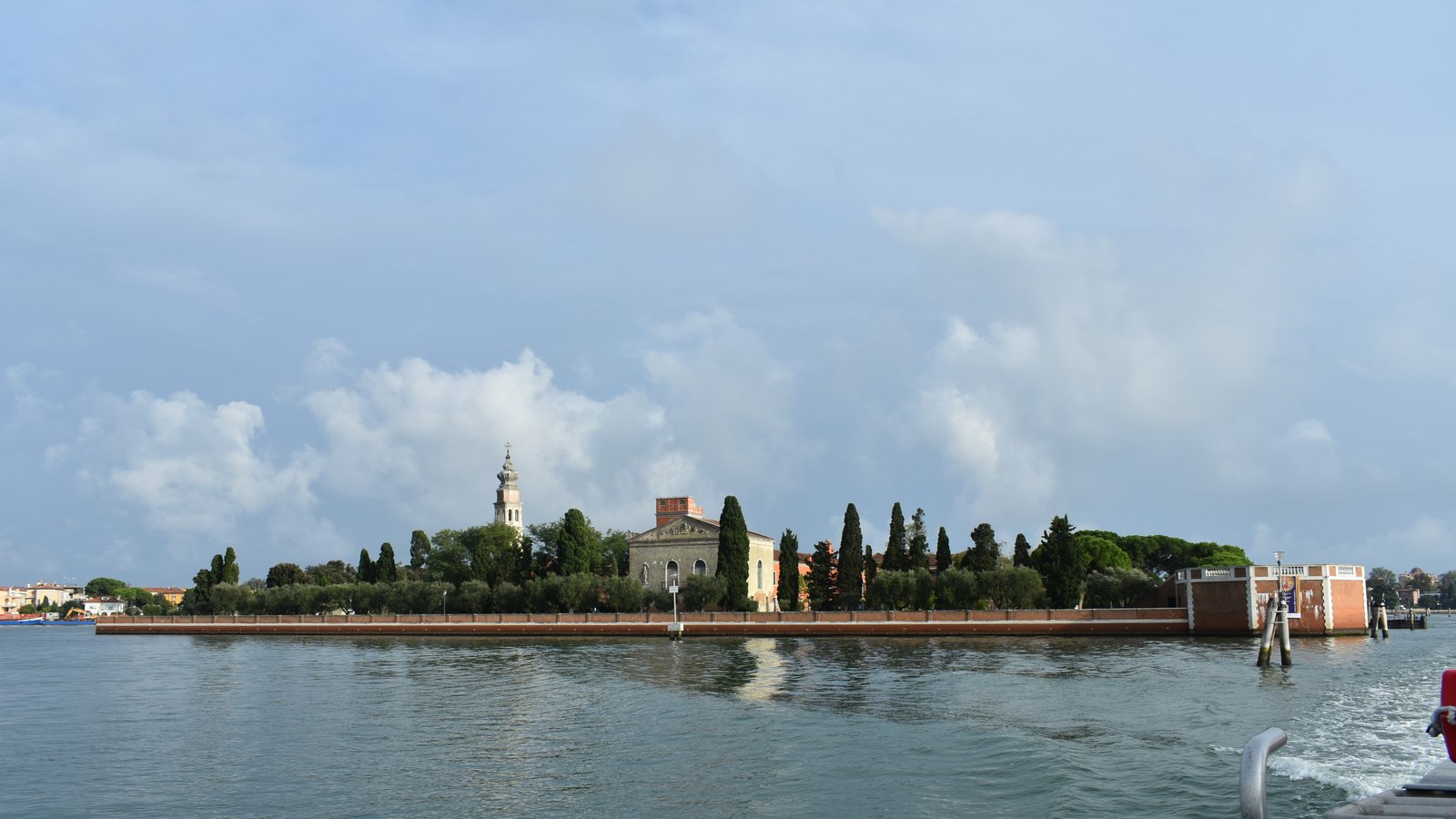
San Lazzaro is not far from St Mark’s Square. Venice recedes behind the boat as it crosses the lagoon, and a low island comes into view, its monastery buildings gathered around a bell tower. From the water, it is hard to guess why this place occupies such a large chapter in Armenian history. There is no capital city here, no fortress or immense cathedral. For centuries, people came here to work with books.
On this island, they collected manuscripts, compiled dictionaries, translated, taught, debated the meaning of old words and prepared texts for printing. Byron came here to study Armenian. Armenian works found new readers, while European writings began to speak in Armenian. Books left the island for destinations far beyond Italy.
The story of the Mekhitarists is particularly revealing because it shows how cultural continuity works in practice. We often say, “We must preserve our language” or “We must know our history.” On San Lazzaro, those words became daily tasks. Someone had to find the right manuscript. Someone had to read it, compare it with another copy, investigate an obscure passage, pay for paper, correct the typesetting and send out the finished book. Thousands of such actions stood behind achievements in which an entire people could take pride.
The idea came first; the island came later
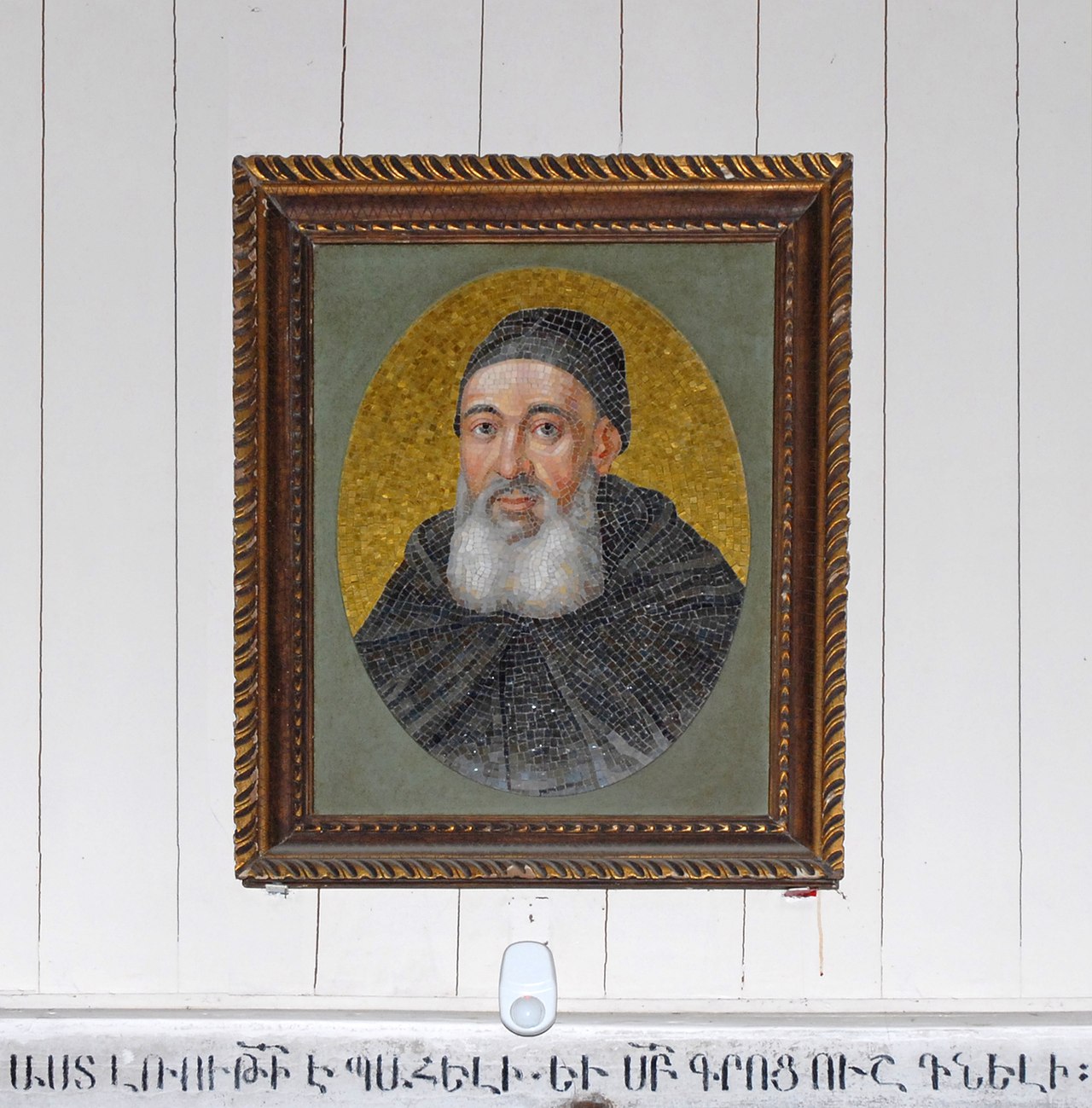
Mkhitar of Sebaste was born in 1676 in Sebaste, now Sivas. His name is associated with the monastic congregation founded in Constantinople on 8 September 1701. It is important, from the outset, not to confuse the beginning of this story with its most famous address: the community existed before it acquired an island in the Venetian lagoon.
Mkhitar was an Armenian Catholic cleric. For him, education and work with books were bound up with his religious vocation. The brotherhood he founded retained the Armenian language and liturgical tradition while adopting a monastic organization based on the Benedictine rule. It would therefore be misleading to imagine San Lazzaro solely as a secular academy. Prayer, communal life and scholarship belonged together here.
Finding a lasting home was difficult. After Constantinople, the community settled in Modon, in the Peloponnese, then under Venetian rule. War forced the monks to seek refuge once again. Eventually they reached Venice itself, and in 1717 received permission to settle on San Lazzaro.
The island already had a history of its own. In the Middle Ages, it had housed a refuge for people with leprosy; later, it stood abandoned. The newcomers did not inherit a ready-made cultural centre. Buildings needed restoration, while the future library, school and the practical organization of the monastery still had to be created. The island we recognize today emerged through the sustained efforts of several generations.
There is something important in this beginning. Mkhitar was not given a finished institution, nor did he simply dream of one. He brought people together, established a framework for communal life and searched for a place where their work could continue without yet another move. His cultural undertaking needed an address, but it needed stability even more.
Why Venice?
Venice was no accidental point on the map of the Armenian world. Armenian connections with the city long predated the Mekhitarists. Trade routes, languages, workshops and book markets met here. In 1512, Hakob Meghapart printed the first Armenian books in Venice. By the time Mkhitar reached the lagoon, that history was already two centuries old.
The Mekhitarists were therefore not starting Armenian printing from scratch. They entered an existing tradition and gave it a particularly systematic form. Their monastery gradually combined the functions of a library, a place of learning, an editorial workshop and a publishing centre. Collected books supplied the foundations for new books, while teaching prepared those who would carry the work forward.
The proximity of a major trading city helped the island remain connected to the wider world. Book production requires paper, skilled workers, money, transport and readers. The monks might work in quiet surroundings, but the outcome depended on people far beyond the monastery walls: benefactors, scholars, merchants, manuscript owners and students.
On a map, San Lazzaro looks isolated. In Armenian cultural history, it became a meeting point. Information, texts and objects flowed towards the island; editions, translations and trained scholars travelled outwards. This movement explains its influence better than the size of its grounds or the number of its beautiful rooms.
What does it mean to “preserve a manuscript”?
The most obvious thing to do with an ancient book is protect it from damp, fire and decay. Without that, everything else becomes meaningless. For a researcher, however, intact bindings and pages are only the beginning. What is the text? When was it copied, by whom and where? How does it relate to other copies of the same work?
A manuscript book is not like one of the identical copies in a modern print run. Scribes might omit lines, alter spellings, add explanations or bring different works together within a single binding. Margins preserve traces of reading, while commemorative notes can record names, places and the circumstances in which a book was produced. Sometimes such a note tells us as much about its time as the main text.
This is why libraries that allow materials to be compared are so important. Another copy may help explain a difficult phrase. A former owner’s inscription may clarify a book’s history. A question about a word can lead into grammar, theology, geography or the history of everyday life. The better a collection is described, the more avenues of research it opens.
To a reader, the result often looks straightforward: an accessible edition with a title, a date and explanatory notes. That clarity conceals work that is easy to underestimate. Someone has already deciphered the handwriting, established the contents, noticed variant readings and explained why a particular reading was chosen. Good scholarship makes difficult material accessible without passing off a conjecture as an established fact.
The Mekhitarist collections matter in precisely this sense. They preserved objects while also creating the conditions for studying them. A book had the chance to take part in the life of the language once again: as a source for a dictionary, the basis of an edition, a subject of research or material for teaching.
A dictionary that takes generations
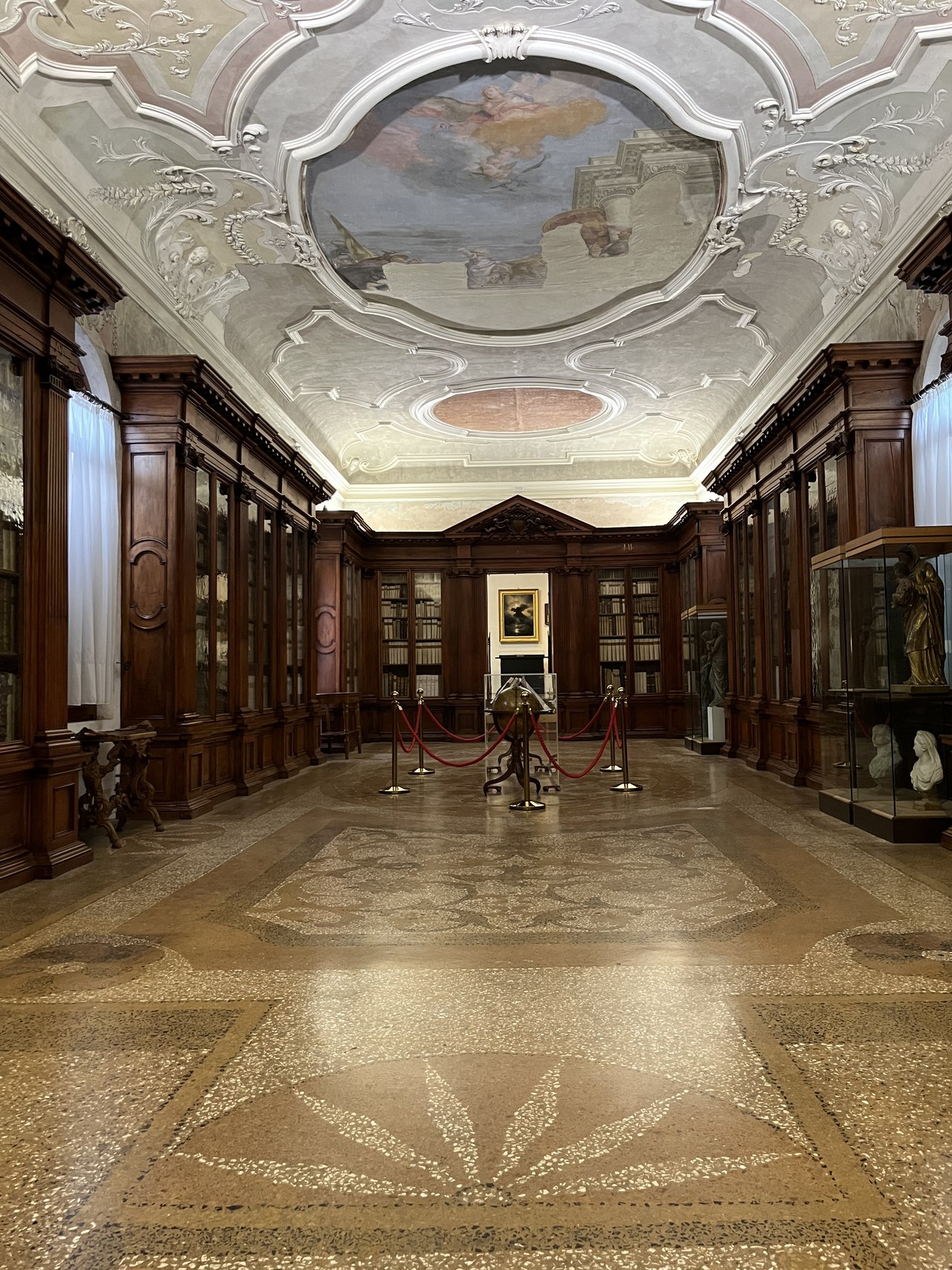
The first volume of Mkhitar of Sebaste’s dictionary of the Armenian language appeared in Venice in 1749. His pupils completed the second volume, published in 1769. The first volume was printed by Antonio Bortoli, the Venetian publisher also associated with Mkhitar’s 1733 Bible. This detail is useful: in its early years, the community relied on printers in the city. Its own printing press arrived on the island much later, in 1789.
Consider the task of compiling a historical dictionary. Listing a word with a short translation beside it is not enough. The compiler must understand its meanings in different works, distinguish its uses, locate examples, check its form and show its relationships with other words. For a language with centuries of written history, a dictionary also becomes a guide to that history.
Such work takes more than memory and linguistic knowledge. It requires access to books, a habit of checking one’s conclusions and a way of passing accumulated findings to the next researcher. An error in a dictionary can be repeated by hundreds of readers; a well-explained passage can help hundreds avoid a mistake. The responsibility is greater than the stillness of the printed pages might suggest.
Decades later, the Mekhitarists published the “New Dictionary of the Armenian Language,” known as the “Nor Bargirk Haykazean Lezui.” Its two volumes appeared in Venice in 1836–1837. Gabriel Avetikian, Khachatur Surmelian and Mkrtich Avgerian worked on it. This was a separate publication, not simply a new title for the dictionary of 1749.
Drawing on written monuments of Classical Armenian, the dictionary supplied examples of usage and comparisons with Greek and Latin. Its value did not disappear with the era of paper slips and hand typesetting. Modern research on digital language resources continues to consult it. A work created almost two centuries ago remains useful in the technologies of our own time.
Here we can see the effect of sustained effort. Today’s researcher need not begin with a blank page, because earlier generations left a tool whose evidence can be checked. A dictionary passes on more than words. It passes on work that has already been done.
How books travelled beyond the island
A printing press does not produce good books by itself. It can multiply accurate knowledge just as readily as a poorly checked text. For the Mekhitarists, the entire sequence mattered: preparing manuscript material, editing, translating, setting type, correcting errors, publishing and distributing.
Owning a press expanded the community’s possibilities, but its publishing project had begun much earlier. A Bible edition, dictionaries, grammars and other works required decisions that could not be made at the touch of a button. What language should the explanations use? Who was the intended reader? Did the text need commentary? How could a concept be expressed when no familiar equivalent yet existed?
These questions are especially apparent in translation. The Mekhitarists introduced Armenian readers to works by ancient and European authors. With the texts came ways of reasoning, literary forms and new terminology. Translators had to make another writer’s thought understandable without damaging its meaning or turning Armenian into an awkward imitation of another language.
The work also moved in the opposite direction. Armenian texts, and translations preserved in Armenian, became accessible to European scholars. A telling example is the “Chronicle” of Eusebius of Caesarea: its Armenian version preserved material that had not survived in the Greek original. An Armenian–Latin edition prepared by Father Aucher and published in 1818 helped bring this inheritance back into scholarly circulation.
In this way, the Armenian book tradition mattered to questions reaching far beyond Armenian history itself. A European researcher studying the ancient world might need a text preserved by Armenian translators and scribes. San Lazzaro helped make that connection possible.
Byron came here to learn
Towards the end of 1816, George Gordon Byron arrived on the island. In a popular account, a famous visitor can easily overshadow the hosts: an image, a name plaque, a short story for a guided tour. At San Lazzaro, it is more revealing to reverse the usual perspective. Byron entered an already established community of learning. There was something to study here, and there were people able to teach him.
The poet studied Classical Armenian with Father Avgerian, known in European publications as Aucher. He took part in translation exercises and work associated with grammar and dictionary publications. This does not justify declaring that he spoke Armenian fluently or crediting him alone with works on which the monks laboured. The actual fact is sufficient: a European writer deliberately came to Armenian scholars as a student.
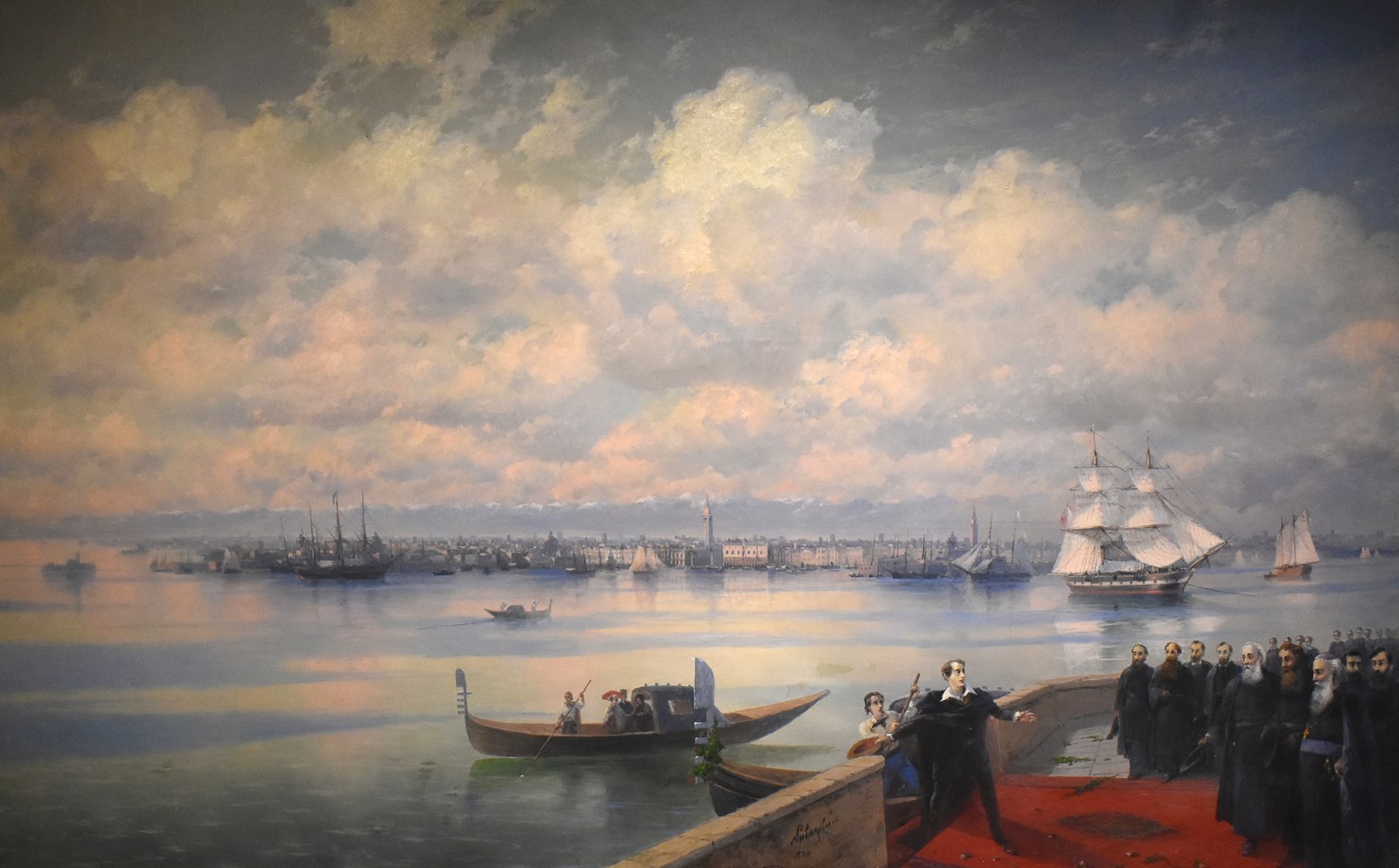
Over time, that encounter entered artistic memory. In 1899, Ivan Aivazovsky painted Byron’s visit to the Mekhitarists. Many decades separated the poet’s visits from the creation of the canvas. It is a later artistic interpretation, not an eyewitness image made on the spot. It is all the more interesting that the artist chose this particular scene to speak about Armenian culture.
Byron lends the story a recognizable name, but the island’s significance does not depend on his fame. Remove the celebrated guest, and the library, dictionaries, translations and schools remain. Keep only the guest, and almost the whole story disappears. San Lazzaro deserves attention above all because of the people who worked here before him and continued after him.
Venice was not the only centre
Mekhitarist history eventually extended beyond a single island. Following the division of the community in 1773, another branch established itself in Trieste and later in Vienna. Two closely spaced dates should be distinguished here: imperial authorization came in 1810, while the monks settled in Vienna in 1811.
The Viennese community developed its own publishing and scholarly activities. Armenian culture gained another enduring centre connected to European intellectual life. The history of the Mekhitarists therefore cannot be reduced to one building or one library, however famous. It is a network of people and institutions with a shared tradition and different local histories.
In 2000, the Venetian and Viennese branches reunited as a single congregation. They had operated separately for a long time before that. Their history reminds us that cultural institutions are not immune to human disagreements. They encounter disputes, changes in organization and the need to renegotiate how they will work together.
Periodicals also helped circulate knowledge. “Bazmavep” began publication in Venice in 1843. Initially associated with broad public education, the journal became an important forum for Armenian studies. A journal follows a different rhythm from a large book: it allows scholars to revisit questions, publish new material and sustain a continuing conversation.
Continuity is especially valuable here. No single author can read every manuscript or resolve every historical question. But a researcher can accurately describe a discovery, identify its source and make verification possible. The next scholar receives work that can be accepted, challenged or developed further, rather than an attractive legend.
From microfilm to the search box
A library continues to live as the ways of accessing it change. In the twentieth century, microfilming played an important part. For example, cooperation between the Viennese Mekhitarist collection and the Hill Museum & Manuscript Library began in 1967. A photographic copy allowed a text to be studied at a distance and reduced the need for repeated handling of a fragile original.
Today, the San Lazzaro collection has an online catalogue that draws on printed catalogue volumes and digital recognition tools. Researchers can search for information about manuscripts without first travelling to Venice. A catalogue, however, is not the same as a complete digital copy of every book. A description helps locate the right item; it does not mean that all its pages are already available online.
This distinction matters to ordinary readers too. Digitization rarely happens in a single sweeping act of “uploading everything.” Photographs, descriptions, indexes, search systems and links between records are created separately. Old errors do not automatically vanish when transferred to a screen. Modern technology is especially useful when careful library work stands behind it.
Unexpected discoveries can emerge among museum objects as well. Research on an old sword in the San Lazzaro collection, involving specialists from Ca’ Foscari, connected it with a very ancient Anatolian tradition of the late fourth millennium BCE. Archival evidence helped trace the object’s journey to the monastery in the nineteenth century. Metallurgical study, comparison with other finds and documentary research came together here.
Studies like this remind us that a collection is not exhausted by what was known about it yesterday. An object may remain in the same place for decades, yet a new question can change our understanding of its age, origin and significance. Libraries and museums therefore need people able to ask questions, as well as visitors passing their display cases.
There is another change too: electronic searches reveal connections that can be difficult to notice when reading a catalogue from beginning to end. The same scribe may have worked on several books. A town may appear in different records. An owner’s name can connect objects now held in separate collections. A search box helps frame such a question, but answering it still requires examination of the material itself. Easier access does not remove the need for care.
For someone just beginning to take an interest in Armenian history, this offers a useful way to change a reading habit. Behind a claim, one can look for a particular book; behind the book, its description; behind the description, the original or a scholarly edition. Not every reader will become a manuscript specialist. Yet understanding where knowledge comes from benefits a much wider audience. It helps distinguish a convincing account from one that is simply repeated often.
The island’s present-day value therefore reaches beyond the past it has preserved. It also lies in the possibility of continuing to learn: to read difficult texts, ask precise questions, recognize the limits of what is known and share discoveries so that someone else can use them. For a culture whose monuments and communities are dispersed across countries, that accessibility is especially important.
What Mkhitar really left behind
It is easy to tell the story of the Mekhitarists through remarkable things: ancient manuscripts, celebrated editions, Byron and a beautiful island. All deserve attention. Yet the most powerful part of this story is less spectacular. Mkhitar and his successors created conditions in which one generation’s work could become the next generation’s starting point.
Many monasteries, schools, families, printers, benefactors and scholars helped preserve Armenian culture. San Lazzaro’s importance does not require diminishing their contribution. What distinguishes the Mekhitarists is the consistency with which they brought several activities together: preservation, research, translation, teaching and dissemination. Each sustained the others. A collection nourished a dictionary; the dictionary helped people read; reading produced new research; and printing found readers for that research.
We often want a quick and visible result: to erect a monument, open a building or hold a great celebration. A dictionary takes longer. A catalogue looks more modest. A corrected error in an old text may go entirely unnoticed beyond a small circle of specialists. Yet achievements like these allow a culture to avoid starting over each time.
San Lazzaro is still reached by water. Visitors can see the monastery rooms, books and objects and hear the community’s story. Or, without travelling to Venice at all, they can open the catalogue and benefit from some of the work accumulated on the island. Between these two ways of encountering it lies a crucial change: inherited knowledge becomes available for new work.
Mkhitar of Sebaste left far more than a famous monastery. He helped build an environment in which love of one’s language was expressed through knowledge of that language, and respect for the past demanded its careful study. His example remains useful beyond monastery walls. To preserve an inheritance is to ensure that those who come after us can use it.